موقع تاريخي · Vlorë
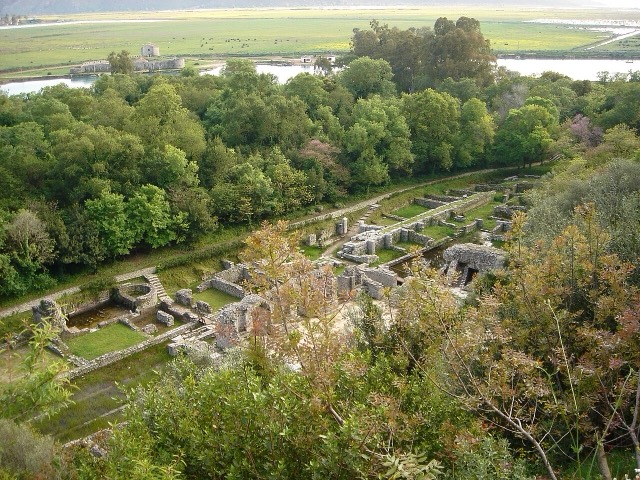
Butrint
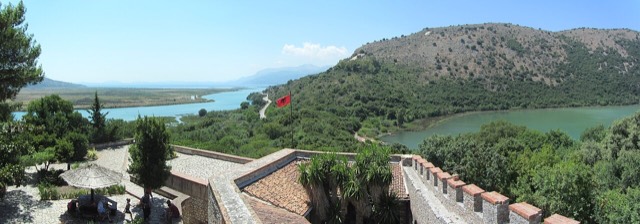
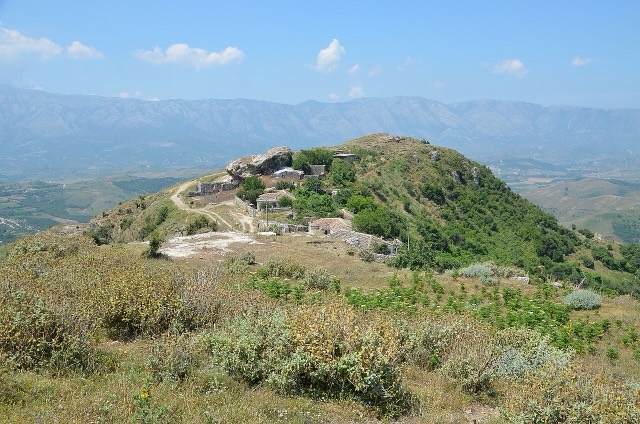
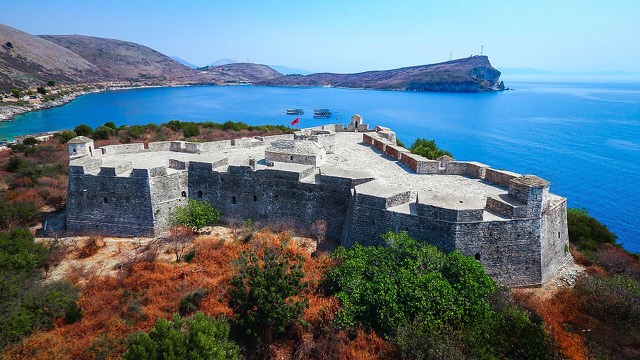
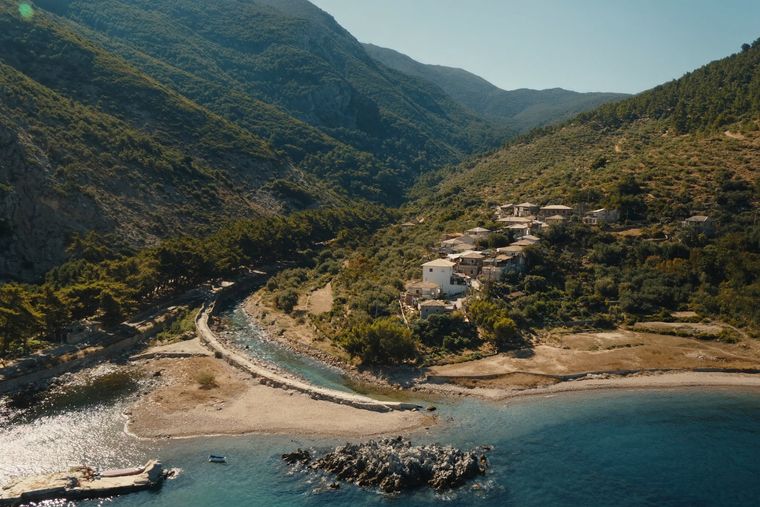
A Greek, Roman, Byzantine, Venetian and Ottoman city layered on one wooded peninsula — Albania's first UNESCO site.
كل مقاطعة، كل ساحل، كل قرن
عرض إرشادي
هل أنت جديد على ألبانيا؟ تفتتح كل صفحة بشرح مبسّط يمكن قراءته لطفل في العاشرة من عمره، قبل أن تبدأ التفاصيل.
عرض للمتخصصين
أنت تعرف الأساسيات بالفعل. مباشرةً إلى الجوهر، مع إخفاء الشروح المبسّطة. هذا هو الوضع الافتراضي.
المحافظة
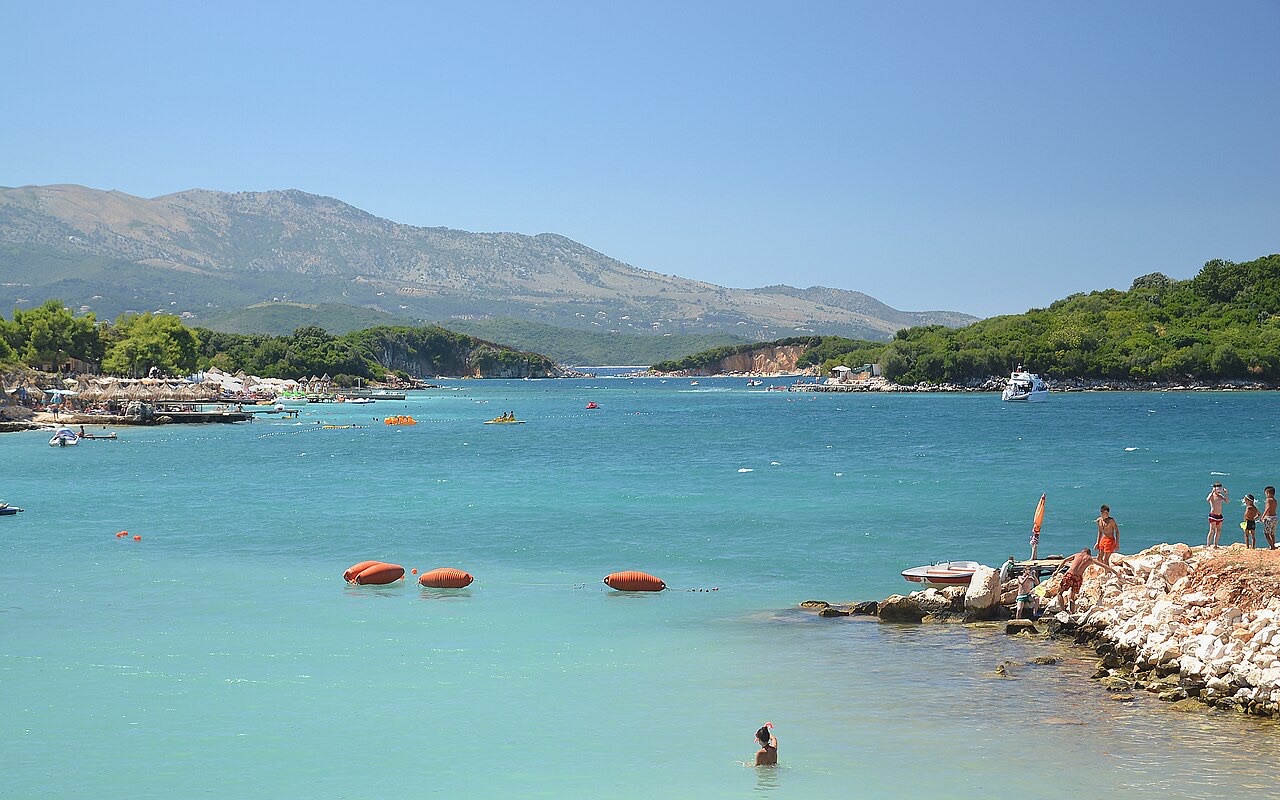
The long southern coast: the Albanian Riviera, the Karaburun peninsula and the Corfu channel.
حفظ
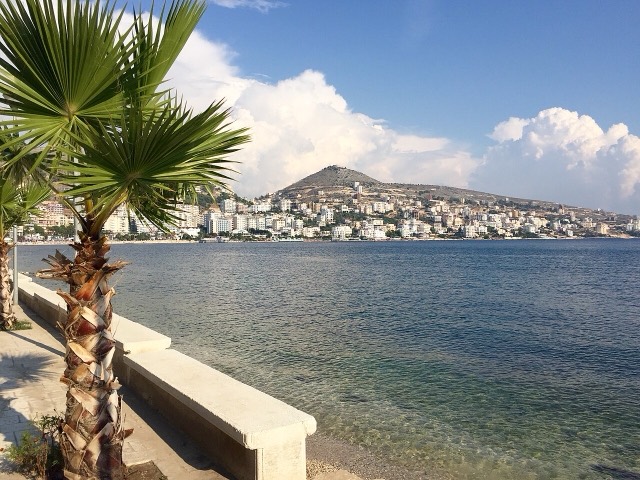
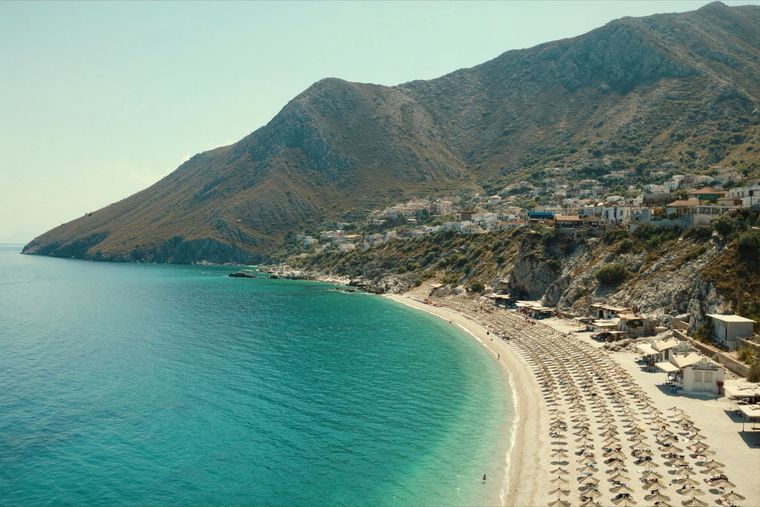
Vlorë County has most of Albania's famous coast. This is where the Adriatic Sea meets the Ionian Sea. The Albanian Riviera, with its clear water and pebble beaches, runs along it, and the town of Sarandë faces the Greek island of Corfu.
Vlorë County has most of Albania's famous coast. This is where the Adriatic Sea meets the Ionian Sea. The Albanian Riviera, with its clear water and pebble beaches, runs along it, and the town of Sarandë faces the Greek island of Corfu.
Vlorë County lies in southwestern Albania, centred on the city of Vlorë, which sits on the Bay of Vlorë along the Albanian Adriatic and Ionian Sea coasts. The bay is widely regarded as the boundary between the Adriatic Sea and the Ionian Sea. The Ceraunian Mountains form the inland backdrop, their foothills surrounding the city and influencing both climate and access routes. The county falls within Albania's Southern Region.
Vlorë Municipality, which is encompassed within the county, covers an area of 647.94 square kilometres (250.17 sq mi). Its administrative units include Novoselë, Orikum, Qendër Vlorë, Shushicë and Vlorë. The municipality stretches from the mouth of the Vjosë river in the north, along the Narta Lagoon, to the Llogara Pass in the south. To the west it encloses the Karaburun Peninsula and Sazan Island, while the Shushica-Vlorë River marks its eastern boundary.
Protected areas within the county include the Karaburun-Sazan Marine Park, Llogara National Park and the Vjosa Wild River National Park. The county is also the source of the commercial term 'valonia oak', which refers to acorn cups harvested from oak forests in the area and used by tanners; the term derives from Valona, the historic name for Vlorë.
The city's name derives from the Ancient Greek Αὐλών (Aulṓn), meaning 'channel' or 'glen', a word that evokes the shape of an aulos instrument and represents a common toponym type in the Greek world. The name first appears in written records in the 2nd century AD, cited by two Ancient Greek authors: Lucian and Ptolemy. Ptolemy described it as a 'town and sea-port', implying the settlement existed well before that century. Earlier Greek and Roman writers recorded instead the nearby port of Oricum; Aulon appears more frequently only in later sources, as references to Oricum decline.
The modern Albanian form developed from ancient Aulon-a through phonological changes internal to Albanian. In Tosk Albanian, intervocalic /n/ regularly shifted to /r/, producing the rhotacism Vlonë > Vlorë. The initial /v/ evolved from an unstressed /u/ after the disappearance of the initial unstressed /a/. In Geg Albanian, spoken in the north, the toponym remains Vlonë, indicating the name was in use among northern Albanians before rhotacism affected the Tosk variety. The name of the city's inhabitants — singular vlonjat, plural vlonjatë — did not itself undergo rhotacism.
Other languages record distinct forms. The medieval and modern Greek name is Avlónas (Αυλώνας), from which Latin derived Aulona, Italian Valona, and the now-obsolete English Avlona. During Ottoman rule the city was known in Turkish as Avlonya. Medieval Latin sources use forms including Avalona, Avelona, Lavalona and Lavellona; Old Serbian sources record Avlona or Vavlona, the latter incorporating the Slavic preposition v meaning 'in'. In Aromanian the city is called Avlona.
The coastal area of Vlorë was among the Illyrian sites experiencing pre-urban activity from the 11th to 10th centuries BC. During the early 8th century BC, Euboean colonisation of the bay was associated with several heroic traditions and the foundation of settlements. Ancient Greek colonists are traditionally credited with founding Orikos, Thronion and Aulon on these shores during the Archaic period.
A large fortified port-town occupied from the 6th century BC to the 2nd century AD has been identified at Triport, northwest of present-day Vlorë, now partially submerged. The site was delimited by three walls, the earliest dating to the late 6th century BC. Port activity at Triport continued from at least the Archaic period through the medieval period. The archaeological site has been identified by different scholars with either ancient Thronion or ancient Aulon; Carl Patsch proposed that Aulon began at Triport and was later transferred to the location of modern Vlorë, while Pierre Cabanes proposed the identification of Triport with Thronion — positions that are not mutually exclusive.
Thronion is attested by Pausanias in the 2nd century AD as a Locrian-Euboean colony, and also by a dedication on a monument at Olympia; both sources report that Apollonia conquered the city around 450 BC. Aulon was first mentioned by Ptolemy in the 2nd century AD among the towns of the Illyrian Taulantii. The site also appears in the Tabula Peutingeriana and Hierocles' Synecdemus. The centre of modern Vlorë contains walls dated from the 4th to the 10th centuries AD, as well as a quadrangular tower and ruins of a structure with ceramics attributable to the 3rd–4th and 6th–7th centuries.
During the Roman period Vlorë served as an important imperial port and was administered as part of Epirus Nova. Aulon became an episcopal see in the 5th century; among the recorded bishops are Nazarius in 458 and Soter in 553. The diocese at that time belonged to the papal Pentarchy. In 733 it was annexed, along with eastern Illyricum, to the Patriarchate of Constantinople, though it does not appear in any Notitiae Episcopatuum of that church. The bishopric was probably suppressed during the period of Bulgarian control, since Avlona is not mentioned in the Notitiae Episcopatuum of the Bulgarian Archbishopric of Ohrid.
A Latin see was also established during the Roman period, and several of its bishops are recorded by Eubel in Hierarchia catholica medii aevi. Aulon is no longer a residential bishopric; the Catholic Church today lists it as a titular see, a suffragan of Durrës. To distinguish it from a Greek titular see also called Aulon, the Latin adjective Aulonitanus is used for the Albanian see, while Aulonensis refers to the Euboean Aulon. The diocese was nominally restored as a Latin titular bishopric; from 1925 it was also named Aulona in Latin and Italian, and since 1933 it is designated Aulon in Latin and Aulona in Italian.
In the 11th and 12th centuries Vlorë was a significant point of contest between the Byzantine Empire and the Norman Kingdom of Sicily. Following Norman occupation the Normans ruled for only four years and established a Latin church episcopal see in the city. In 1321, while under Byzantine control, Vlorë was attacked by a Venetian fleet commanded by Giovanni Michiel, an assault that caused the deaths of many of its Greek inhabitants.
Vlorë subsequently served as the capital of the Principality of Valona, which was initially a vassal state of the Serbian empire and later an independent Christian state from 1346 to 1417. The Ottoman Empire captured the city in 1417. In 1432 Albanian rebels freed Vlorë and expelled the Ottomans, though Ottoman rule was re-established and the city became a sanjak centre in Rumelia Eyalet under the name Avlonya. In 1690 it briefly became a Venetian possession, but was returned to Ottoman control in 1691 after the siege of Vlorë, thereafter functioning as a kaza of the Sanjak of Avlona in the vilayet of Janina. At that time the city had approximately 10,000 inhabitants and maintained a Catholic parish belonging to the Archdiocese of Durrës.
In 1426, the Ottomans supported the settlement of a Jewish community engaged in mercantile activities in Vlorë. The community grew in subsequent decades through immigration from Corfu, Venetian territories, Naples, France and the Iberian Peninsula. Around seventy Jewish families from Valencia, including former conversos, settled in Vlorë between 1391 and 1492. Following the expulsion of Jews from Spain in 1492, the Ottoman state resettled additional Jewish exiles in Vlorë toward the end of the 15th century.
Ottoman censuses of 1506 and 1520 recorded the Jewish population of Vlorë as consisting of 528 families and approximately 2,600 people. The community was involved in trade; the city imported European goods and exported spices, leather, cotton fabrics, velvets, brocades and mohair sourced from Istanbul and Bursa. In 1596 the Vlorë Jewish community intervened to secure the release of war-related captives held in Durrës. After the Battle of Lepanto in 1571 and the subsequent deterioration of security along the Ottoman-controlled Adriatic and Ionian coasts, the Jewish population of Vlorë declined. The Jewish community of Yanina renewed the Vlorë community in the 19th century. A museum dedicated to the historical Jewish population is planned to open in the historical centre of Vlorë.
Between the 18th and 19th centuries, cultural and intellectual developments coalesced into the Albanian Renaissance, with Vlorë emerging as a central location for the movement by 1912. In 1833, Albanian rebels captured Vlorë, compelling the Ottoman government to abolish certain taxes and comply with rebel demands. The city suffered severely from an earthquake in 1851.
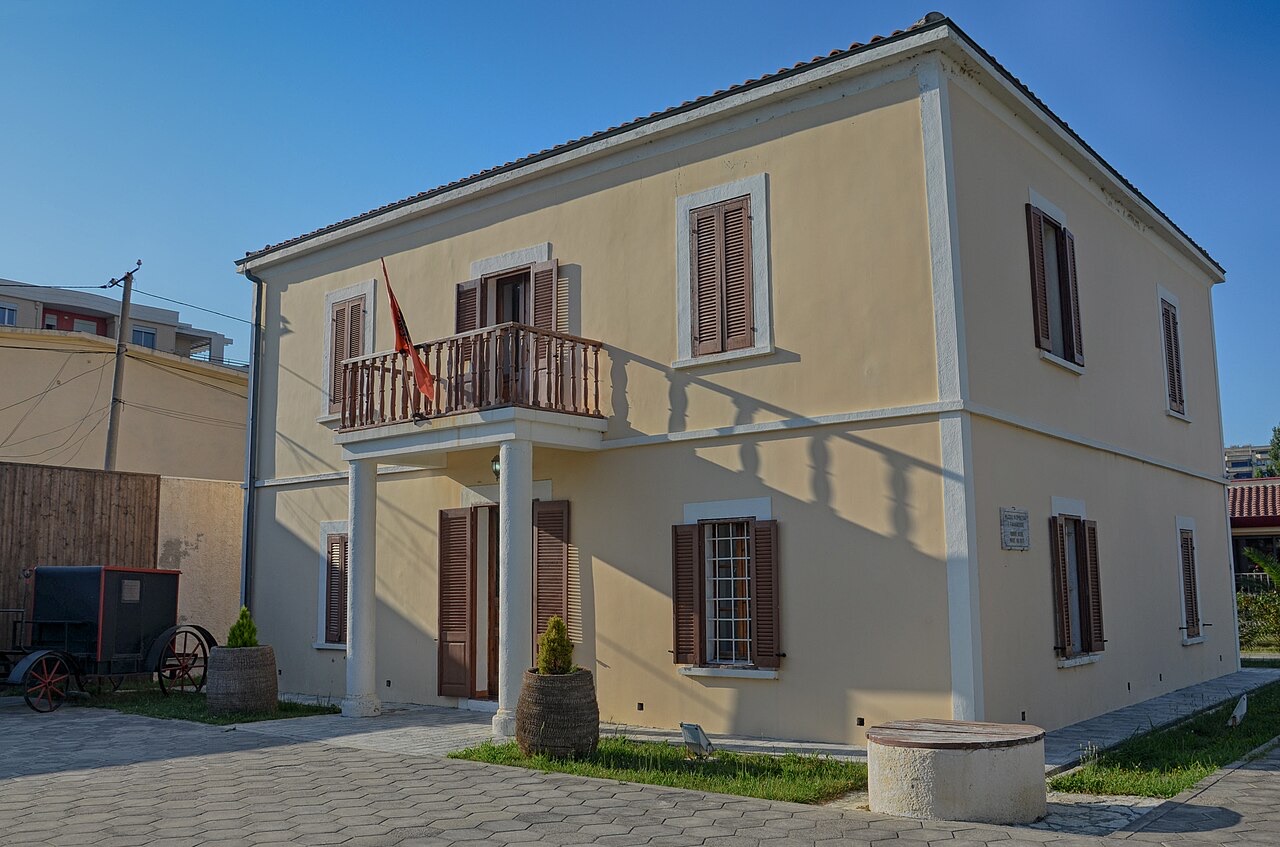
On 28 November 1912, during the First Balkan War, Ismail Qemali led the declaration of Albanian independence in Vlorë, making the city Albania's first capital. The Museum of Independence is housed in the 19th-century building where the founding fathers signed the declaration; its balcony is considered a national symbol. In January 1914, the short-lived Vlorë Raid attempted to return Albania to Ottoman control. Italy invaded Vlorë in 1914 during the First World War, and Italian forces remained until an Albanian rebellion expelled them in 1920. Italy again invaded in 1939 and occupied the city until Italy's surrender to the Allies in 1943. Nazi Germany then occupied Vlorë until 1944, when communist forces under Enver Hoxha liberated the city.
During the Second World War, Sazan Island became the site of a German and Italian submarine base and naval installations, which were heavily bombed by the Allies. After the war, with Albania under Communist Party rule, the port was leased to the Soviet Union for use as a submarine base. During 1960 and 1961 the facility became a focal point of tension following Enver Hoxha's decision to denounce Nikita Khrushchev's reforms.
In April 1961 the Soviet Union, resenting its displacement from the naval facilities at nearby Pasha Liman Base after considerable investment, threatened to occupy Vlorë with Soviet troops and severed all Soviet economic, military and technical aid to Albania. The threat was not carried out, partly because of concurrent international events including the Cuban Missile Crisis. After the 1968 Warsaw Pact invasion of Czechoslovakia, Hoxha ordered the construction of hundreds of thousands of concrete bunkers across Albania. Vlorë also served as an important recruiting centre for the Sigurimi, the Albanian state security and secret police.
In 1997, Vlorë was the centre of the Albanian civil unrest that followed the collapse of several investment pyramid schemes and contributed to the fall of the Sali Berisha administration.
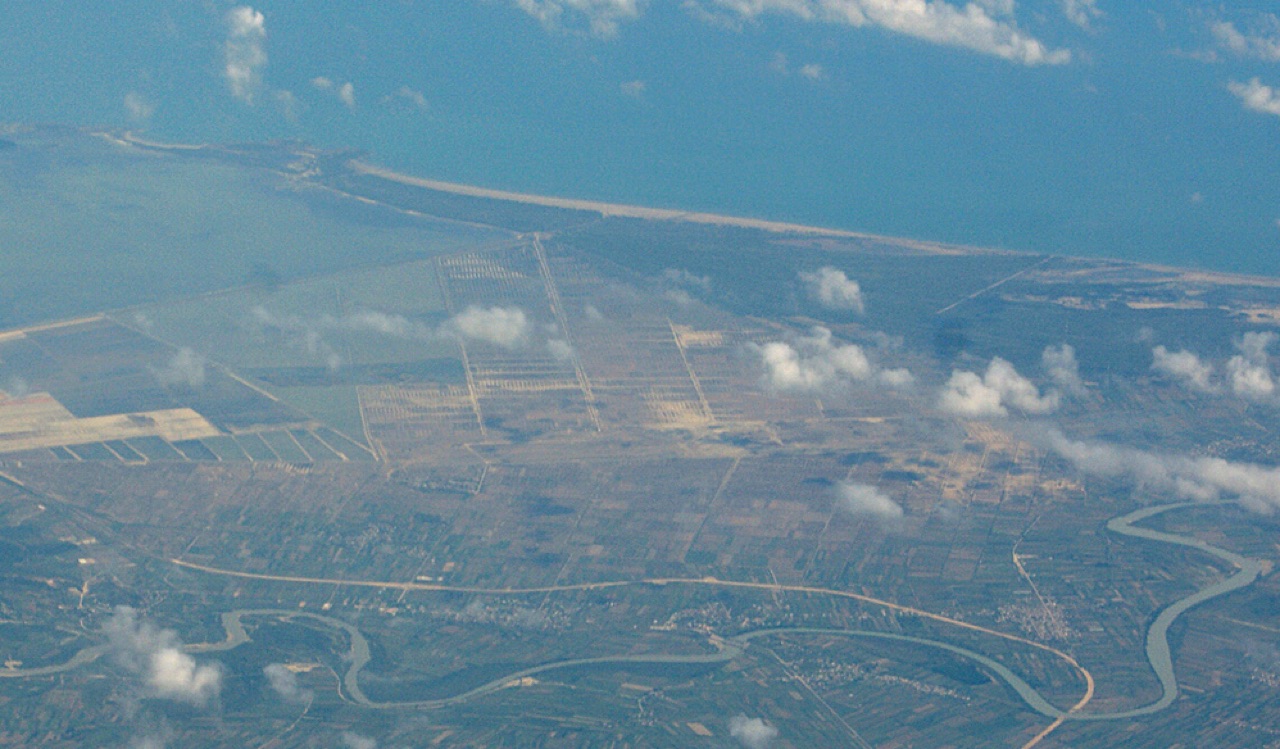
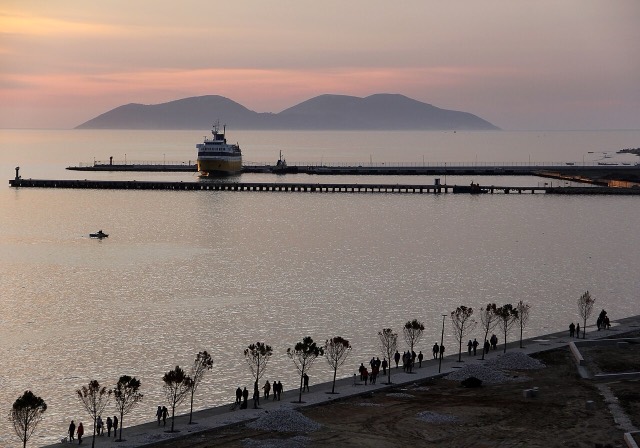
Vlorë functions as a major seaport and commercial centre. The surrounding region produces petroleum, natural gas, bitumen and salt. Agricultural output includes olive oil, oats, maize, cotton, cattle, sheep and related products. The city also contains significant Albanian Navy installations. The Port of Vlorë is the second busiest port in Albania, located on the northern section of the city's coastline. The A2 motorway runs from Fier to Vlorë, paralleling the SH8 highway, which connects the city to the Albanian Riviera and continues to Sarandë. The Vlorë railway station is the southern terminus of the Durrës-Vlorë line, which opened in 1985 when the line was extended from Fier. Regular passenger services south of Fier ended by 2015, though the private operator Albrail began freight services from Fier to Vlorë in 2018.
The Technical and Economic Development Area (TEDA) in Vlorë is located approximately 151 kilometres from Tirana and is designated for industrial, processing, commercial, storage, light industry, electronics, auto-parts manufacturing and port-related activities. Official data from 2014 recorded the employable labour force in Vlorë at 125,954, of which 84,836 were employed; 35 percent held a high school degree and 17 percent a university degree. According to World Bank rankings conducted in 2016, Vlorë placed 7th among 22 cities in southeastern Europe, ahead of Tirana, Belgrade and Sarajevo.
The University of Vlora, the second-largest university in Albania, was founded in 1994 as a technological institution and has since expanded into economics and finance, education, medicine and law. Two private universities also operate in the city: Universiteti Pavarësia Vlorë and Akademia e Studimeve të Aplikuara 'Reald', the latter having operated as a university since 2011. As of the 2011 census, the city of Vlorë had 79,513 residents and the municipality 104,827, making Vlorë the third most populous city and fifth most populous municipality in Albania. The estimated population density of the municipality was 169.9 inhabitants per square kilometre.
موقع تاريخي · Vlorë
A Greek, Roman, Byzantine, Venetian and Ottoman city layered on one wooded peninsula — Albania's first UNESCO site.
مدينة · Vlorë
The Ionian resort town facing Corfu, and the arrival point for most visitors to southern Albania.
بلدة · Vlorë
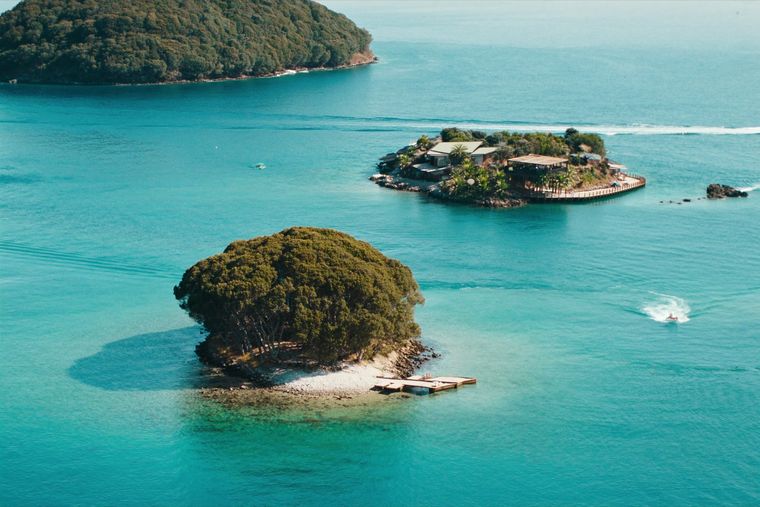
Four small islands and very clear shallow water; the most photographed and most crowded stretch of the Albanian coast.
منطقة محمية · Vlorë
A wetland and forest park wrapped around the archaeological city, on the Vivari channel.
مدينة · Vlorë
Where the Adriatic meets the Ionian, and where Albanian independence was declared in 1912.
سلسلة جبلية · Vlorë
The coastal ridge that makes the Riviera: 2,000 m peaks rising directly out of the Ionian.
بلدة · Vlorë
The centre of the Riviera coast: a Greek-speaking historical community, an old hill village and a string of coves.
بحيرة · Vlorë
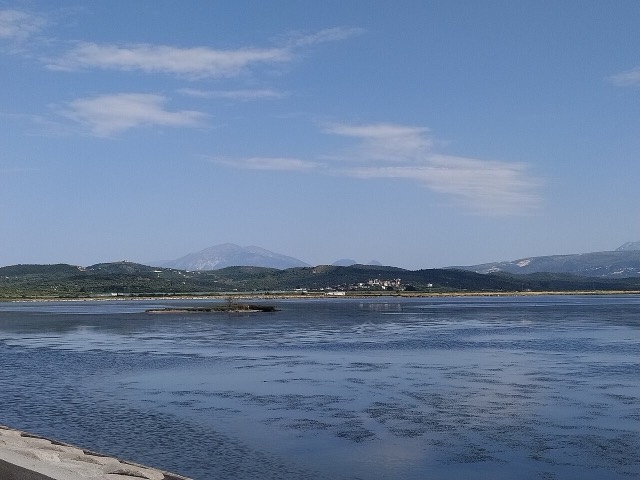
Albania's second-largest lagoon, with working saltpans and the island monastery of Zvërnec.
موقع تاريخي · Vlorë
An Illyrian hill city whose stadium — cut into the slope — is among the best preserved in the region.
منطقة محمية · Vlorë
Albania's only marine national park: sea caves, wrecks and the country's clearest water.
منطقة محمية · Vlorë
A pine-forested pass at 1,027 m where the road drops from mountain forest to the Ionian in a few kilometres.
Albania's largest island: a former Italian and then Soviet-era military base at the mouth of the Bay of Vlorë.
A long white pebble shore under the Ceraunian ridge, and the Riviera's main nightlife strip.
A triangular fortress on a causeway peninsula, built for Ali Pasha of Tepelena.
A hill town above the Sarandë plain with a mixed Albanian and Greek population.
A karst spring of extraordinary clarity whose bottom has never been definitively reached.
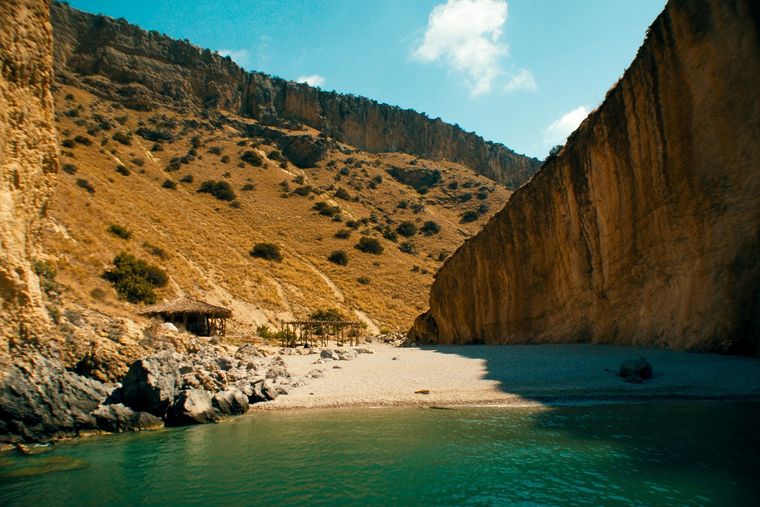
A pebble beach at the mouth of a limestone canyon, reachable only on foot or by boat.
A remote bay on the Karaburun peninsula whose cliffs carry Greek and Latin inscriptions cut by ancient sailors.
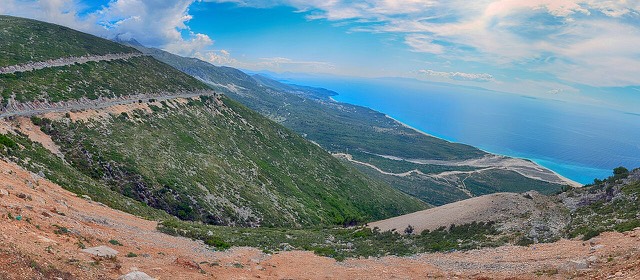
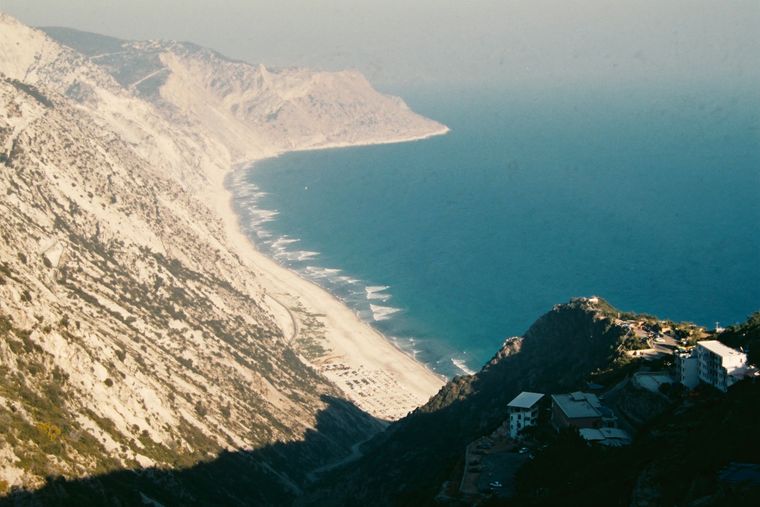
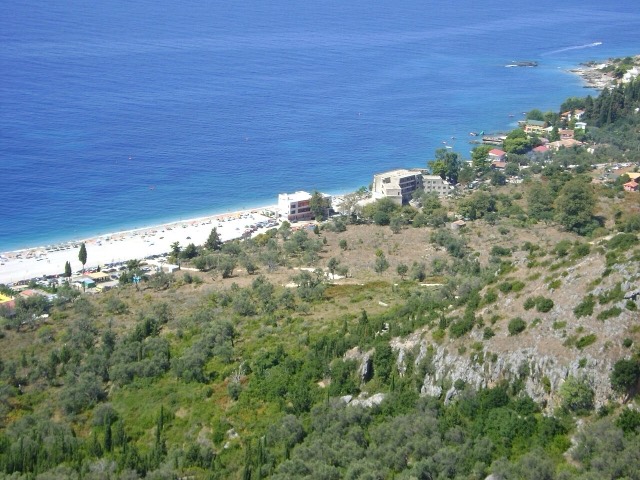
The 120 km of Ionian coast between the Llogara pass and Sarandë, where the Ceraunian mountains fall straight into the sea.
A cypress-covered island in the Narta lagoon holding a 13th–14th-century Orthodox monastery.
The first Riviera beach south of the Llogara pass, below the road's most dramatic descent.
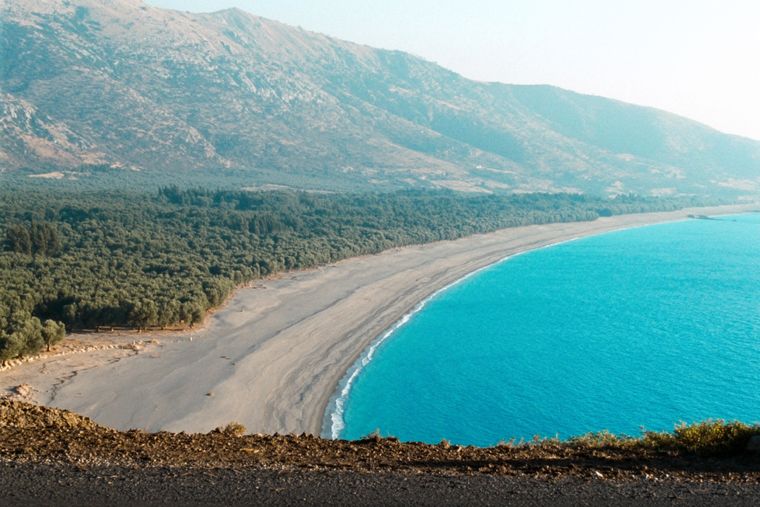
At roughly 7 km, the longest single beach on the Riviera, backed by one of Albania's largest olive groves.
The pine-backed northern half of the Dhërmi bay, slightly quieter than the main strip.
Albania's southernmost town, on the Greek border near the Butrint wetlands.
A run of small coves — Bunec, Krorëz and Shpella — below the village of Lukovë.
A marina town at the foot of Llogara, beside the ancient harbour of Oricum.
The sheltered eastern shore of the Bay of Vlorë, facing the Karaburun peninsula.
A municipality of villages near Sarandë, containing the Blue Eye and the ancient site of Phoenice.
An old white village on the slope above one of the Riviera's longest pebble beaches.
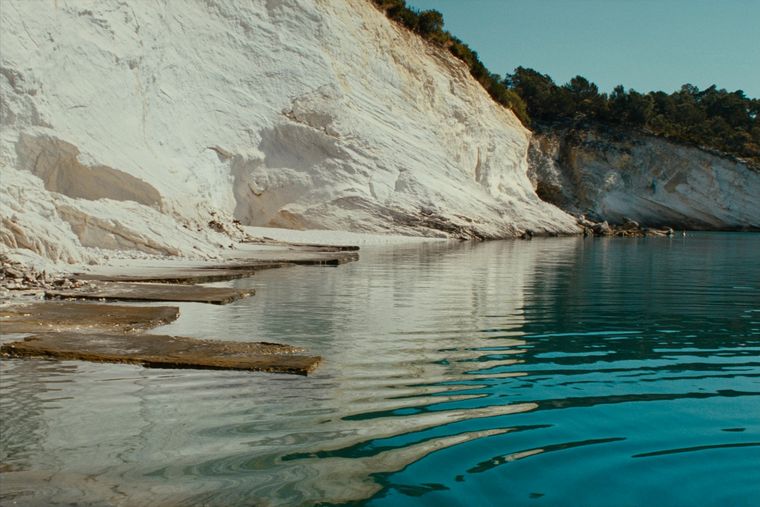
Rock shelves and a small pebble strip where the water is unusually still.
A steep stone village between Dhërmi and Himarë, above Jal and Gjipe.
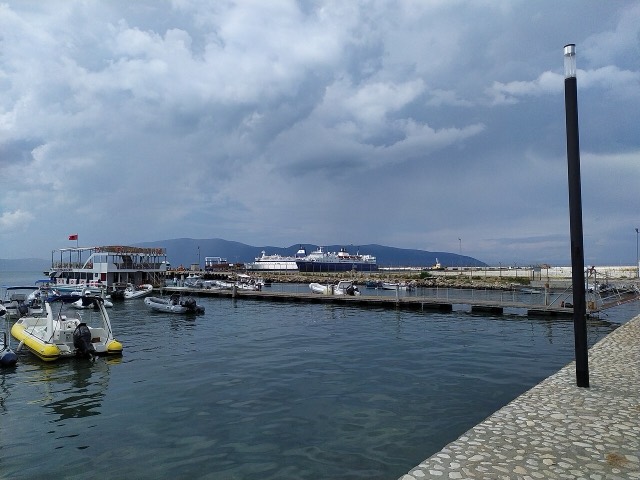
Albania's second passenger port, with a seasonal fast link to Brindisi.
A near-enclosed bay wrapped around Ali Pasha's triangular fortress on its own peninsula.
A small cove between Sarandë and Ksamil, reached by a rough track.
A narrow limestone slot that meets the sea at Gjipe beach — the Riviera's one true canyon.
ثمة خطأ في هذه الصفحة؟ نرحب بالتصويبات وتُراجَع في مواجهة سجل المصدر. أخبرنا بما هو خاطئ، وإن أمكن، بالمكان الذي يأتي منه الرقم الصحيح.