Città di medie dimensioni · Vlorë
Himarë
The centre of the Riviera coast: a Greek-speaking historical community, an old hill village and a string of coves.
Ogni contea, ogni costa, ogni secolo
Vista guidata
Non conosci l'Albania? Ogni pagina si apre con una spiegazione in linguaggio semplice, comprensibile anche a un bambino di dieci anni, prima di entrare nei dettagli.
Vista per esperti
Conosci già le basi. Direttamente alla sostanza, con le spiegazioni elementari nascoste. Questa è l'impostazione predefinita.
Sito storico · Vlorë County
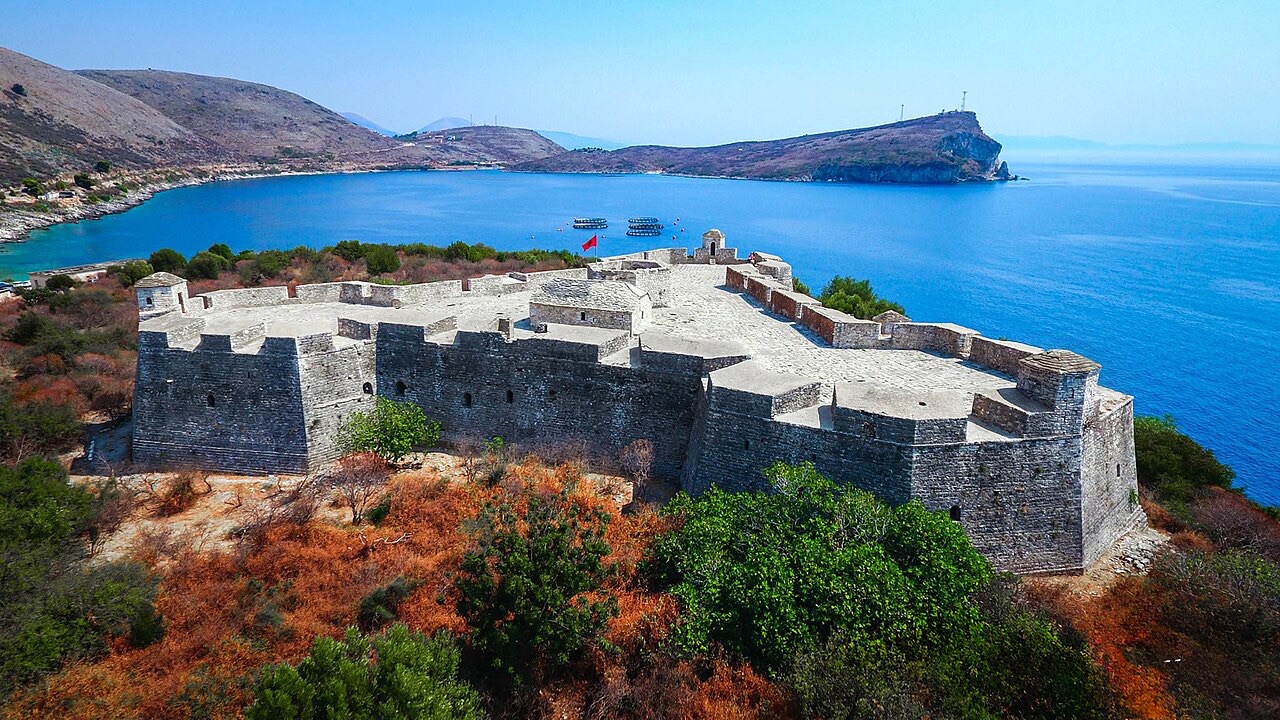
A triangular fortress on a causeway peninsula, built for Ali Pasha of Tepelena.
Salva
Porto Palermo Castle is a small stone fort shaped like a triangle, standing on a piece of land that reaches into a very sheltered bay. Ali Pasha built it about 200 years ago.
Porto Palermo Castle is a small stone fort shaped like a triangle, standing on a piece of land that reaches into a very sheltered bay. Ali Pasha built it about 200 years ago.
Porto Palermo Castle (Albanian: Kalaja e Porto Palermos) stands in the bay of Porto Palermo, in southern Albania, a few kilometers south of Himarë along the Albanian Riviera. It lies west of the road connecting Vlorë and Saranda, placing it on one of the principal coastal routes of the region.
The site was originally a small island. Landfill work subsequently connected it to the mainland, and today a low, narrow isthmus links the castle to the shore. The French traveler François Pouqueville, writing in 1806, described this feature explicitly, noting that 'the tower or fort stands on the southern point of the entrance, connected with the continent by a low narrow isthmus.'
The castle was built in the early 19th century by Ali Pasha of Tepelena, the powerful Ottoman ruler who controlled much of what is now southern Albania and northwestern Greece. An inscription above the entrance records that it was constructed in 1804 and that French engineers carried out the work.
Scholars have assessed whether an earlier Venetian or Ottoman fortification occupied the site beforehand, and the conclusion is that this is unlikely. The 1804 structure appears to be an original commission rather than a reconstruction or adaptation of an older fortified position.
Ali Pasha's motivation was strategic. He was concerned about the exposed coastal flank of his pashalik and Porto Palermo Castle was one of several sea fortresses he ordered built to address that vulnerability.
The castle takes the form of a three-sided fortress with three large gun bastions positioned at its corners. The southern side is left open as a terrace rather than enclosed by a wall, giving the structure its distinctive triangular plan.
At the center of the castle is a hexagonal chamber with a domed ceiling supported by six large pillars. This central space functions as a circulation hub, providing access to all the surrounding rooms and terraces. Soldiers were accommodated in rectangular rooms arranged around this core. The terrace is reached by a staircase.
Defensive and surveillance features include observation posts protected by walls and a number of guard houses with stone roofs. The castle is considered the most well-preserved garrison erected by Ali Pasha in the region.
The shores of Porto Palermo have been used for defensive purposes across a long span of time, from antiquity through to World War II, reflecting the bay's persistent military value as a sheltered anchorage on the southern Albanian coast.
The early 19th-century castle represents the most substantial surviving expression of this tradition, though the site's wartime use continued well beyond Ali Pasha's era, indicating that successive powers recognized the same qualities that originally drew attention to the location.
In 1803, one year before the inscription date of the castle's completion, Ali Pasha offered both the castle and the port of Porto Palermo to the British Royal Navy. The offer provides an indication of the diplomatic and military negotiations Ali Pasha conducted with European powers during the Napoleonic period.
At the time of the offer the fort held only four or five cannon, which suggests that Ali Pasha did not regard it as a particularly significant asset to his own military position. The offer may therefore have been a diplomatic gesture or an attempt to draw British attention and support rather than the cession of a prized installation.
The British military surveyor William Martin Leake visited the fort and recorded that its garrison at the time consisted of ten men armed with two four-pound cannon. This small complement is consistent with the limited armament noted at the time of the 1803 offer to the Royal Navy.
François Pouqueville, writing in 1806, described the structure in detail: 'The tower or fort stands on the southern point of the entrance, connected with the continent by a low narrow isthmus. It consists of a square with bastions, having a few guns, of no service either to command the entrance or to protect the shipping at anchor. Near it are some warehouses, a custom-house, and a Greek church.' Pouqueville's assessment was critical of the fort's practical utility, judging its guns insufficient either to control the bay's entrance or to defend vessels anchored within it.
The construction of the castle by Ali Pasha was celebrated in verse by Ioannis Vilaras, a Greek poet who was a member of Ali Pasha's court. Vilaras praised the erection of the castle, making his writing one of the few contemporary literary references to the structure.
Vilaras's position at Ali Pasha's court illustrates the multilingual and multinational character of the pasha's administration, in which Greek intellectuals and officials played significant roles alongside Albanian and Ottoman figures.
The Albanian Government has designated Porto Palermo Castle and the surrounding area, together with Llamani beach, for proclamation as a protected area with the status of Protected Landscape. As of the information available in the source article, this status is described as forthcoming rather than already in force.
The designation reflects official recognition of the combined natural and cultural significance of the bay, linking the preservation of the castle with the protection of the adjacent coastal landscape.
Porto Palermo Castle is described as well preserved. It is identified as the most well-preserved garrison that Ali Pasha erected in the region, which gives it particular importance as a physical record of early 19th-century Ottoman military architecture in southern Albania.
The castle's survival in relatively intact condition makes it a significant reference point for understanding the building programme Ali Pasha undertook along the coastline of his pashalik, a programme that included several other sea fortresses of which this is the best-remaining example.
Beyond the Ottoman-era castle, the bay of Porto Palermo has served military purposes across an unusually long timeframe. The article records use of the shores for defensive purposes from antiquity through to World War II, though specific details of ancient or 20th-century installations are not elaborated in the source.
This continuity of use underlines that the bay's geographic qualities — its sheltered water, narrow entrance, and position on the southern Albanian coast between Vlorë and Saranda — made it a recurring choice for those seeking to control or defend the coastal corridor, irrespective of the political authority in power.
Il mese più caldo è August (massima giornaliera media 29°C), il più freddo è January (minima giornaliera media 7°C), e il più piovoso è November (306 mm). La precipitazione annua totale è in media 1,707 mm. La temperatura del mare raggiunge il picco in agosto, intorno a 26°C.
| Mese | Massima | Minima | Pioggia | Giorni piovosi | Sole/giorno | Mare |
|---|---|---|---|---|---|---|
| January | 12°C | 7°C | 222 mm | 14 | 7.2 h | 17°C |
| February | 13°C | 8°C | 189 mm | 12 | 8.1 h | 15°C |
| March | 15°C | 9°C | 160 mm | 12 | 9.7 h | 15°C |
| April | 18°C | 12°C | 97 mm | 10 | 11.0 h | 16°C |
| May | 22°C | 16°C | 67 mm | 7 | 12.2 h | 19°C |
| June | 26°C | 20°C | 33 mm | 4 | 13.7 h | 24°C |
| July | 29°C | 23°C | 12 mm | 2 | 13.8 h | 26°C |
| August | 29°C | 23°C | 23 mm | 3 | 12.9 h | 26°C |
| September | 25°C | 20°C | 131 mm | 8 | 10.7 h | 26°C |
| October | 22°C | 16°C | 183 mm | 10 | 9.2 h | 25°C |
| November | 17°C | 13°C | 306 mm | 15 | 7.2 h | 21°C |
| December | 14°C | 9°C | 283 mm | 15 | 6.6 h | 18°C |
Fonte: ERA5 reanalysis via Open-Meteo, 1994–2023 · «Massima» e «Minima» sono la temperatura dell'aria massima e minima giornaliera media. «Giorni piovosi» conta i giorni con almeno 1 mm di precipitazione.
Città di medie dimensioni · Vlorë
The centre of the Riviera coast: a Greek-speaking historical community, an old hill village and a string of coves.
Spiaggia · Vlorë
A near-enclosed bay wrapped around Ali Pasha's triangular fortress on its own peninsula.
Persona
The 'Lion of Ioannina': an Ottoman governor who built his own state, courted Britain and France, and was finally killed for it.
Hai notato un errore in questa pagina? Le correzioni sono benvenute e vengono verificate rispetto al record di fonte. Indica cosa è sbagliato e, se possibile, da dove proviene il dato corretto.