Objet

The Albanian Language
An independent branch of the Indo-European family with no close living relative, written in a 36-letter Latin…
🧭 Vue guidée
Nouveau en Albanie ? Chaque page s'ouvre sur une explication en langage clair, accessible à un enfant de dix ans, avant d'entrer dans le détail.
⚡ Vue expert
Vous connaissez déjà les bases. Directement à l'essentiel, les explications simples étant masquées. Il s'agit du réglage par défaut.
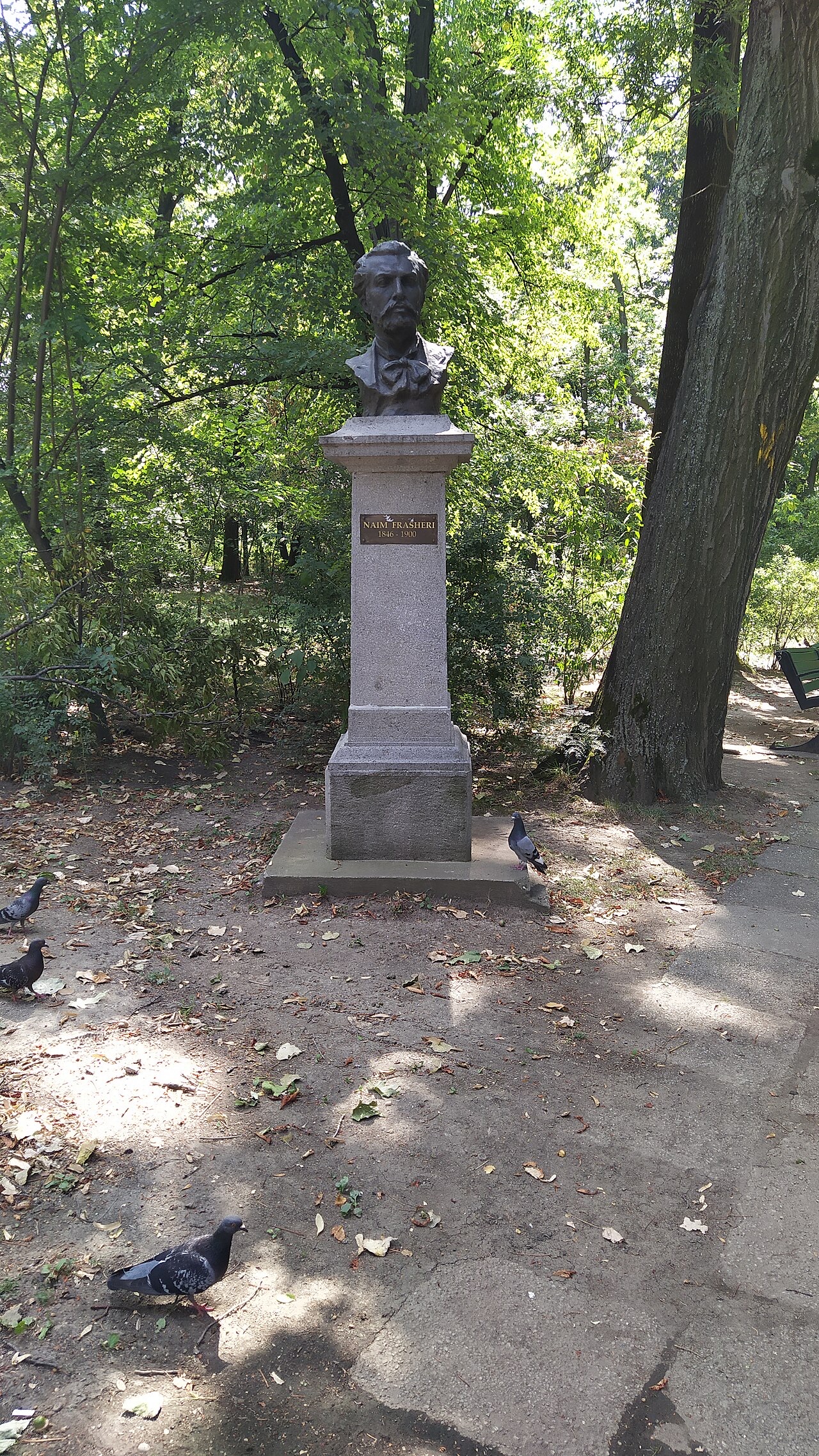
Naim Frashëri is considered Albania's national poet. He wrote in Albanian at a time when the language was barely taught, and his poems became central to the movement for independence. His brothers Abdyl and Sami were also leading figures.
Naim Frashëri is considered Albania's national poet. He wrote in Albanian at a time when the language was barely taught, and his poems became central to the movement for independence. His brothers Abdyl and Sami were also leading figures.
Naim Frashëri was born on 25 May 1846 in the village of Frashër, then part of the Ottoman Empire and now within Albania. He was one of eight children of Halid Frashëri (1797–1859), a landowner and military commander, and Emine (1814–1861), whose family traced its ancestry to Iljaz Bej Mirahori from the region around Korçë and back to the 15th century. His brothers Abdyl and Sami were among the most prominent of the siblings. The family belonged to the Dakollari branch of the Frashëri family, descended from Ajaz Bey of Gramsh, who received the command of Frashër in the period 1650–60.
The family's longer history was marked by reversals and recoveries of fortune. Ajaz Bey's grandfather, Hamza Bey, lost his lands in Tomorrica in 1570 after rebelling and being exiled, but the family's position was restored through the intervention of Köprülü Mehmed Pasha, who secured their pardon. The family's religious affiliation was with the Bektashi tariqa of Islam, a connection that shaped Naim's upbringing, education, and later literary and political outlook in fundamental ways.
Naim, Abdyl, and Sami were raised in Frashër on the southern slopes of the Tomorr Mountains. Through upbringing and later formal study, Naim became conversant in Arabic, Ancient and Modern Greek, French, Italian, Ottoman Turkish, and Persian. He was described as one of the few individuals for whom the literary cultures of both the Occident and Orient were equally familiar.
Frashëri's earliest formal instruction took place in the Tekke of Frashër, where he studied languages including Arabic, Ottoman Turkish, and Persian alongside other subjects of the period. As a member of a family with a strong Bektashi upbringing, he also spent time in a Bektashi tekke. Following the deaths of both parents, the family relocated to Ioannina in 1865. The eldest brother, Abdyl, born in 1839, became the family head at the age of 22 and began work as a merchant.
That same year, 1865, Naim and Sami enrolled in the Zosimaia secondary school in Ioannina. The school provided a classical education along Western lines. Through the Zosimaia, Frashëri gained formal instruction in Ancient and Modern Greek, French, and Italian. He additionally took private lessons in Persian, Turkish, and Arabic from two local Bektashi teachers of note.
After completing his studies in 1870, Frashëri worked briefly at a press office in Istanbul. Tuberculosis forced him to return to Frashër, where the climate temporarily aided his recovery. He subsequently entered the Ottoman bureaucracy as a clerk, serving in Berat and later in Saranda between 1872 and 1877. In 1876 he left that position and travelled to Baden, in what is now Austria, to treat rheumatism at a health resort.
In 1879, Naim Frashëri co-founded the Society for the Publication of Albanian Writings in Istanbul alongside his brother Sami and 25 other Albanians. The society was established to promote publications in the Albanian language. When Ottoman authorities banned writing in Albanian in 1885, publications were moved abroad, and Frashëri used the initials N.H.F. to circumvent the restrictions when issuing his own works.
Albanian schools were established in 1887 in southeastern Albania. An Albanian-language magazine, Drita, had appeared in 1884 under the editorship of Petro Poga and later Pandeli Sotiri. Frashëri acted as a behind-the-scenes editor, since open involvement was prohibited by Ottoman authorities. He and his brother Sami contributed to the magazine under pseudonyms. Due to a shortage of educational material, Naim, Sami, and several other Albanians also wrote textbooks in Albanian during the late 1880s for the Albanian school in Korçë.
In a letter to Faik Konitza in 1887, Frashëri expressed the view that the Ottoman Empire was in a precarious condition and that the best outcome for Albanians would be future annexation of all Albanian-inhabited territory by Austria-Hungary. Frashëri died in Istanbul on 20 October 1900. During the 1950s the Turkish government permitted his remains to be transferred and reburied in Albania.
Frashëri produced twenty-two works in total: fifteen written in Albanian, four in Turkish, two in Greek, and one in Persian. His output spanned poetry, history, translation, educational materials, and theological writing. He is considered the most representative writer of Sufi poetry in Albanian, reflecting in his poetic ideals a mingling of Sufism with Western philosophy, the latter influence traced in part to his uncle Dalip Frashëri.
His contribution to Albanian letters is assessed less in terms of purely creative expression than in the social and political intention embedded in his poetry. His works were shaped by a desire for an independent Albanian unity that could transcend denominational and territorial divisions, and by a belief in the political, economic, and cultural advancement of the Albanian people. He is regarded as the prime representative of Romanticism in Albanian literature and as the most distinguished Albanian poet of the Albanian Renaissance.
The themes running through his work include freedom, humanity, unity, tolerance, and revolution. He had a profound impact on subsequent Albanian literature and society during the 20th century, with the poets Asdreni, Gjergj Fishta, and Lasgush Poradeci among those most notably influenced.
Frashëri's earliest published work was Kavâid-i farisiyye dar tarz-i nevîn (Grammar of the Persian language according to the new method), issued in Istanbul in 1871. His first significant Albanian-language works appeared in Bucharest in 1886 and included Bagëti e Bujqësi (Herds and Crops), the reader E këndimit çunavet, a general history for primary grades, a poetry collection, and a general knowledge text. Also published in Bucharest in 1886 was the Greek-language O alithis pothos ton Skypetaron (The True Desire of Albanians).
Later major works included Luletë e Verësë (Flowers of the Summer, Bucharest, 1890), Parajsa dhe fjala fluturake (Paradise and the Flying Word, Bucharest, 1894), Gjithësia (Omneity, Bucharest, 1895), Fletore e bektashinjët (The Bektashi Notebook, Bucharest, 1895), and a translation of Homer's Iliad into Albanian (Bucharest, 1896). His Histori e Skënderbeut (History of Skanderbeg) was published in Bucharest in 1898, followed by Qerbelaja that same year. The last two works, Istori e Shqipërisë (History of Albania, Sofia, 1899) and Shqipëria (Albania, Sofia, 1902), appeared near and after the end of his life.
Among his Turkish-language works, Ihtiraat ve kessfiyyat (Inventions and Discoveries) was published in Istanbul in 1881, and Fusuli erbea (Four Seasons) and Tahayyülat (Dreams) both appeared in Istanbul in 1884. The two Greek works were O alithis pothos ton Skypetaron (1886) and O eros (Love, Istanbul, 1895).
Bagëti e Bujqësi (Herds and Crops), published in Bucharest in 1886, is among Frashëri's most celebrated Albanian-language poems. In it, he idyllically describes the natural and cultural landscape of Albania and the modest life of its people, presenting an environment in which mystical euphoria is undisturbed and conflicts find reconciliation. The poem celebrated Albania's natural beauty and the simple life of its people while expressing gratitude that Albania had bestowed upon the poet the identity of being Albanian.
The poem was part of a body of work that used pastoral and romantic registers to advance political and national aims. Frashëri saw the natural landscape and communal life of Albania as emblematic of a unity that denominational or territorial divisions threatened but could not destroy. Bagëti e Bujqësi remained one of the works most cited when assessing his legacy, particularly by Albanians of the Bektashi faith, who found in his writing both spiritual and national motivation.
Frashëri's Bektashi faith was not peripheral to his literary and political project but central to it. He understood his liberal religious tradition as a source of tolerance and national awareness capable of bridging Albania's denominational divisions. He composed Fletore e Bektashinjët (The Bektashi Notebook), published in Bucharest in 1895, as a theological text that is now considered a work of national importance. It contains an introductory profession of faith and ten spiritual poems offering a contemporary view of Bektashi belief.
Beyond theology, Frashëri attempted in his lifetime to Albanianise the hierarchical terms of the Bektashi order through this work, effectively calling for an Albanian Bektashism. His poem Feja addressed Albanians directly, urging them not to make religious distinctions among themselves on the grounds that they all shared a common origin and a common language. Albanians of the Bektashi faith were described as being particularly influenced and motivated by his work overall.
The line Ti Shqipëri, më jep nder, më jep emrin Shqipëtar — translating as 'You Albania, you give me honour, you give me the name Albanian' — comes from Frashëri's poem O malet e Shqipërisë and has been designated as the national motto of Albania. The line addresses themes of unity and freedom and conveys a sense of pride in both country and people.
The designation of this line as a national motto reflects the degree to which Frashëri's verse became identified with the Albanian national movement itself. His poem Gjuha Jonë called upon Albanians to honour their nation and to write in Albanian, while Istori e Skënderbeut celebrated medieval resistance to Ottoman expansion, highlighting Skanderbeg's Albanian origins and his campaign for liberation. Both works extended the same themes — language, identity, historical pride — that run through O malet e Shqipërisë.
After his death, Frashëri became a source of inspiration for Albanian writers and intellectuals including Asdreni, Gjergj Fishta, Mitrush Kuteli, and Lasgush Poradeci. He is celebrated as national poet not only in Albania but among Albanian communities in Kosovo, Montenegro, North Macedonia, and other Albanian-inhabited areas of the Balkans. Numerous organisations, monuments, schools, and streets across Albania and Kosovo, and to a lesser extent in North Macedonia and Romania, have been dedicated to his memory.
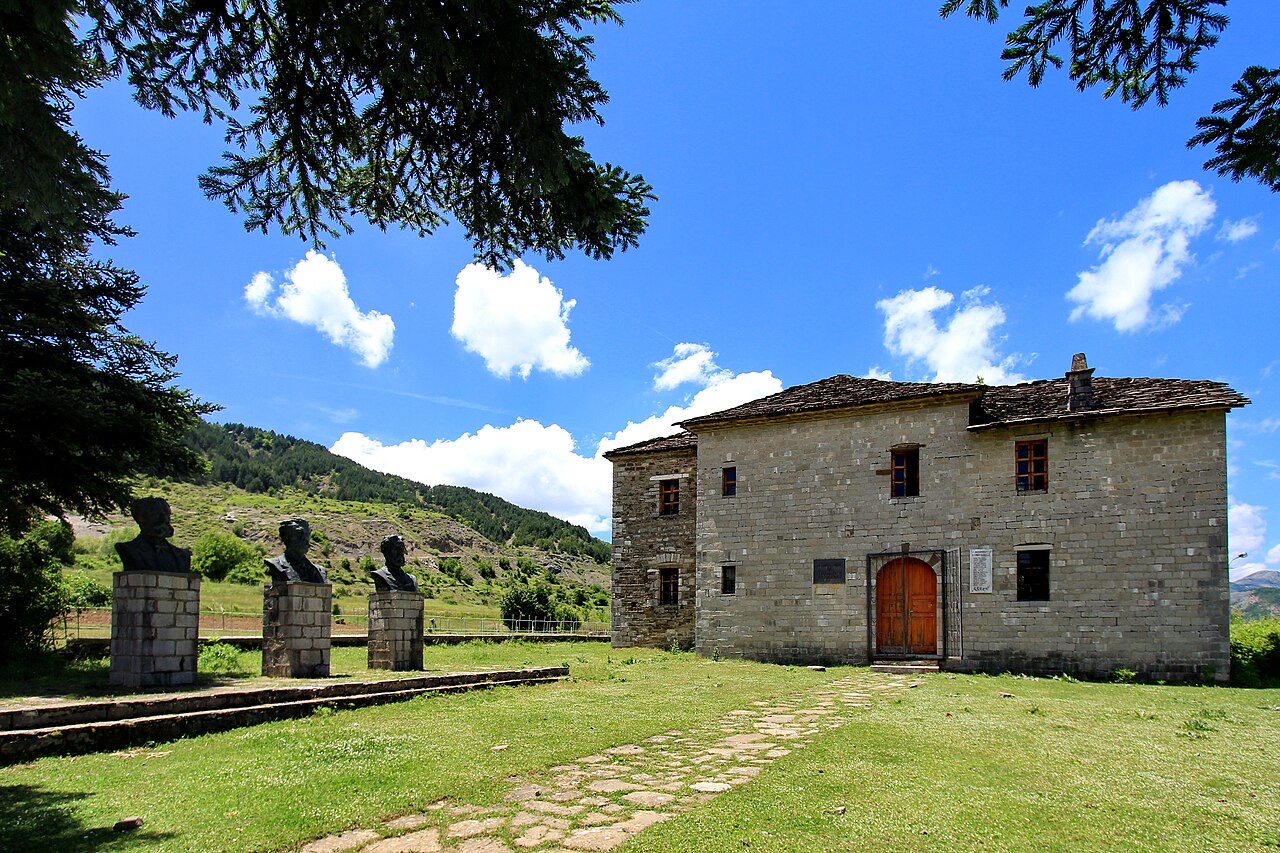
The family house in Frashër, in Gjirokastër County, where he was born and raised, is today a museum and has been declared a monument of important cultural heritage. It holds handwritten manuscripts, portraits, clothing, and busts of Naim and his brothers Abdyl and Sami.
Frashëri's portrait appears on the obverse of the 500 lek banknote issued from 1992 to 1996, and on the 200 lekë banknote issued from 1996 onward. The reverse of the banknote carries an image of the family house in Frashër. Albania has also established an order of merit bearing his name; among the recipients recorded is Mother Teresa, described as an Albanian nun and missionary.
Ce sont de vraies relations dans l'Atlas — des lieux proches de celui-ci et des sujets auxquels il appartient réellement. Rien ici n'est une recommandation générique.
An independent branch of the Indo-European family with no close living relative, written in a 36-letter Latin…
The Rilindja: the League of Prizren, the fight for an alphabet, and the first Albanian-language school.
A small Vjosa-side town known for its fruit preserves, thermal baths and polyphonic singing.
Les sections marquées « analyse approfondie » ci-dessus ont été rédigées pour cet Atlas à partir de l'article source indiqué ci-dessous, qui a été lu intégralement (11,358 caractères). Il s'agit d'une recherche assistée par IA sur ce document, vérifiée par rapport aux faits sélectionnés sur cette page. Vérifier tout élément ayant des conséquences auprès d'une source primaire.
Une erreur sur cette page ? Les corrections sont les bienvenues et sont vérifiées par rapport au document source. Indiquer ce qui est erroné et, si possible, d'où provient le chiffre correct.