Country
Albania
A mountainous country of about 2.4 million people on the Adriatic and Ionian seas, between Montenegro, Kosovo, North Macedonia…
Every county, coast and century
Guided view
New to Albania? Every page opens with a plain-language explanation you could read to a ten-year-old, before the detail begins.
Expert view
You already know the basics. Straight to the substance, with the simple explanations hidden. This is the default.
Subject
An independent branch of the Indo-European family with no close living relative, written in a 36-letter Latin alphabet.
Save
Albanian is a language on its own. It belongs to the big Indo-European family — the same one as English, Greek and Hindi — but it has no close cousins at all. It has its own branch. It is written with 36 letters, including some pairs that count as one letter, like dh and sh.
Albanian is a language on its own. It belongs to the big Indo-European family — the same one as English, Greek and Hindi — but it has no close cousins at all. It has its own branch. It is written with 36 letters, including some pairs that count as one letter, like dh and sh.
Albanian is an Indo-European language and the sole surviving representative of its own branch, which belongs to the Paleo-Balkan group. It constitutes one of eleven major branches of the Indo-European family and occupies an independent position within it. The only other living languages that are similarly the sole survivors of their own Indo-European branch are Armenian and Greek. In 1854, the philologist Franz Bopp first demonstrated that Albanian is an Indo-European language.
The subfamily from which Albanian descends is termed 'Albanoid'. Messapic is considered the closest language to Albanian, and the two are grouped together in a branch called 'Illyric' in the 2022 classification by Hyllested and Joseph. Earlier scholarship had compared Albanian with Germanic and Balto-Slavic on the basis of shared isoglosses, and other linguists grouped it with Latin, Greek, and Armenian. Current scholarship holds that Albanian is closely related to Greek and Armenian, and that its satem-like treatment of palatal consonants is less significant for classification than previously thought.
Albanian also forms part of the Balkan Sprachbund, sharing features with other Balkan languages at the phonological, morphological, and lexical levels. A hypothesis of a 'Balkan Indo-European' continuum posits a common period of prehistoric coexistence of several Indo-European dialects in the Balkans prior to 2000 BC, to which would belong Albanian, Ancient Greek, Armenian, Phrygian, and the relatively well-attested Messapic in southern Italy, among others. It has been proposed that Albanian was the first Balkan IE language to branch off from a common pre-stage shared with Greek and Armenian, though the split and following divergences may have been very close in time.
The place and time at which the Albanian language was formed remain uncertain. Albanian in antiquity is often thought to descend from Illyrian, given geographic and historical proximity, or from an otherwise unrecorded Balkan Indo-European language closely related to Illyrian and Messapic. Among the candidates—Illyrian, Thracian, and Dacian—Illyrian is considered the most probable ancestor, but there is insufficient evidence to establish this conclusively.
The American linguist Eric Hamp proposed that during an unknown period a pre-Albanian ('Albanoid') population inhabited areas stretching from Poland to the southwestern Balkans, and that Albanian developed in a mountainous region. This inference is drawn from vocabulary: words for plants and animals characteristic of mountains are native, while terms for fish and agricultural activities such as ploughing are borrowed. However, analysts have noted this pattern may reflect prolonged Latin domination of coastal and lowland areas rather than an original mountain homeland. Indigenous words for 'ship', 'raft', 'navigation', and 'sea shelves' exist alongside borrowed maritime vocabulary, suggesting Proto-Albanians were displaced from coastal zones after Latin conquest rather than that they were never coastal dwellers.
Pre-Indo-European sites are found throughout the territory of Albania, at locations including Maliq, Vashtëmi, Burimas, Barç, Dërsnik, Kamnik, Kolsh, Rashtan, and Nezir. The pre-IE substrate language spoken in the southern Balkans is thought to have influenced pre-Proto-Albanian, though the extent of this influence cannot be determined precisely. Proposed substrate loanwords include shegë ('pomegranate') and lëpjetë ('orach'). Some core vocabulary items—among them zemër ('heart') and hekur ('iron')—have no known etymology connecting them to Proto-Indo-European or any attested source language, and as of 2018 are tentatively attributed to an unknown pre-Indo-European substrate.
The first attested written mention of the Albanian language is dated 14 July 1284, in Ragusa (present-day Dubrovnik, Croatia), where a crime witness named Matthew testified: 'I heard a voice crying on the mountain in the Albanian language' (Latin: Audivi unam vocem, clamantem in monte in lingua albanesca). A separate document, the Descriptio Europae Orientalis dated 1308, notes that Albanians have a language distinct from Latin, Greek, and Slavic. A letter from Dominican Friar Gulielmus Adea in 1332 mentions Albanians using the Latin alphabet in their writings, and a French monk signed as 'Broccardus' noted the same year that Albanian books used Latin letters despite the language being entirely different from Latin.
The oldest surviving document written in Albanian dates to 1462: the formula e pagëzimit (Baptismal Formula), recorded by Pal Engjëlli (c. 1417–1470), Archbishop of Durrës, in the Gheg dialect for a synod at the Holy Trinity in Mat. The text reads: Unte paghesont premenit Atit et Birit et Spertit Senit ('I baptise you in the name of the Father and the Son and the Holy Spirit'). It was discovered and published in 1915 by Nicolae Iorga. Other early texts include Arnold Ritter von Harff's lexicon of Albanian phrases with German glosses (1496), and a song written in Albanian in the Greek alphabet, recovered from a codex dated to the 14th century but judged on internal grounds to be a 16th-century composition.
The first printed book in Albanian is the Meshari ('The Missal'), written by Gjon Buzuku between 20 March 1554 and 5 January 1555 in the Gheg dialect using the Latin script with some adapted Slavic letters. Its 188 pages contain approximately 154,000 words and a total vocabulary of around 1,500 distinct words. The book includes liturgies, prayers, catechetical texts, and passages from the Psalms, Isaiah, Jeremiah, and the Letters to the Corinthians. The only known copy is held by the Apostolic Library; it was published with transliterations and commentary by linguists in 1968. The first printed work in Tosk Albanian is the Mbsuame e krështerë (Dottrina cristiana) by Lekë Matrënga, published in 1592 in the Arbëresh dialect.
Albanian has two main dialect groups: Gheg, spoken to the north of the Shkumbin River, and Tosk, spoken to the south. The Shkumbin, a 181-kilometre river lying near the old Via Egnatia, forms the approximate boundary. The two groups are primarily distinguished by phonological differences but are mutually intelligible in their standard varieties. Gheg uses long and nasal vowels absent in Tosk, and loses the mid-central vowel ë at the end of words. A characteristic sound change is Gheg n becoming r through rhotacism in Tosk (e.g., femën in Gheg versus femër in Tosk).
Gheg is subdivided into four sub-dialects: Northwest Gheg, Northeast Gheg, Central Gheg, and Southern Gheg. It is spoken in northern Albania, Kosovo, Montenegro, and northwestern North Macedonia. One notably divergent variety is the Upper Reka dialect, classified as Central Gheg. A diaspora dialect, Arbanasi, is spoken in Croatia. Tosk is divided into five sub-dialects: Northern Tosk (the most numerous in speakers), Labërisht, Cham, Arvanitika, and Arbëresh. Cham Albanian is spoken in northwestern Greece; Arvanitika is spoken by the Arvanites of southern Greece; and Arbëresh is spoken by descendants of 15th- and 16th-century migrants in small communities in Sicily and Calabria in southern Italy.
Evidence from the treatment of native words and loanwords in both dialects indicates that the split into northern and southern varieties occurred after the Christianisation of the region in the 4th century AD, and most likely not later than the 6th century AD. This places the dialectal division in the Post-Roman and Pre-Slavic period, straddling the Jireček Line. Archaic elements of the language are preserved in the Malsia e Madhe Gheg Albanian, in Arvanitika, and in Arbëresh.
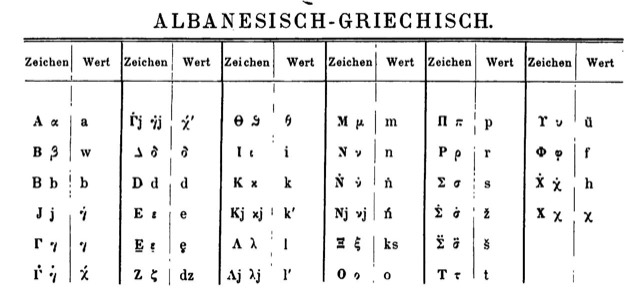
Albanian has been written in many different scripts since the earliest records from the 15th century, with choices reflecting the cultural orientation and religious affiliations of writers. The Tosk dialect was originally written in the Greek alphabet; Gheg was written in the Latin script. Both dialects were also written in the Ottoman Turkish Arabic script and in Cyrillic. Writers in northern Albania under Catholic influence used Latin letters; those in southern Albania under Greek Orthodox influence used Greek letters; those under Islamic influence used Arabic letters. Albanian scholars count at least ten different alphabets in use between 1750 and 1850, which Robert Elsie has described as almost certainly a record for European languages.
Several locally invented writing systems were also produced, including the Elbasan, Vithkuqi, Todhri, Veso Bey, and Jan Vellara alphabets. Attempts to create an original Albanian alphabet intensified after the League of Prizren and culminated with the Congress of Manastir, held by Albanian intellectuals from 14 to 22 November 1908 in Manastir (present-day Bitola). The Congress settled on the alphabet and standardised spelling still in use today: the Latin alphabet augmented by the letters ⟨ë⟩ and ⟨ç⟩, and nine digraphs—dh, gj, ll, nj, rr, sh, th, xh, and zh.
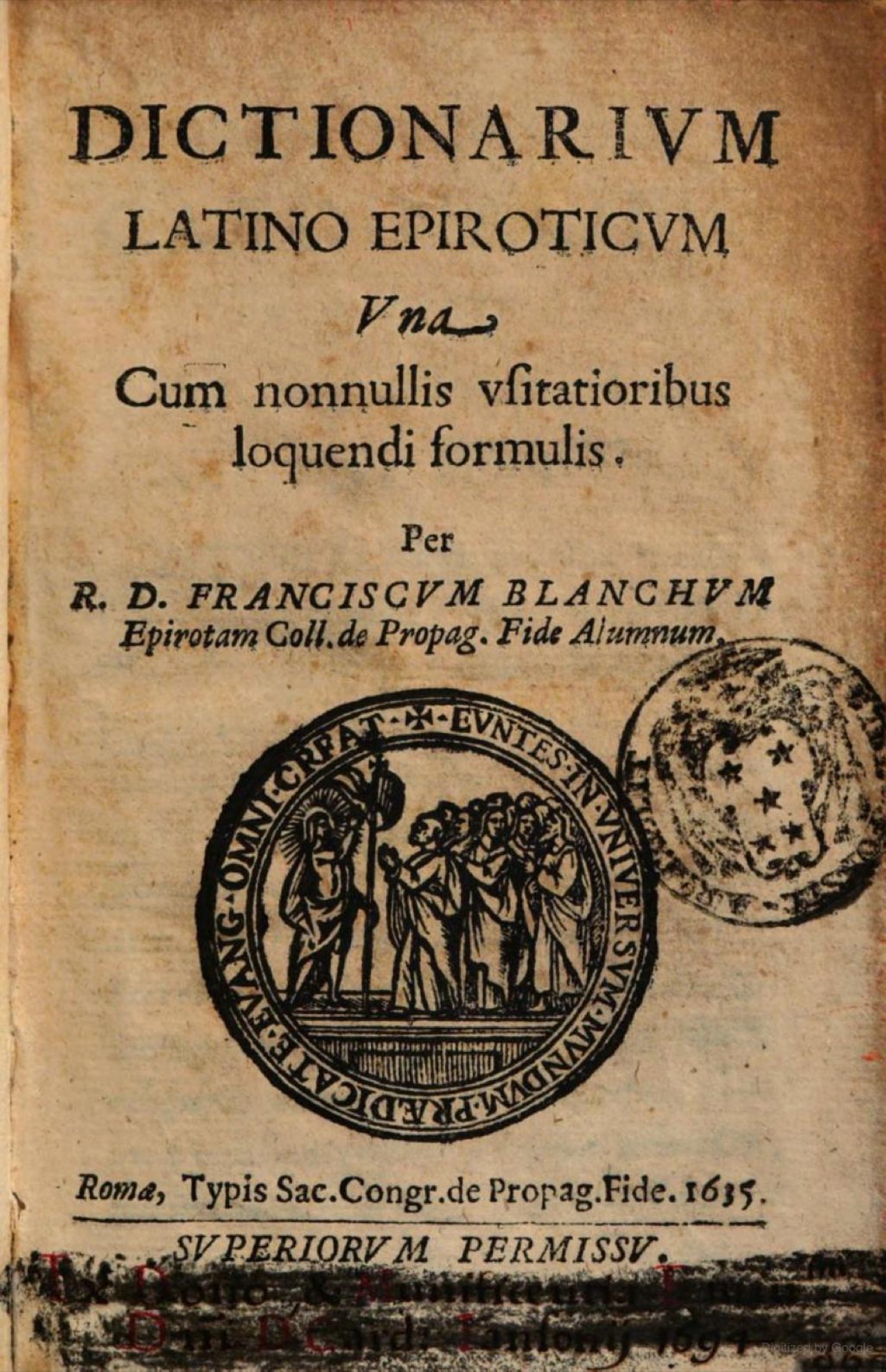
The earliest surviving records come from the Gheg area in makeshift spellings based on Italian or Greek. The first dictionary of Albanian, titled Dictionarium latino-epiroticum, was published in Rome in 1635 by Albanian bishop and writer Frang Bardhi. The term lingua epirotica ('Epirotan language') was preferred in intellectual and clerical circles during the period of Humanism and the Renaissance as a synonym for Albanian. One of the earliest Albanian dictionaries, the Italian manuscript Pratichae Schrivaneschae by Montenegrin sea captain Julije Balović, was written in 1693 and includes multilingual entries in Italian, Slavic, Greek, Albanian, and Turkish.
Until the early 20th century, Albanian writing developed across three literary traditions: Gheg, Tosk, and Arbëreshë. A Gheg sub-dialect spoken around Elbasan served as a spoken lingua franca. The Congress of Manastir (1908) recommended the Elbasan sub-dialect as the basis for a unified national literary language. Although technically a southern Gheg variety, Elbasan speech is closer to Tosk in phonology and is practically a hybrid between other Gheg sub-dialects and literary Tosk. Between 1916 and 1918, the Albanian Literary Commission met in Shkodër under Luigj Gurakuqi and confirmed this choice, publishing spelling rules for the Elbasan variety in 1917. The Congress of Lushnje upheld those decisions after World War I.
After World War II, the new communist government imposed the Tosk dialect across all domains—administration, education, and literature—most Communist leaders being Tosks from the south. Standardisation was directed by the Albanian Institute of Linguistics and Literature of the Academy of Sciences of Albania. Two dictionaries were published in 1954; new orthography rules followed in 1967 and 1973 with the Drejtshkrimi i gjuhës shqipe (Orthography of the Albanian Language). Kosovo and other Albanian-speaking areas in Yugoslavia had followed the 1917 Elbasan-based standard until 1968, when they adopted the Tosk project published by Tirana the previous year. The unified literary language was formalised in 1972 by an Orthography Congress held in Tirana, at which approximately only 1 in 9 participants were from Kosovo.
Debate over the standard has continued since the fall of the communist regime. Critics argue that Standard Albanian excludes the 'me + participle' infinitive and the Gheg lexicon, stigmatising Gheg speakers. Supporters of the Tosk standard regard the 1972 Congress as a significant achievement and resist reform. Moderates, particularly in Kosovo, broadly support a unified language but favour incorporating the 'me + participle' infinitive and Gheg vocabulary. In 2013 a group of academics from Albania and Kosovo proposed minor orthographic changes; hardline academics boycotted the initiative, while other reformers considered it insufficient. Many writers continue using the Elbasan dialect, though most publications require submissions in Tosk, and some print media translate direct speech to replace Gheg grammatical forms.
Albanian is estimated to have approximately 7.5 million native speakers worldwide. Around 6 million speakers live in the Balkans, primarily in Albania, Kosovo, North Macedonia, Serbia, Montenegro, and Greece. Albanian is the official language of Albania and Kosovo, a co-official language in North Macedonia and Montenegro, and a recognised minority language in Croatia, Italy, Romania, and Serbia. Albanian became an official language in North Macedonia on 15 January 2019. In Switzerland, Albanian is the sixth most spoken language, with 176,293 native speakers recorded.
Long-established Albanian-speaking communities exist outside the Balkans. Italy has a historical Albanian minority of around 500,000, the Arbëreshë, settled in southern Italy and descended from 15th- and 16th-century migrants. Albanian is the third most common mother tongue among foreign residents in Italy. Approximately 1 million Albanians from Kosovo are dispersed throughout Germany, Switzerland, and Austria, mainly as migrants from the 1990s. In Greece, approximately 450,000 Albanian immigrants speak the language, in addition to indigenous Greek Albanian communities in Thesprotia, Preveza, and parts of Ioannina and Florina.
In the Americas, Albanian speakers are estimated at approximately 250,000 in the United States and Canada, concentrated in cities including New York City, Boston, Chicago, Philadelphia, and Detroit, and in parts of New Jersey, Ohio, and Connecticut. Argentina has nearly 40,000 Albanian speakers, mostly in Buenos Aires. Approximately 1.3 million people of Albanian ancestry live in Turkey, with more than 500,000 acknowledging that ancestry; however, the vast majority are assimilated and no longer fluent in Albanian. Egypt has around 18,000 Albanians, mostly Tosk speakers, many descended from the entourage of Muhammad Ali Pasha. Albanian diaspora communities also reside in Australia and New Zealand.
Standard Albanian has seven vowels and 29 consonants. It possesses dental fricatives /θ/ and /ð/, written ⟨th⟩ and ⟨dh⟩, which are rare cross-linguistically and parallel to those in English. The schwa, spelled ⟨ë⟩, shows wide variability from back to front articulation. Stress normally falls on the penultimate syllable, but shifts to the final syllable when that syllable is open and ends in a, i, or u, or when it is closed with a vowel other than schwa. Albanian is neither centum nor satem in the strict sense: PIE *ḱ, *k, and *kʷ develop distinctly into th, q, and s respectively, preserving the original three-way distinction among dorsal consonants.
Albanian nouns are categorised by gender (masculine, feminine, and neuter) and inflected for number and case. There are five declensions and six cases: nominative, accusative, genitive, dative, ablative, and vocative. The genitive and dative forms are identical. The definite article is suffixed to the noun rather than placed before it, as in Romanian, Macedonian, and Bulgarian—a feature Albanian has had since ancient times. Albanian has developed an analytical verbal structure in place of the earlier synthetic inherited system, with six mood types and eight tense constructions (three simple, five complex).
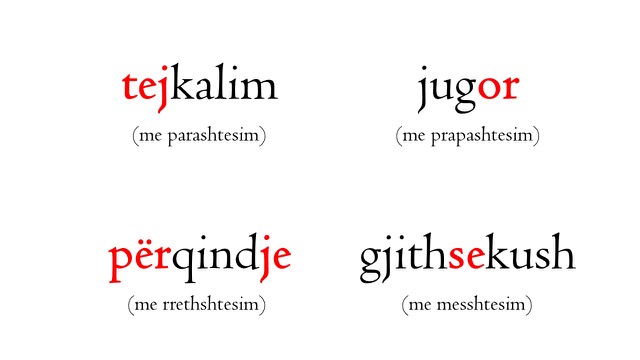
Albanian has a canonical SVO word order, but word order is relatively free in practice, with all six permutations of subject, verb, and object grammatically possible with slight pragmatic differences. Verbal negation is mood-dependent: the particles nuk or s' are used in indicative, conditional, and admirative sentences, while mos is used with subjunctive, imperative, optative, and non-finite verb forms. Albanian possesses a distinctive set of verb forms called miratives (or admiratives) used to express surprise, irony, doubt, or neutral reportedness—a feature unique in the Balkan context. Albanian also retains remnants of a vigesimal (base-20) counting system alongside the standard decimal one: njëzet means 'twenty' and dyzet means 'forty'. Albanian is the only Balkan language to have preserved this pre-Indo-European vigesimal system.
Albanian is noted within historical linguistics for an exceptionally high influx of loanwords across its history. The deepest and most extensive foreign influence came from Latin, with some scholars estimating that Latin-origin words account for as much as 60% of Albanian vocabulary—a proportion that once led to Albanian being falsely classified as a Romance language. The period of Latin influence lasted from the 2nd century BC to the 5th century AD. Jernej Kopitar (1780–1844) was the first to note that Latin loanwords in Albanian reflect the pronunciation of the Augustan period. Haralambie Mihăescu established that some 85 Latin words survived in Albanian but not in any Romance language, and that 151 Albanian words of Latin origin were not inherited in Romanian. Early church terminology—kishë ('church'), engjëll ('angel'), kryq ('cross'), meshë ('mass'), peshkëp ('bishop')—shows phonological features confirming very early borrowing from Latin.
There are approximately 30 Ancient Greek loanwords in Proto-Albanian, many reflecting a dialect that voiced its aspirants, similar to the Macedonian Greek dialect. Examples include drapër ('sickle') from Northwest Greek drápanon, mollë ('apple') from mēlon, and pellg ('pond') from pélagos ('high sea')—the last representing a semantic shift suggesting a change in the Albanian-speaking area after Greek contact. After the arrival of Slavs in the Balkans, Slavic became an additional source, with contact lasting intensively for almost four centuries into the late Middle Ages; Vladimir Orel (1998) counted approximately 556 Slavic loanwords. The Ottoman period brought Turkish words and, through Turkish, Persian and Arabic vocabulary. Emanuele Banfi (1985) estimated approximately 2,000 Turkish loanwords in Albanian, with a larger number when obsolete, rare, and dialectal forms are included.
Albanian is also known to contain a small number of Gothic loanwords, a conclusion supported by multiple modern sources despite the sparse nature of the evidence. Martin Huld argues these date to the late 4th and early 5th centuries, during Gothic invasions of the Balkans under Alaric, Odoacer, and Theodoric. Words attributed to Gothic include tirk ('felt gaiters'), shkumë ('foam'), zverk ('nape'), horr ('villain'), and punjashë ('purse'). Huld argues that the Gothic loans provide evidence for the internal chronology of Proto-Albanian sound changes: Proto-Albanian had already shifted /uː/ to /y/ by this point, but had not yet shifted /t͡s/ to /θ/. It has also been proposed that Albanian is the source of the suffixed definite article in Romanian, Bulgarian, and Macedonian, as this has been a feature of Albanian since ancient times.
Country
A mountainous country of about 2.4 million people on the Adriatic and Ionian seas, between Montenegro, Kosovo, North Macedonia…
City · Korçë
The highland city of serenades, the first Albanian-language school, and the country's oldest brewery.
Historical period
The Indo-European tribes of the western Balkans, and the ancestors most Albanians claim.
Subject
The forty or so words and phrases that cover most day-to-day exchanges for a visitor.
Subject
Thirty-six letters agreed at the Congress of Monastir in 1908, replacing competing Arabic, Greek and Latin scripts.
River · Elbasan
The river that splits Albania in two — the historic dividing line between Gheg and Tosk.
Person
The most influential writer of the Rilindja, and one of three brothers central to the national movement.
Subject
The two dialect groups, divided by the Shkumbin river: Gheg to the north, Tosk to the south.
Something wrong on this page? Corrections are welcome and are checked against the source record. Tell us what is wrong and, if you can, where the right figure comes from.