제목
Besa
The customary obligation of keeping one's word — the principle behind Albania's wartime sheltering of Jewish refugees.
모든 주, 모든 해안, 모든 세기
안내 보기
알바니아가 처음이신가요? 모든 페이지는 세부 내용이 시작되기 전에, 열 살짜리 아이도 이해할 수 있는 평이한 설명으로 시작됩니다.
전문가 보기
기본 내용은 이미 알고 계신가요? 간단한 설명은 숨기고 핵심 내용만 바로 확인하세요. 이것이 기본 설정입니다.
제목
A body of customary law, best known in the Lekë Dukagjini recension, that governed the northern highlands for centuries.
저장
The Kanun was a set of unwritten rules that people in the northern mountains lived by for hundreds of years, covering property, marriage, hospitality and disputes. It also contained rules about blood feuds, which is the part it is most often remembered for. It was written down in the 20th century.
The Kanun was a set of unwritten rules that people in the northern mountains lived by for hundreds of years, covering property, marriage, hospitality and disputes. It also contained rules about blood feuds, which is the part it is most often remembered for. It was written down in the 20th century.
The Kanun is a body of Albanian traditional customary law that has directed all aspects of Albanian tribal society. It is not a single, unified written code but a living legal tradition, maintained orally by tribal elders for at least the last five centuries and into the present day. Its authority has been described as sacred in character yet secular in operation, and it has commanded cross-religious observance among both Christian and Muslim Albanians, attributed to an earlier pagan code common to all Albanian tribes.
The Kanun rests on four pillars: honour (Albanian: nderi), hospitality (Albanian: mikpritja), right conduct (Albanian: sjellja), and kin loyalty (Albanian: fis). Besa — a concept of personal honour comparable to the Latin fides — and nderi, meaning family honour, are of prime importance throughout the code as the cornerstone of personal and social conduct. The code regulates the economic organisation of the household, hospitality, brotherhood, clan, boundaries, work, marriage, and land, among other matters.
Several distinct regional codes exist. The most widely studied is the Kanun of Lekë Dukagjini, applicable in the northern highlands. Other codified variants include the Kanun of Skanderbeg (also called the Kanun of Arbëria), the Kanun of Labëria (also known as the Kanun of Papa Zhuli or Kanun of Idriz Suli), the Kanun of Mirdita, the Kanun of Pukë, the Kanun of Dibra, and the Kanun of Çermenikë. The Kanun of Lekë Dukagjini, as codified by Shtjefën Gjeçovi, is divided into 12 books and contains 1,262 articles.
The word kanun derives from the early Greek word kanōn, meaning, among other things, 'pole' or 'rule'. It passed into Arabic as a word meaning 'law', then into Ottoman Turkish, and from there entered Albanian usage during the Ottoman period. The term became so embedded in Albanian that a legal act was described as being 'kanun', and an illegal one as something 'the kanun doesn't give'. Baroness Von Godin held that it was the Ottomans who supplied the name kanun, and that the Albanian association of the word with Lekë — perceived as derived from the Latin lex — was a later attribution to the medieval nobleman of the Dukagjini family.
Regional terminology varied considerably. In Martanesh and Çermenikë the term kanun was standard. In Toskëria it was known as 'The Kanun of the Adet'; in Labëria as 'The sharte of Idriz Suli'; in the Bregu district as Venomet e Himarës. In Dibër, Kurbin, Bendë, and Tamadhe the term zakon was used, a word of Slavonic origin. Turkish-extract words also circulated: usull, itifak, adet, and sharte. In Albanian periphrasis the law was sometimes called rrugë or udhë, meaning 'way' or 'path'. According to scholars Çabej, Camaj, and Schmidt-Neke, the oldest Albanian word for customary law was doke, meaning 'custom', 'usance', or 'tradition'.
The Albanian Kanun is regarded as a literary monument of interest to Indo-European studies. Scholars have observed that its laws governing hospitality, the rights of heads of households, marriage, blood feuds, and payment of damages find precise echoes in Vedic India, ancient Greece, and ancient Rome, suggesting possible inheritance from Proto-Indo-European culture. The stratification of Albanian oral customary law across historical eras is visible in its powerful pre-Christian motifs mixed with motifs from the Christian era, reflecting the persistence of pagan concepts including ancestor worship, animism, and totemism.
British anthropologist and writer Edith Durham suggested that the Albanian Kanun likely dates back to the Bronze Age culture. Others have conjectured that it may be a continuation of ancient Illyrian tribal laws, though these remain conjectures rather than established conclusions. Japanese scholar Kazuhiko Yamamoto, comparing the Albanian Kanun of the Mountains with the Iliad and the Odyssey, concluded that the basic ethical concepts of the stateless social structure of the Homeric Age — faith, honour, blood, revenge, food, and guest — correspond to the same customary concepts found in Albanian tribal society.
The success of the oral transmission system over at least five centuries is itself taken as an indication of ancient origins. In his codification of the Kanun, Shtjefën Gjeçovi added footnotes referencing Roman law, and scholars have identified in the doke an indigenous legal system that survived the Roman occupation. Some researchers define the Albanian Kanun as a set of traditions widespread in the Balkans and the Mediterranean area, while others argue it should be understood independently as a normative heritage created autonomously from the laws imposed by successive conquerors.
Albanian customs survived intact into modern times partly because of the lack of state formation among Albanians and their Illyrian ancestors, allowing tribal social organisation to persist where centralised state structures would otherwise have disrupted oral legal traditions. According to some historical sources, the Roman and Byzantine imperial governments recognised autonomous customary laws in various local communities to enable self-administration. Albanian customary laws were thus implemented in parallel with Roman, Byzantine, Ecclesiastic, and later Sharia and Ottoman law during successive periods.
Historical sources from Ragusa mention 'the Albanian customs of the Balsha'. In the late Middle Ages, Albanian cities codified statutes incorporating regulations drawn from ancient local customary laws. In the Statutes of Scutari, the verb bessare is considered to trace an Old Albanian term, taken as early evidence of the Albanian institution of Besa. In the 11th century, the Albanioi are mentioned in Byzantine sources with the same legal status — isopoliteia — as the Byzantines themselves.
It has been argued, though speculatively, that an article in Dušan's Code may represent an early attempt to suppress the self-administered Albanian customary law of the mountains, which would constitute early documentary evidence that such laws were in effect. Scholar Syrja Pupovci argues that while there is some similarity between Dušan's Code and the Kanun on matters relating to pastoral communities, the Kanun developed independently of Dušan's Code. She does not, however, exclude the possibility of mutual influence between similar tribal laws among Albanian, Montenegrin, and Herzegovinian tribes.
In 1492 the Sublime Porte officially recognised Himara's own customary law — known in Albanian as Venome — for self-government, in the context of the Labëria uprisings against the Ottoman Empire. By around 1550, when the Ottoman administration had become acquainted with the social organisation of Albanian lands, it referred to the local customary law as the Canun of the Mountains (Turkish: Xhibal Kanuni). In the 17th century, an anonymous study written in Venetian — Informazioni sopra origine e metodo delle arbitrarie in affari di sangue in Albania — was addressed to the Republic of Venice to harmonise Venetian state law with the Kanun in areas from Kotor to Shkodra under Venetian administration. The Venetian Senate rejected the study, maintaining that no other law could be recognised in its provinces.
During the Tanzimat reform period, the Ottoman administration opened the 'Shkodra Mountains Commission' (Turkish: Iskodra Xhibali Komisi), established in 1856–1858 and based in Shkodra, with administrative and judicial power over the provinces. The Commission relied mainly on the Kanun of the Mountains (Turkish: Kanun-i Jhibal) with some Ottoman administrative elements. In 1863 the bylykbashi of Gruda sent a letter requesting the Kanun-i Jhibal, indicating that a codification in Ottoman Turkish already existed at that date. Parts of this codification were published in twenty paragraphs in the salname of the Vilayet of Shkodra in 1894 and subsequently translated into Italian and French. The key topics addressed in the relationship between the Ottoman administration and local populations were murder, blood feud, reconciliation, blood money, hospitality, theft, and tribal disputes.
Albanian ruler Ali Pasha, in his autonomous Pashalik, enforced his own laws in addition to Sharia for Muslims and canon law for Christians, permitting only rare use of local Albanian tribal customary law. After annexing Suli and Himara into his semi-independent state in 1798, he sought to organise the judiciary by province on the principle of social equality. To limit blood feud killings, Ali Pasha replaced the practice of gjakmarrje with punishments including blood payment, expulsion, or the death penalty. He also reached a territorial agreement with the Kurveleshi population not to trespass their lands. Since the 18th century, blood feuds in Labëria have been limited principally by councils of elders. The mountain region of Kurveleshi represents the last example of a tribal system among southern Albanians, regulated by the Code of Zuli.
The first known codification of Albanian oral customary law is Lek Dukagin Kanunu, published in 1872 in Prizren in Ottoman Turkish by the Ottoman administration. The Kanun of Lekë Dukagjini takes its name from Lekë Dukagjini, a medieval prince who ruled in northern Albania. The code was written down in the 19th century by the Franciscan scholar Shtjefën Gjeçovi and partially published in the periodical Hylli i Drites in 1913. The full version appeared only in 1933, seven years after Gjeçovi's death in 1926.
Gjeçovi's codification contains 1,262 articles across 12 books. Though the laws are attributed to Lekë Dukagjini, the text — often contested, with many different interpretations — evolved significantly from the 15th century onward; it was codified and named by Dukagjini rather than authored by him in any modern sense. Gjeçovi added footnotes referencing Roman law in recognition of the ancient legal substrata visible in the text.
Several other regional variants were subsequently collected and published during the 20th and 21st centuries: the Kanun of Mirdita, the Kanun of Pukë, the Kanun of Skanderbeg (also called the Kanun of Arbëria), the Kanun of Dibra, the Kanun of Çermenikë, and the Kanun of Labëria. Albanian tribes including the Bytyqi, Gashi, Gruda, Trieshi, Hoti, Kastrati, Kelmendi, Krasniqi, Shkrel, and Kuçi follow the Kanuni i Malësisë së Madhë, a variant applicable from their tribal regions around Shkodër to the Highlands of Gjakova. The tribes of the Dibra region governed themselves according to the Law of Skanderbeg.
German Baroness Marie Amelie von Godin, in collaboration with Eqrem Vlora and at the request of the Franciscans, began a systematic translation of the Kanun of Lekë Dukagjini into German in 1938, based on Gjeçovi's earlier Albanian codification. The translation was published in the 1950s, shortly before Von Godin's death. It was republished in 2001, edited by Robert Elsie with an introduction by Michael Schmidt-Neke.
An Italian translation of the Kanun of Lekë Dukagjini was published in 1941, translated by Franciscan Pal Dodaj, edited by Gjergj Fishta and Giuseppe Schirò, with an introduction by Federico Pateta. It was republished in 2009 with an introduction by Donato Martucci. A dual English-Albanian edition was published in 1989 and republished in 1992. An Italian translation of the Kanun of Skanderbeg was published in 2017, translated by Genc Lafe and edited by Donato Martucci.
Among the Kanun's most controversial provisions are those in book 10, section 3, which specify how murder is to be handled. Tribal law stipulates the principle of koka për kokë — head for a head — under which the relatives of a murder victim are obliged to seek gjakmarrja, or blood vengeance. The code also held that thieves were required to pay fines proportional to what was stolen. Women are referred to in discriminatory terms within the code and are not considered legitimate targets under blood feud rules. Kanun law also holds that a man's home is a safe refuge, a provision that blood feud families have relied upon in practice.
Former Albanian communist leader Enver Hoxha suppressed the practice of the Kanun through hard repression and a strong state apparatus. After the fall of communism, some communities attempted to revive old traditions, but parts of the oral code had been lost, raising concern about misinterpretation. The rules around blood feud resurfaced in the 1990s in northern Albania as confidence in the local government and police collapsed.
Estimates of the scale of blood feud activity carry significant uncertainty and are disputed. In 2014, approximately 3,000 Albanian families were estimated to be involved in blood feuds; since the fall of communism, this is said to have led to roughly 10,000 deaths, though the reliability of such figures is debated. Cedoca reported in 2017 that, according to Albanian State Police Headquarters, from 2013 to March 2017 there were five deaths attributable to blood feuds; the British embassy in Tirana stated that police tend to report the lowest possible numbers. Albanian Daily News reported one blood feud death in 2018. A complicating factor in any count is the use of blood feud claims in asylum applications. Organisations exist that attempt to mediate between feuding families and encourage 'pardoning of the blood' (Albanian: Falja e Gjakut).
Albanian writer Ismail Kadare returns to the Kanun repeatedly in his work. It is the main theme of his novel Broken April. In Komisioni i festës (The Celebration Commission), Kadare describes the Monastir massacre of 1830 as a confrontation between the Albanian Kanun with its code of besa and the Ottoman Empire. In his literary critique Eskili, ky humbës i madh (Aeschylus, this big loser), Kadare draws parallels between the kanun and vendetta customs across Mediterranean countries.
Joshua Marston's 2011 film The Forgiveness of Blood, set in modern-day Albania, depicts a blood feud between two families in northern Albania and focuses on the effect of the feud on the children involved. The Belgian film Dossier K. also draws on the Kanun. Elvira Dones's novel Sworn Virgin addresses the Kanun in the context of the practice of sworn virgins — women who swear celibacy in exchange for being accepted socially as men. Barbara Nadel's Deep Waters refers to the Kanun and gjakmarrja. The Kanun has also appeared as a plot element in US television series including Law & Order: Criminal Intent (season 6, episode 9) and The Closer (season 6, episode 14).
제목
The customary obligation of keeping one's word — the principle behind Albania's wartime sheltering of Jewish refugees.
제목
A culture shaped by mountain isolation, five centuries of Ottoman rule, and fifty years of enforced separation.
산맥 · Shkodër
The limestone wall of the far north — locally the Accursed Mountains — shared with Montenegro and Kosovo.
마을 · Shkodër
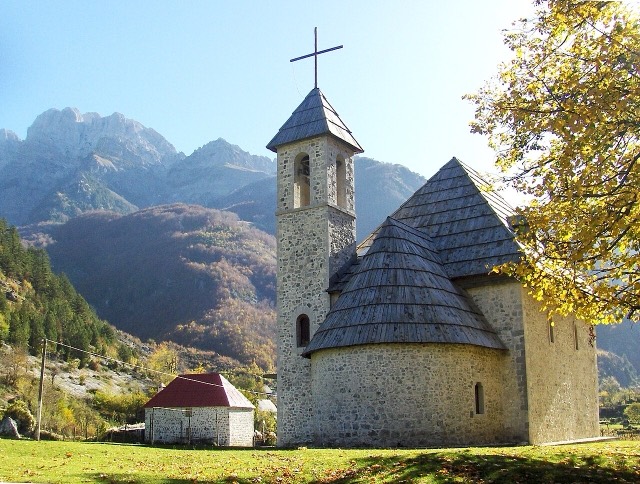
A glacial valley village in the Albanian Alps: a lock-in tower, a waterfall, and one end of the country's best-known trek.
해설
A body of customary law that governed the northern highlands for centuries — and the part of it that everyone has heard of.
이 페이지에 오류가 있습니까? 수정 제안을 환영하며, 출처 기록과 대조하여 검토합니다. 잘못된 내용과 가능하다면 올바른 수치의 출처를 알려 주십시오.