제목
The Albanian Diaspora
More Albanians may live outside the country than in it — chiefly in Italy, Greece, Germany, Switzerland, the UK and the US.
모든 주, 모든 해안, 모든 세기
안내 보기
알바니아가 처음이신가요? 모든 페이지는 세부 내용이 시작되기 전에, 열 살짜리 아이도 이해할 수 있는 평이한 설명으로 시작됩니다.
전문가 보기
기본 내용은 이미 알고 계신가요? 간단한 설명은 숨기고 핵심 내용만 바로 확인하세요. 이것이 기본 설정입니다.
제목
The two dialect groups, divided by the Shkumbin river: Gheg to the north, Tosk to the south.
저장
Albanian has two main ways of speaking. North of the Shkumbin river people speak Gheg; south of it they speak Tosk. They differ in sounds, some grammar and some words. The written standard used in schools is based mostly on Tosk.
Albanian has two main ways of speaking. North of the Shkumbin river people speak Gheg; south of it they speak Tosk. They differ in sounds, some grammar and some words. The written standard used in schools is based mostly on Tosk.
Albanian is divided into two major varieties: Gheg and Tosk. The geographic boundary between them is the Shkumbin River, which runs through central Albania. Gheg is spoken to the north and in adjacent territories; Tosk to the south. The two varieties differ in phonology, vocabulary, and certain grammatical features, and they have distinct literary and political histories.
Gheg is spoken in northern and central Albania, Kosovo, northwestern North Macedonia, southeastern Montenegro, and southern Serbia. The Albanian-speaking population associated with this variety is referred to as the Ghegs. Tosk forms the basis of Standard Albanian, the official written form used across all countries where Albanian has official status.
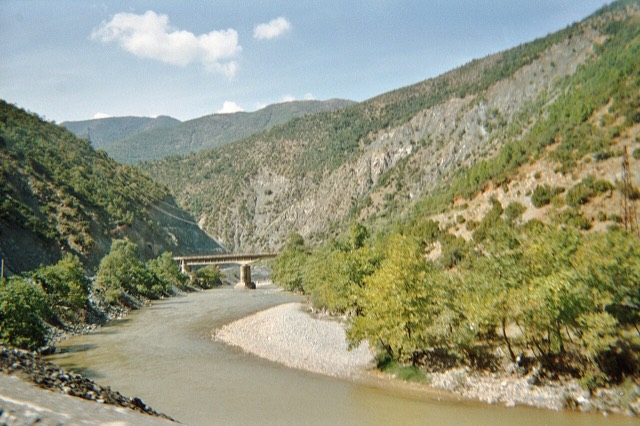
The Shkumbin River, which winds through central Albania, serves as the traditional dividing line between Gheg-speaking populations to the north and Tosk-speaking populations to the south. This boundary is geographical and historical rather than a sharp linguistic wall: transitional dialects exist near the boundary, and some settlements at the extreme southern edge of the Gheg zone show features of both varieties.
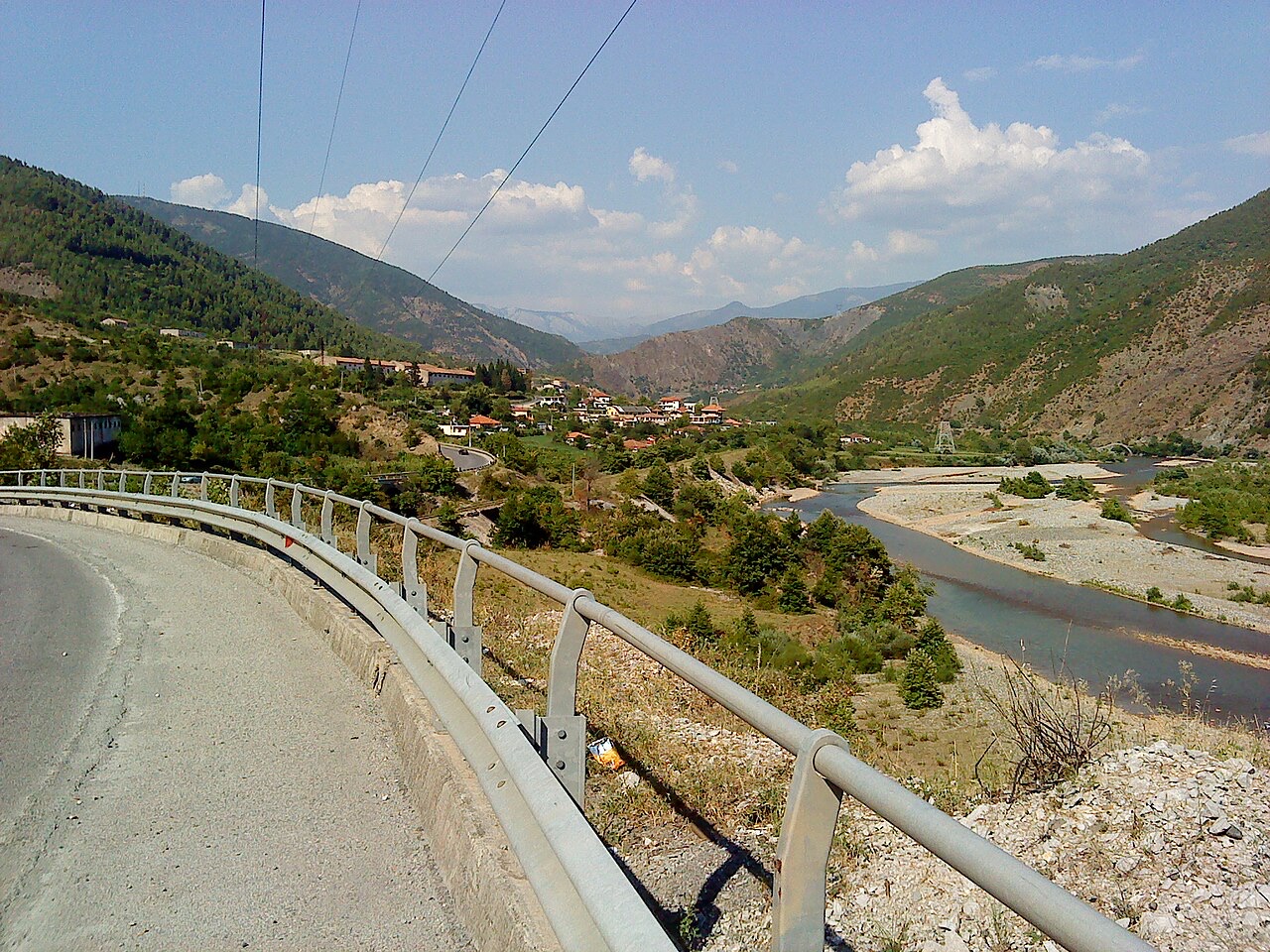
Villages such as Dars in Peqin, the coastal settlements of southernmost Kavajë such as Rreth-Greth, and a number of settlements in Qukës and Hotolisht are described in the linguistic literature as transitional, combining characteristics of both Gheg and Tosk.
Before the Second World War, no official effort had been made to impose a unified Albanian literary language. Both literary Gheg and literary Tosk were in use. The situation changed after the war, when the communist regime in Albania imposed a nationwide standard based on the variant of Tosk spoken in and around the city of Korçë.
In Yugoslavia after 1945, there were plans to create a distinct Kosovan language based on Gheg, as part of Tito's broader policy of defining nations through language and as a step toward union with Albania. Following the 1948 split between Stalin and Tito, the plan was abandoned. Beginning in 1968, Kosovo Albanians began adopting the Tosk-based standard, a process that culminated in 1972 with the publication of the first unified Albanian orthographic handbook and dictionary. By 1974, this Tosk-based standard Albanian had become Kosovo's official language.
The choice to adopt Tosk was made for political rather than purely linguistic reasons, even though almost all Albanian writers in Yugoslavia at the time were Ghegs. Gheg remains the everyday spoken dialect for most Kosovo Albanians, while Standard Albanian is used in schools and media.
The standardisation of written Albanian on a Tosk basis has attracted significant criticism. The writer Arshi Pipa argued that the change had deprived the Albanian language of its richness at the expense of the Ghegs. He described literary Albanian as a "monstrosity" produced by the Tosk communist leadership, who, he contended, had conquered anti-communist northern Albania and imposed their own dialect.
The stakes of this debate extend beyond linguistics. Albanian language identity is described in the sources as the main criterion for Albanian self-identity, meaning that the choice of which dialect forms the literary standard carries direct political and cultural consequences for the Gheg-speaking population.
Gheg is divided into four sub-dialects: Central Gheg, Southern Gheg, Northwestern Gheg (also called Western Gheg), and Northeastern Gheg (also called Eastern Gheg). These sub-dialects differ in phonology, vocabulary, and certain morphological features, though speakers of adjacent sub-dialects can generally understand one another.
The Italian linguist Carlo Tagliavini placed the Gheg of Kosovo and North Macedonia in the Eastern Gheg category. Some linguists, including Jorgji Gjinari and Xhevat Lloshi, regard Central Gheg as a sub-group of the broader Southern Gheg zone rather than a fully independent category.
Southern Gheg is spoken across central and north-central Albania, in the regions of Durrës, Tirana, Elbasan, and Librazhd, and extends to Struga. It divides into two main groupings: Southwestern Gheg, covering Durrës, Tirana, Kavajë, and parts of Elbasan including Peqin and the western villages of Krrabë; and Southeastern Gheg, covering Elbasan, Librazhd, and Martanesh.
The dialects of Shëngjergj in Tirana and Krrabë in Elbasan function as transitional dialects between the two groupings: Shëngjergj is closer to the Southwestern group, while the eastern villages of Krrabë lean toward the Southeastern group. The dialects of Ishëm, Vorë, Zall-Herr, and Zall-Dajt represent the northernmost extensions of Southern Gheg and show direct influence from Central Gheg, spoken in neighbouring Krujë, Mat, and Bulqizë.
Central Gheg is spoken in the interior basin of the Mat river, extending east to and beyond the Black Drin river. It encompasses Kruja and Fushë Kruja, Mati, part of Mirdita, Lurë, Luma, and the Dibër Valley. Outside Albania, the majority of Albanians in North Macedonia speak Central Gheg dialects, including the divergent idiom of Upper Reka.
The North Macedonian regions where Central Gheg is spoken include the Polog Valley (Tetovo and Gostivar) and the Southwestern Statistical Region, covering Kičevo, Debar, and parts of Struga.
Northwestern Gheg is spoken in northwestern Albania and southern Montenegro, associated with highland tribes including the Malësor and Dukagjin groups and their constituent clans. The sub-dialect also includes an isolated, particularly divergent variety: the Arbanasi dialect of diaspora Albanians in Croatia.
Northeastern Gheg is spoken in northeastern Albania, Kosovo, and parts of Serbia, in a zone beginning roughly from the eastern Montenegrin-Albanian border and covering the Albanian districts of Tropojë, Pukë, Has, Mirditë, and Kukës, the whole of Kosovo, and the Serbian municipalities of Bujanovac and Preševo. The speech around Skopje, Karadak, and Kumanovo in North Macedonia is sometimes also regarded as part of Northeastern Gheg.
The two northern sub-dialects differ in tone and vocabulary. Northeastern Gheg has deeper, more prolonged vowel sounds and uses words such as "kon" (been) and "qysh" (how), while Northwestern Gheg uses "kjen o ken" and "si" respectively. In Northeastern Gheg, the palatal stops of Standard Albanian—[c] as in qen and [ɟ] as in gjumë—are realised as palato-alveolar affricates [t͡ʃ] and [d͡ʒ]. Serbian calques are evident in the syntax and morphology of Northeastern Gheg. Despite these differences, speakers of both sub-dialects are reported to have no difficulty understanding each other.
Within Northwestern Gheg, the area of Malësia e Madhe (Albanian for 'Great Highlands') shows phonological, syntactic, and lexical patterns distinct enough from the Shkodër and Lezhë areas that it is treated as a separate variety, termed Malsia e Madhe Albanian (MMA). The differences are attributed to the historical and geographic isolation of the mountainous region.
Malsia Albanian has preserved archaic features of Proto-Albanian and Proto-Indo-European that other Gheg varieties and Tosk have lost. In particular, it retains word-initial voiceless and voiced stops that other varieties replaced. Tosk Albanian produced a shift in which a word-initial stop became a nasal-stop cluster by prefixing en- (from Proto-Albanian preposition *en, meaning 'in'); Gheg is in a transitional position, featuring nasals from reduced nasal-stop clusters; Malsia Albanian retains the original stop without any prefixation. Examples include: Tosk mbuʃa 'to fill' (from Proto-Albanian *en-busa) against Malsia buʃa; Tosk ŋga 'from where' (from *en-ka) against Malsia ka.
The Proto-Albanian preposition *en 'in' has been preserved solely in the Malsia Albanian dialect as a functioning preposition. In all other Gheg varieties and in Tosk, it has been reanalysed as a prefix attached to lexical terms and no longer exists as a standalone preposition.
제목
More Albanians may live outside the country than in it — chiefly in Italy, Greece, Germany, Switzerland, the UK and the US.
제목
An independent branch of the Indo-European family with no close living relative, written in a 36-letter Latin alphabet.
강 · Elbasan
The river that splits Albania in two — the historic dividing line between Gheg and Tosk.
해설
Why the same town appears as Vlorë and Vlora, and what the endings tell you.
제목
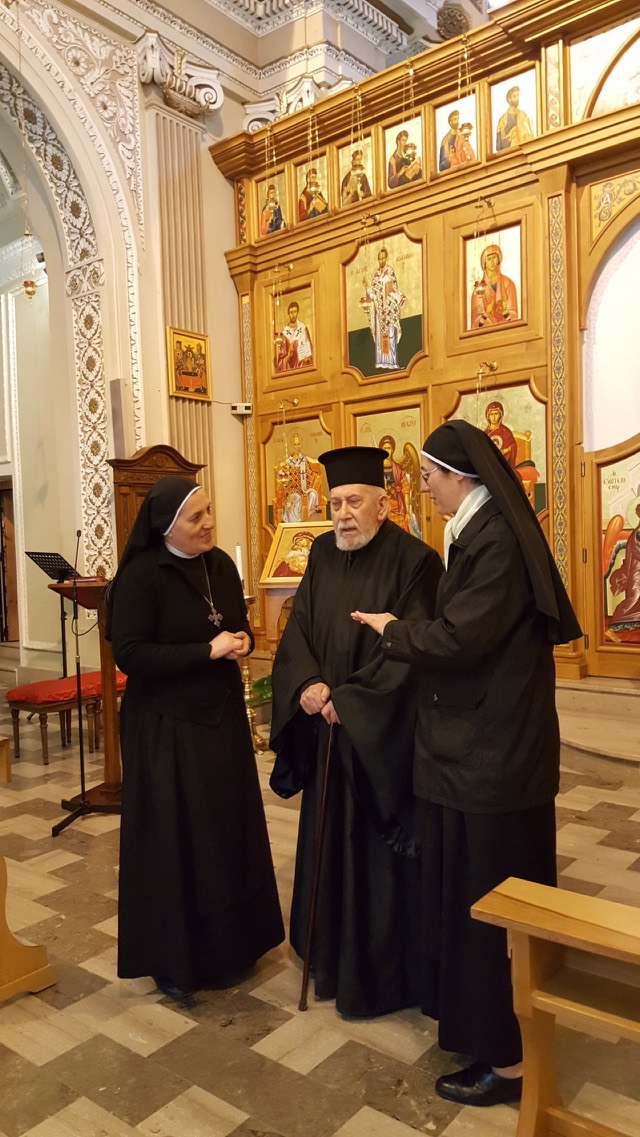
Albanian-speaking communities in southern Italy, settled from the 15th century and still speaking an archaic Tosk.
이 페이지에 오류가 있습니까? 수정 제안을 환영하며, 출처 기록과 대조하여 검토합니다. 잘못된 내용과 가능하다면 올바른 수치의 출처를 알려 주십시오.