Onderwerp
The Albanian Language
An independent branch of the Indo-European family with no close living relative, written in a 36-letter Latin alphabet.
Elke provincie, elke kust, elke eeuw
Begeleidende weergave
Nieuw in Albanië? Elke pagina begint met een uitleg in eenvoudige taal die u aan een tienjarige zou kunnen voorlezen, voordat de details beginnen.
Expertweergave
U kent de basis al. Meteen naar de kern, met de eenvoudige uitleg verborgen. Dit is de standaardinstelling.
Onderwerp
The forty or so words and phrases that cover most day-to-day exchanges for a visitor.
Opslaan
You do not need much Albanian to get by, but a few words go a long way. 'Faleminderit' means thank you. 'Përshëndetje' means hello. 'Ju lutem' means please. People are usually delighted when a visitor tries.
You do not need much Albanian to get by, but a few words go a long way. 'Faleminderit' means thank you. 'Përshëndetje' means hello. 'Ju lutem' means please. People are usually delighted when a visitor tries.
Albanian, known to its speakers as shqip, gjuha shqipe, or arbërisht, is an Indo-European language and the sole surviving representative of its own branch within that family. This branch belongs to the broader Paleo-Balkan grouping. Only two other living languages occupy analogously isolated positions as the lone survivor of their own Indo-European branches: Armenian and Greek.
The language is estimated to have as many as 7.5 million native speakers worldwide. Approximately 6 million of these live in the Balkans, primarily in Albania, Kosovo, North Macedonia, Serbia, Montenegro, and Greece. The worldwide figure is higher because of long-established diaspora communities in Italy dating to the era of Skanderbeg, and a large modern diaspora concentrated in the Americas, Europe, and Oceania.
Standard Albanian is the official language of Albania and Kosovo, and a co-official language in North Macedonia and Montenegro. It is recognised as a minority language in Italy, Croatia, Romania, and Serbia. Albanian-speakers do not correspond exactly to the ethnic Albanian population: many ethnic Albanians who identify as Albanian are no longer fluent in the language, particularly in Turkey and Egypt.
The place and time at which Albanian formed are uncertain. Albanian in antiquity is often thought to have descended from Illyrian, given geographic and historical proximity, but it is also proposed to derive from an otherwise unattested Balkan Indo-European language closely related to Illyrian and Messapic. In current phylogenetic classification, Albanian and Messapic are grouped together in a common branch, termed Illyric by Hyllested and Joseph (2022), on the basis of shared features and innovations.
In 1854, the philologist Franz Bopp demonstrated that Albanian is an Indo-European language. Scholars subsequently compared it with Germanic and Balto-Slavic, and separately with Latin, Greek, and Armenian. Current scholarship finds evidence that Albanian is closely related to Greek and Armenian. Hyllested and Joseph (2022) identify Greco-Phrygian as the Indo-European branch closest to the Albanian-Messapic one; together these form an areal grouping often called Balkan Indo-European, which also includes Armenian.
The American linguist Eric Hamp proposed that a pre-Albanian population he termed 'Albanoid' once inhabited areas stretching from Poland to the southwestern Balkans, in a mountainous rather than coastal or lowland environment. Vocabulary analysis partially supports this: words for plants and animals of mountainous regions are native, while words for fish and some agricultural activities are borrowed. However, scholars have argued this pattern reflects prolonged Latin domination of coastal and plain areas rather than indicating the original homeland environment. Words for 'ship', 'raft', 'navigation', and 'sea shelves' are native, suggesting proto-Albanian speakers were pushed from coastal areas after the Latin conquest of the region.
The first written mention of the Albanian language appears on 14 July 1284 in Ragusa (modern Dubrovnik, Croatia), where a crime witness named Matthew testified in Latin: 'I heard a voice crying on the mountain in the Albanian language' (Audivi unam vocem, clamantem in monte in lingua albanesca). A letter written by Dominican Friar Gulielmus Adea in 1332 mentions Albanians using the Latin alphabet in their writings, and a Franciscan monk signed as 'Broccardus' noted the same year that Albanians used Latin letters in all their books.
The oldest surviving text written in Albanian is the formula e pagëzimit (Baptismal Formula) of 1462, recorded by Pal Engjëlli, Archbishop of Durrës and a counsellor of Skanderbeg, in the Gheg dialect using Latin characters: Unte paghesont premenit Atit et Birit et Spertit Senit. This document was discovered and published in 1915 by Nicolae Iorga. Another early text is a short list of Albanian phrases with German glosses compiled by Arnold von Harff, dated 1496.
The first printed book in Albanian is the Meshari ('Missal') written by Gjon Buzuku between 20 March 1554 and 5 January 1555, in the Gheg dialect using the Latin script with some adapted Slavic letters. Its 188 pages contain approximately 154,000 words drawn from a total vocabulary of around 1,500 distinct words. The only known copy is held by the Apostolic Library. The first printed book in Tosk Albanian is the Mbsuame e krështerë (Dottrina cristiana) by Lekë Matrënga, published in 1592, written in an early form of the Arbëresh language.
Albanian has two principal dialect groups: Gheg, spoken to the north of the Shkumbin river, and Tosk, spoken to the south. The Shkumbin, a river approximately 181 kilometres long near the old Via Egnatia, forms the rough boundary between the two. The dialects are mutually intelligible in their standard varieties and are distinguished primarily by phonological differences. Gheg uses long and nasal vowels absent in Tosk, and the mid-central vowel ë is lost at the end of words in Gheg. The letter n in Gheg changes to r by rhotacism in Tosk (for example, femën in Gheg corresponds to femër in Tosk).
Gheg is divided into four sub-dialects: Northwest Gheg, Northeast Gheg, Central Gheg, and Southern Gheg. It is spoken in northern Albania, Kosovo, Montenegro, and northwestern North Macedonia. A particularly divergent variety is the Upper Reka dialect, classified as Central Gheg. A diaspora Gheg variety, the Arbanasi dialect, is spoken in Croatia.
Tosk is divided into five sub-dialects: Northern Tosk (the most numerous in speakers), Labërisht, Cham, Arvanitika, and Arbëresh. Tosk is spoken in southern Albania, southwestern North Macedonia, and parts of Greece. The characteristics of both dialects in their treatment of native words and loanwords indicate that the split between north and south occurred after the Christianisation of the region in the 4th century AD, and most likely no later than the 6th century AD. The dialects have thus occupied roughly their present areas, divided by the Shkumbin, since the Post-Roman and Pre-Slavic period.
Centuries-old Albanian-speaking communities are found in Greece (the Arvanites and some communities in Epirus, Western Macedonia, and Western Thrace), Croatia (the Arbanasi), and Italy (the Arbëreshë). The Arbëreshë of Italy, who number approximately 500,000 and are scattered across southern Italy, descend from migrants who settled in southeastern Italy in the 15th and 16th centuries, principally in Sicily and Calabria. They speak an archaic variety of Tosk called Arbëresh, which has absorbed Italian vocabulary over time. Italy also hosts around 1 million more recent Albanian immigrants, making Albanian the third most common mother tongue among foreign residents there.
In Switzerland, Albanian is the sixth most spoken language, with 176,293 native speakers recorded. Approximately 1 million Albanians from Kosovo are dispersed throughout Germany, Switzerland, and Austria, predominantly immigrants who left during the 1990s. In the United States and Canada, there are approximately 250,000 Albanian speakers, concentrated on the East Coast in cities including New York City, Boston, Chicago, Philadelphia, and Detroit. In Argentina, nearly 40,000 Albanian speakers live mostly in Buenos Aires.
Approximately 1.3 million people of Albanian ancestry live in Turkey, though estimates of those with Albanian ancestry or background run as high as 5 million; the vast majority are assimilated and no longer speak Albanian fluently. Egypt has approximately 18,000 Albanian speakers, mostly Tosk, many of them descendants of the followers of Muhammad Ali Pasha, an Albanian who became Wāli and self-declared Khedive of Egypt and Sudan. Albanian is also spoken by diaspora communities in Australia and New Zealand.
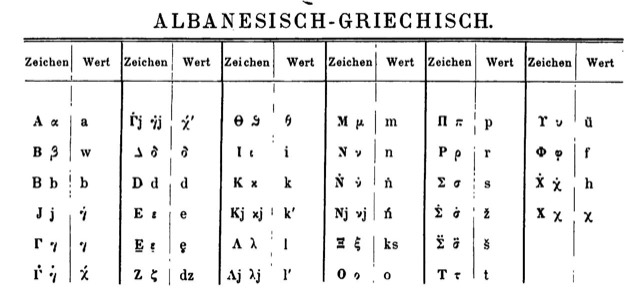
Albanian has been written in many different scripts since the earliest attested records in the 15th century. The earliest written records come from the Gheg area in improvised spellings based on Italian or Greek. Tosk was originally written in the Greek alphabet and Gheg in Latin script; both dialects were also written in the Ottoman Turkish version of the Arabic script, in Cyrillic, and in several locally invented alphabets, including those known as Elbasan, Vithkuqi, Todhri, Veso Bey, and Jan Vellara. The choice of script broadly followed religious affiliation: Catholic writers in northern Albania used Latin letters, Orthodox writers in the south used Greek letters, and Muslims throughout Albania used Arabic letters.
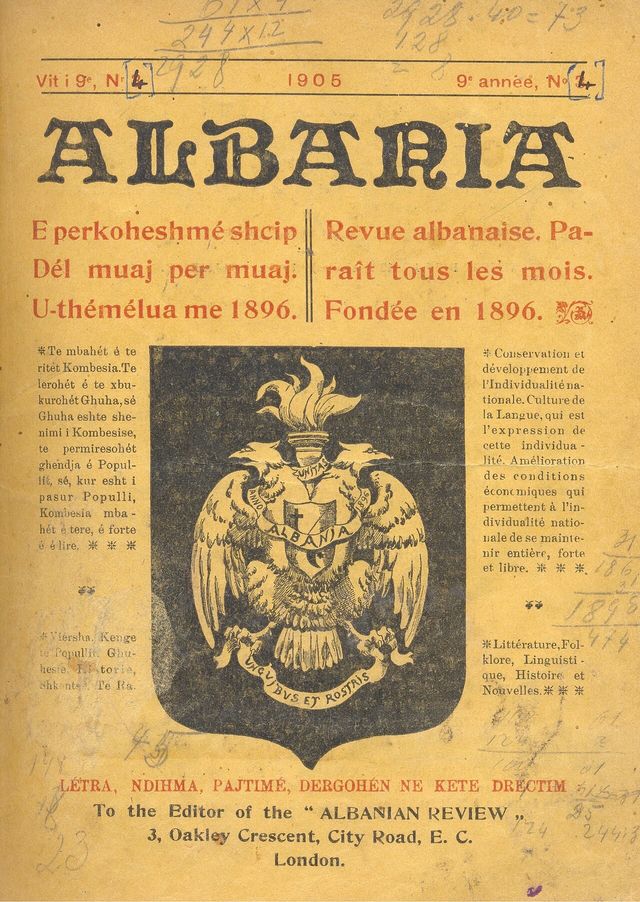
Attempts to create a unified original Albanian alphabet were made during the period 1750–1850. These efforts intensified after the League of Prizren and culminated in the Congress of Manastir, held from 14 to 22 November 1908 in Manastir (present-day Bitola). The Congress decided on a standardised alphabet and spelling for Standard Albanian. The result is the Latin alphabet with the addition of the letters ë and ç, and nine digraphs: dh, gj, ll, nj, rr, sh, th, xh, and zh.
Robert Elsie, a specialist in Albanian studies, described the century between 1750 and 1850 as 'an age of astounding orthographic diversity', during which Albanian was committed to writing in at least ten different alphabets, which he considered a record for European languages.
Before the early 20th century, Albanian writing developed in three main literary traditions: Gheg, Tosk, and Arbëreshë. The Congress of Manastir in 1908 recommended the Elbasan subdialect of southern Gheg, which is phonologically closer to Tosk, as the basis for a unified national language. Between 1916 and 1918, the Albanian Literary Commission met in Shkodër under Luigj Gurakuqi and reaffirmed the Elbasan subdialect, publishing orthographic rules for it in 1917. Kosovo and other Albanian-speaking areas in Yugoslavia followed this 1917 standard until 1968.
After World War II, the new communist government in Albania imposed the Tosk dialect across administration, education, and literature. Most Communist leaders were Tosks from the south. New orthography rules were published in 1967 and 1973 in the Drejtshkrimi i gjuhës shqipe. Kosovo adopted the Tosk-based standard in 1969, after a period of developing a distinct Kosovan norm; Kosovars adopted Tirana's Tosk project, which then became the 'unified literary language' in 1972 when approved by an Orthography Congress held in Tirana, at which only about 1 in 9 participants were from Kosovo.
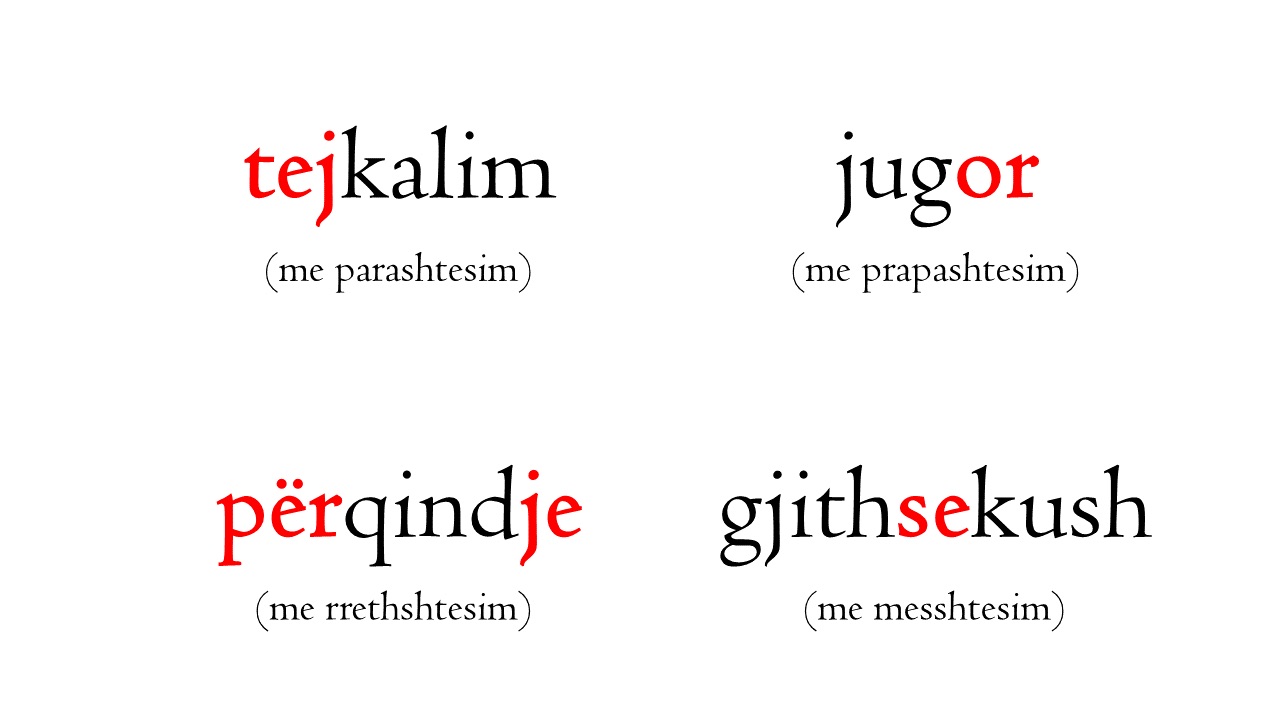
Since the fall of the communist regime, the orthography has been the subject of significant public and scholarly debate in Albania and Kosovo. Critics argue that Standard Albanian marginalises Gheg speakers and excludes the 'me + participle' infinitive form and Gheg vocabulary, impairing effective public communication. Supporters regard the 1972 Congress as a historic achievement. In 2013, a group of academics from Albania and Kosovo proposed minor orthographic changes; hardline academics boycotted the initiative, while other reformers considered it superficial.
Standard Albanian has seven vowels and 29 consonants. Like English, it has dental fricatives represented by the digraphs th and dh. Stress in Albanian normally falls on the penultimate syllable, unless the final syllable is open and ends in a, i, or u, or is closed with a vowel other than schwa, in which case the final syllable is stressed. The canonical word order is subject-verb-object, as in English, though Albanian word order is relatively free, and all six possible arrangements of subject, verb, and object are grammatically permissible with slight pragmatic differences.
Albanian nouns are categorised by gender (masculine, feminine, and neuter) and inflected for number and case. There are five declensions and six cases: nominative, accusative, genitive, dative, ablative, and vocative, though the vocative occurs with only a limited set of words and the genitive and dative share identical forms. Some dialects retain a locative case absent from the standard language. The definite article is suffixed to the noun rather than placed before it, a feature shared with Romanian, Macedonian, and Bulgarian. Albanian is the only Balkan language to have preserved a Pre-Indo-European vigesimal (base-20) counting system: njëzet means 'twenty' and dyzet means 'forty'; the Arbëreshë in Italy and Arvanites in Greece may still use trezet for sixty and katërzet for eighty.
Albanian has a distinctive set of verb forms called miratives or admiratives, which are unique in the Balkan context. These forms may express surprise, irony, doubt, or neutral reportedness on the part of the speaker. The system of moods (six types) and tenses (three simple and five complex constructions) is distinctive among Balkan languages. Verbal negation is mood-dependent: in indicative, conditional, and admirative sentences the particles nuk or s' precede the verb, while subjunctive, imperative, optative, and non-finite forms are negated with mos.
Albanian is regarded by historical linguists as a language that absorbed an exceptionally high proportion of loanwords while maintaining continuous use through prolonged foreign rule. The most extensive influence was Latin, with some scholars estimating Latin loans at as much as 60% of the Albanian vocabulary — a figure that led early observers to classify Albanian mistakenly as a Romance language. Latin loanwords include core vocabulary items such as shumë ('very', from Latin summus), pak ('few', from paucus), pemë ('tree', from poma), and vij ('to come', from venio). Jernej Kopitar (1780–1844) was the first to examine Latin's influence systematically, noting that Albanian preserves the pronunciation of Latin as it sounded in the time of Emperor Augustus. About 85 Latin words survive in Albanian but not as inherited vocabulary in any Romance language; 151 Albanian words of Latin origin were not inherited in Romanian.
There are around 30 Ancient Greek loanwords in Proto-Albanian, many relating to commodity items and trade, including drapër ('sickle'), mollë ('apple'), and presh ('leek'). After the Slavic migrations, Albanian absorbed heavily from South Slavic for approximately four centuries; Vladimir Orel (1998) counted around 556 Slavic loanwords. The Ottoman period added Turkish words as well as Persian and Arabic terms through Turkish; Emanuele Banfi (1985) estimated around two thousand Turkish loanwords, with the total considerably higher when obsolete and dialectal forms are included. Albanian also possesses a small number of Gothic loanwords, attributed by Martin Huld to contact during Gothic invasions of the Balkans in the late 4th and early 5th centuries under Alaric, Odoacer, and Theodoric.
Some words in Albanian's core vocabulary have no known etymology linking them to Proto-Indo-European or any identified source language. As of 2018, words including zemër ('heart') and hekur ('iron') are tentatively attributed to an unknown pre-Indo-European substrate. Certain pre-IE substrate words in Albanian have been tentatively linked to substrate words in neighbouring languages, such as lule ('flower'), which has been connected with Latin lilia and Greek leirion. Lexicostatistical analysis by Ukrainian linguist Tyshchenko places Albanian closest to Slovenian (49% lexical distance) and Romanian (53%), and most distant from Bulgarian and Macedonian (both 86%) among the languages studied.
Onderwerp
An independent branch of the Indo-European family with no close living relative, written in a 36-letter Latin alphabet.
Onderwerp
Thirty-six letters agreed at the Congress of Monastir in 1908, replacing competing Arabic, Greek and Latin scripts.
Gids
What to know before you book: how you get in, how you move around, what things cost, and what the country is not.
Iets onjuist op deze pagina? Correcties zijn welkom en worden gecontroleerd aan de hand van de bronregistratie. Laat ons weten wat onjuist is en, indien mogelijk, waar het juiste cijfer vandaan komt.