历史时期
The Albanian National Awakening
The Rilindja: the League of Prizren, the fight for an alphabet, and the first Albanian-language school.
每个县、每段海岸、每个世纪
引导视图
初次了解阿尔巴尼亚?每个页面均以通俗易懂的说明开篇——即便是十岁的孩子也能读懂——随后再展开详细内容。
专业视图
您已掌握基础知识。直接进入正题,简明解释默认隐藏。此为默认模式。
主题
Thirty-six letters agreed at the Congress of Monastir in 1908, replacing competing Arabic, Greek and Latin scripts.
保存
Albanian is written with 36 letters. Nine of them are made of two letters that count as one: dh, gj, ll, nj, rr, sh, th, xh and zh. Before 1908 people wrote Albanian in several different alphabets, so a meeting in Monastir chose one for everybody.
Albanian is written with 36 letters. Nine of them are made of two letters that count as one: dh, gj, ll, nj, rr, sh, th, xh and zh. Before 1908 people wrote Albanian in several different alphabets, so a meeting in Monastir chose one for everybody.
The Albanian alphabet (Albanian: abetarja shqipe) is a 36-letter variant of the Latin script used to write Standard Albanian. Each letter represents a distinct phoneme of the language. Letters are named by their sounds, with consonants followed by the vowel ë — for example, the letter sh is named shë.
Nine of the 36 letters are digraphs: dh, gj, ll, nj, rr, sh, th, xh, and zh. These two-character combinations each represent a single sound not covered by a single Latin letter, a design inherited from the Bashkimi alphabet tradition that preceded full standardisation.
The earliest known reference to Albanian writing appears in a French Catholic church document from 1332, attributed either to Archbishop Guillaume Adam or the monk Brocardus Monacus. The document states that Albanians used Latin letters in all their books, though scholars note that this could mean Albanians wrote in the Latin language itself, not necessarily Albanian text rendered in Latin script.
The oldest surviving document containing certain Albanian text is the Formula e pagëzimit (baptismal formula) of 1462, issued by Pal Engjëlli (1417–1470) and written in Latin characters. It was a brief phrase intended for use by relatives of a dying person when access to a church was impossible during the Ottoman invasion.
The five principal writers of 16th- and 17th-century Albanian literature — Gjon Buzuku, Lekë Matrënga, Pjetër Budi, Frang Bardhi, and Pjetër Bogdani — all employed a Latin alphabet for their Albanian works. This alphabet remained in use by writers in northern Albania until the early 20th century.
For several centuries, the choice of script for written Albanian was determined largely by religious affiliation. Writers in northern Albania, under the influence of the Catholic Church, used Latin letters. Writers in southern Albania, under the Greek Orthodox Church, used Greek letters. A third group used Arabic letters under Islamic influence.
The conditions for an Albanian literature in Greek script were particularly unfavourable. As albanologist Robert Elsie has written, the Orthodox Church was never convinced of the utility of writing in the vernacular as a means of converting the masses, and southern Albanians lacked publishing facilities comparable to those available to Catholic Albanian clerics in Venice and Dalmatia. With the exception of the printing press at Voskopojë, Orthodox Albanian writing remained largely confined to translations of religious texts and the compilation of dictionaries.
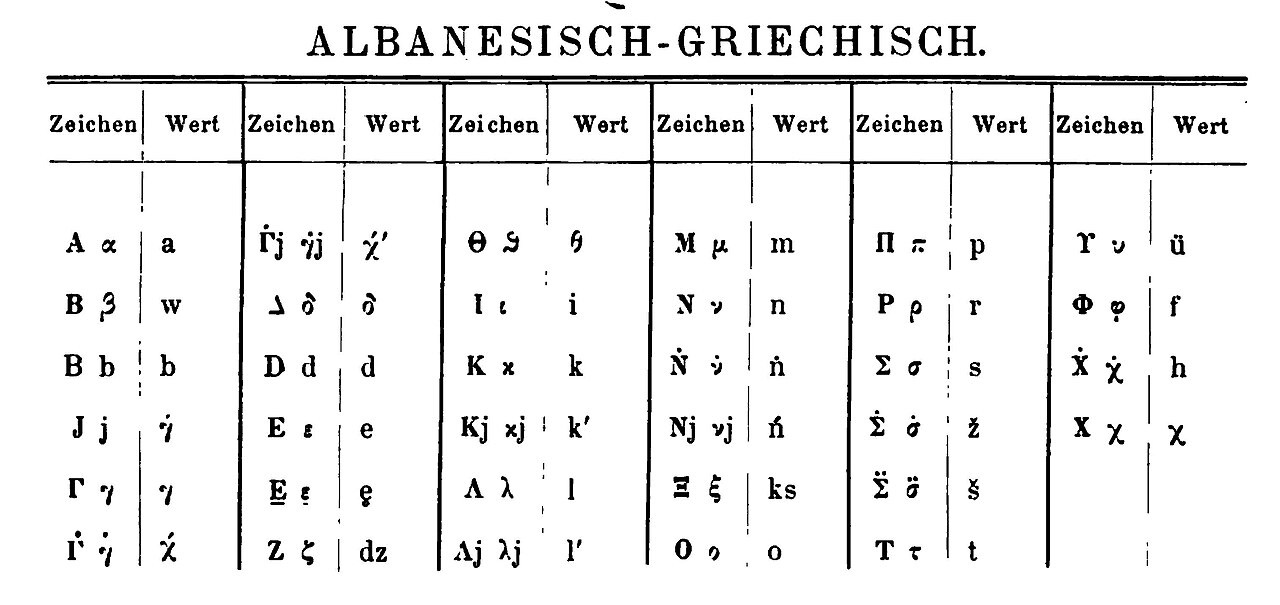
The Greek script was used to write Tosk Albanian from approximately 1500. The printing press at Voskopojë published several Albanian texts in Greek script during the 18th century. The Ottoman Turkish (Arabic-derived) alphabet was also used from the 19th century onward, with a primer published in 1861 in Constantinople by Daut Boriçi and a final version published in 1911 by Rexhep Voka.
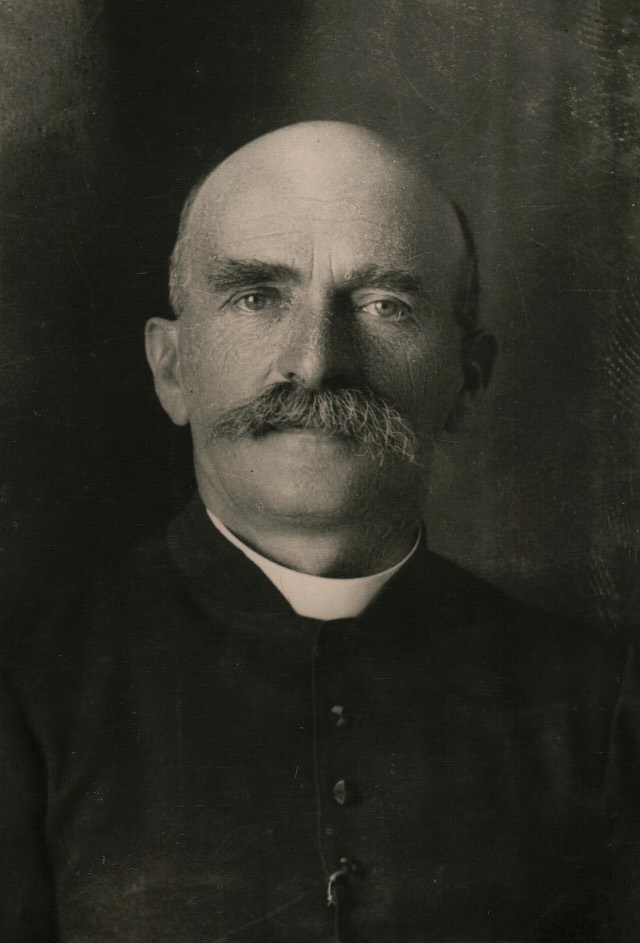
In 1857, Albanian scholar and translator Kostandin Kristoforidhi drafted a memorandum on the Albanian language in Istanbul. He subsequently spent time at a Protestant seminary in Malta until 1860, completing translations of the New Testament in both the Tosk and Gheg dialects. Nikolla Serreqi of Shkodër assisted with the Gheg version and promoted the use of Latin script, an idea Kristoforidhi embraced.
In November 1869, a Commission for the Alphabet of the Albanian Language convened in Istanbul. Kristoforidhi was among its members. By January 1870, the commission had produced a standardised alphabet based primarily on Latin letters and drafted a plan for Albanian-language textbooks and schools. The plan was not realised because the Ottoman government declined to finance the establishment of such schools.
The pivotal shift came after the League of Prizren events of 1878. In 1879, Sami Frashëri and Naim Frashëri formed the Society for the Publication of Albanian Writings. Sami Frashëri, Koto Hoxhi, Pashko Vasa, and Jani Vreto created what became known as the Istanbul alphabet (also called the Frashëri alphabet), based on the principle of one sound per letter. By 1905, this alphabet was in widespread use across all Albanian territory — northern and southern, Catholic, Muslim, and Orthodox areas alike.
The Congress of Manastir was held from 14 to 22 November 1908 in Manastir (present-day Bitola, North Macedonia), convened by Albanian intellectuals and hosted by the Bashkimi ('Unity') club. Prominent delegates included Gjergj Fishta, Ndre Mjeda, Mit'hat Frashëri, Sotir Peçi, Shahin Kolonja, and Gjergj D. Qiriazi. The three competing alphabets under consideration were the Istanbul, the Bashkimi, and the Agimi.
The Congress could not reach a definitive decision and adopted a compromise: both the widely used Istanbul alphabet (with minor changes) and a modified version of the Bashkimi alphabet were approved. In practice, the Istanbul alphabet declined rapidly in the following decades, largely because it required custom-made glyphs that the Bashkimi alphabet did not.
A second congress at Manastir was held in April 1910 and confirmed the decisions of the first. After Albanian independence in 1912, two alphabets remained in use. Following the disruptions of the Balkan Wars and World War I, the Bashkimi variant came to dominate. The Bashkimi alphabet is the direct origin of the official Albanian alphabet in use today.
During 1909 and 1910, members of the Young Turks movement attempted to promote the adoption of an Arabic alphabet, regarding Latin script as un-Islamic. Demonstrations in favour of the Latin script took place in Korçë and Gjirokastër, while in Elbasan, Muslim clerics led a counter-demonstration for the Arabic script. In 1911, the Young Turks abandoned their opposition to the Latin script, and the Latin Bashkimi alphabet was adopted definitively.
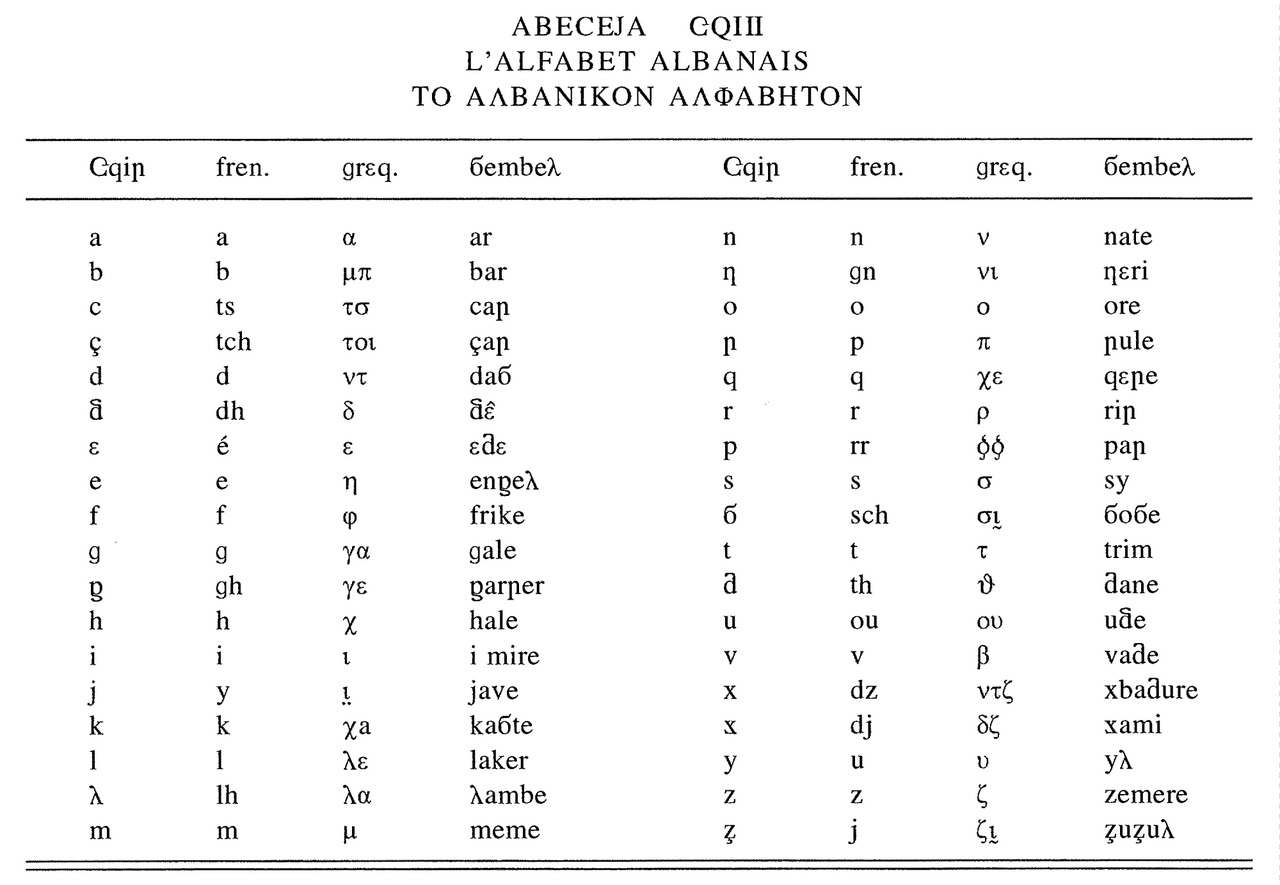
The Bashkimi alphabet was developed by the Albanian literary society Bashkimi (Unity) in Shkodër, with the involvement of Catholic clergy and Franciscans. It was designed for use on a French typewriter and includes no diacritics other than é, compared with ten non-standard or diacritic graphemes in the Istanbul alphabet. It used digraphs for sounds distinctive to Albanian and closely resembles the current alphabet.
The principal differences between Bashkimi and the current standard include: ch for ç, c for q, ts for c, é for e, e for ë, gh for gj, gn for nj, and swapped positions for z/zh and x/xh. The choice of ç over ch in the final standard was made because the c with cedilla was available on every typewriter due to its use in French.
The Agimi alphabet was developed in 1901 by the Agimi ('Dawn') Literary Society, with Ndre Mjeda as its leading figure. Rather than digraphs, Agimi used diacritics to represent Albanian sounds. It was one of the three alphabets debated at the Congress of Manastir, and some of its characters were incorporated into modifications made to the Bashkimi alphabet after the congress.
Seven original Albanian scripts have been identified by researchers. The Elbasan script, dating to the 18th century, was used to write the Elbasan Gospel Manuscript and is widely attributed to Gregory of Durrës. According to Robert Elsie, it is well suited to Albanian phonology, employing one character per phoneme with minor exceptions, and using dots over characters to distinguish r from rr and l from ll. The front page of the same manuscript contains a dozen words in an entirely different, as yet undeciphered script; Elbasan scholar Dhimitër Shuteriqi (b. 1915) has attempted a reading without resolution.
The Todhri script of the 18th century is attributed to Theodhor Haxhifilipi and was discovered by Austrian consul Johann Georg von Hahn (1811–1869), who published it in his Albanesische Studien (Jena, 1854), treating it as a derivative of ancient Phoenician script. Leopold Geitler (1847–1885) later regarded it as derived primarily from Roman cursive. The Todhri script comprises 52 characters and was used sporadically for written communication in and around Elbasan from the late 18th century; it does not conform as well to Albanian as the Elbasan Gospel script.
The Vithkuqi (Veqilharxhi) alphabet was developed between 1824 and 1844 by Naum Veqilharxhi, who had it printed in an eight-page Albanian spelling book in 1844. The booklet was distributed across southern Albania, from Korçë to Berat. A second edition of 48 pages appeared in 1845. The alphabet's spread was limited by the author's death the following year and by the prohibitive cost of producing a new printing font. The Codex of Berat, a 154-page paper manuscript now held in the National Library of Tiranë, contains on page 104 two lines of Albanian in an original 37-letter script apparently influenced by Glagolitic. The manuscript is commonly attributed to Constantine of Berat (c. 1745–c. 1825), though there is no evidence he was its author. Recent observations suggest this script had a wider usage, including in Elbasan and possibly Voskopojë.
The Vellara script, named after Greek doctor and writer Ioannis Vilaras (Albanian: Jan Vellara), is found in 86 pages of bilingual grammatical notes dated 1801. Vilaras, who studied medicine in Padua in 1789, was not a native Albanian speaker; his notes were designed to teach Greek speakers Albanian. The Albanian text is in a Tosk dialect written in a 30-letter script based primarily on Latin with some Greek influence. The manuscript was donated to the Bibliothèque Nationale in Paris in 1819 by François Pouqueville (1770–1839), French consul in Janina. The Veso Bey script is attributed to Veso Bey of Gjirokastër, who reportedly learned it in his youth from an Albanian hodja as a hereditary secret script used for family correspondence.
Before standardisation, the specific sounds of Albanian were rendered inconsistently across publications. Because the earliest Albanian writers were educated in Italy, letter values initially followed Italian conventions. The present-day letter c was written as z, and ç was written as c as late as 1895. The letter ç itself was first used by Frashëri in 1879. The sound now written q appeared in numerous forms — including ch, chi, k, ky, kj, and ḱ — before Frashëri introduced q in his 1879 Istanbul alphabet.
The digraph dh was originally represented by a character resembling the Greek letter xi (ξ), doubled (ξξ) for th; these characters were used as late as 1895. William Martin-Leake first used dh and th in their modern forms in 1814. The letter ë was not consistently distinguished from e until Rada introduced ë in 1870; earlier representations included æ (Matranga, 1592), ė, ö, υ, œ, and ə.
The digraph rr was first used by Blanchi (1635), but the sound was subsequently represented by Greek rho (ρ), ṙ, rh, r̄, and a modified p (Frashëri). The 1908 revision at Manastir replaced Frashëri's ρ with the rr digraph to avoid confusion with p. The digraph sh was first used by Rada in 1866; nj was first used in the Grammaire albanaise of 1887, as was xh. The letter z in its modern use was introduced by Leake in 1814.
Kostandin Kristoforidhi's Albanian dictionary (Fjalori i Gjuhës Shqipe) was published in 1904, one year after his death, having been drafted approximately 25 years before publication. Despite Kristoforidhi's personal advocacy for the Latin script, the dictionary was written in the Greek alphabet.
The Society for the Publication of Albanian Writings, formed in 1879 by Sami Frashëri and Naim Frashëri, printed Alfabetare — described as the first Albanian abecedarium — in that same year using the Istanbul alphabet. This society's adoption of the Istanbul alphabet contributed significantly to its widespread use across Albanian-speaking territories by 1905. The Greek intellectual Anastasios Michael, in a speech to the Berlin Academy around 1707, had mentioned an Albanian alphabet produced 'recently' by Kosmas from Cyprus, bishop of Dyrrachium, calling Kosmas the 'Cadmus of Albania'; this is assumed to be the alphabet later used in the Elbasan Gospel Manuscript.
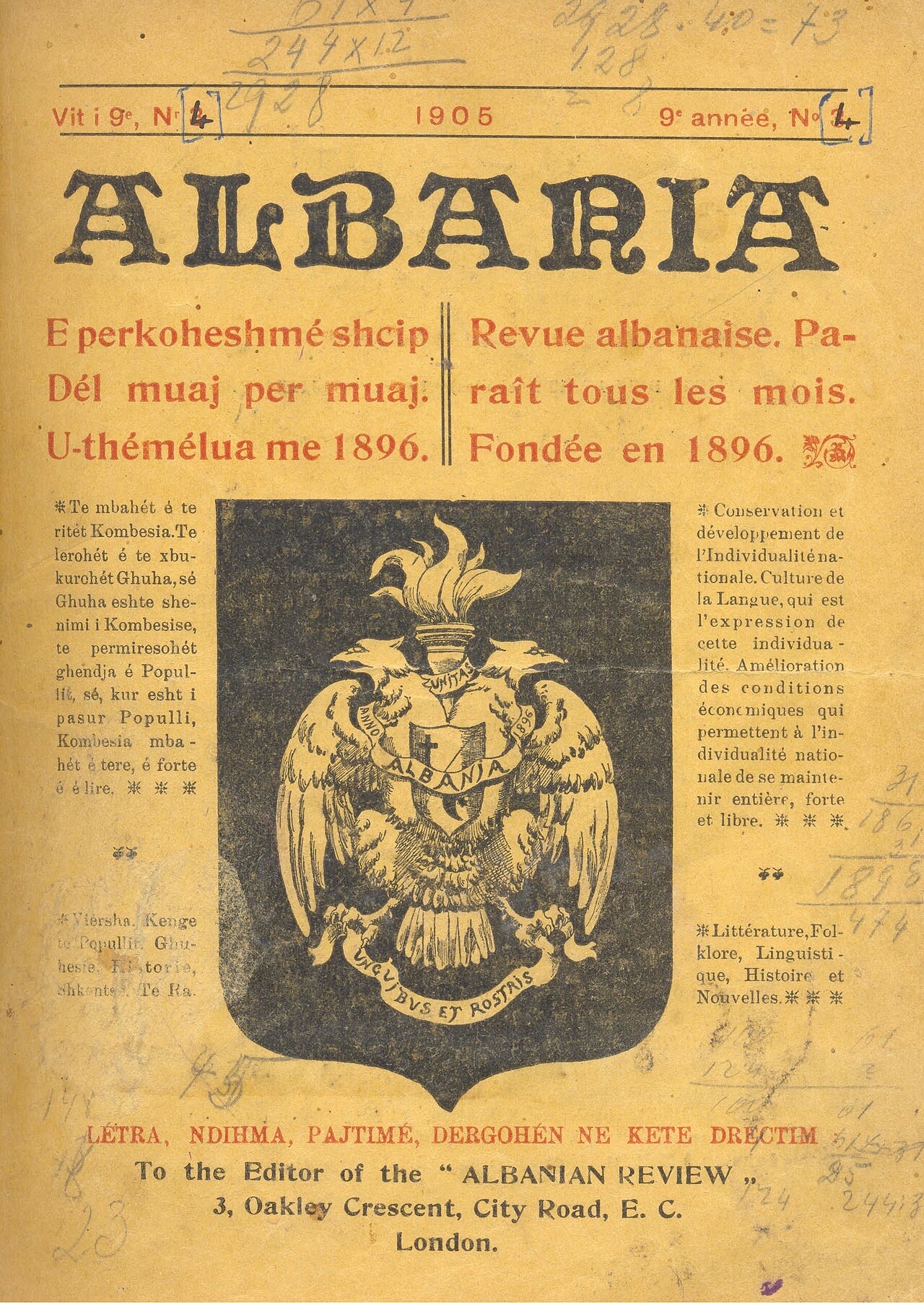
历史时期
The Rilindja: the League of Prizren, the fight for an alphabet, and the first Albanian-language school.
主题
An independent branch of the Indo-European family with no close living relative, written in a 36-letter Latin alphabet.
主题
The forty or so words and phrases that cover most day-to-day exchanges for a visitor.
专题解析
Why the same town appears as Vlorë and Vlora, and what the endings tell you.
本页内容有误? 欢迎提交更正意见,所有意见均会与原始记录核对。请告知错误所在,如能提供正确数据的出处,请一并注明。