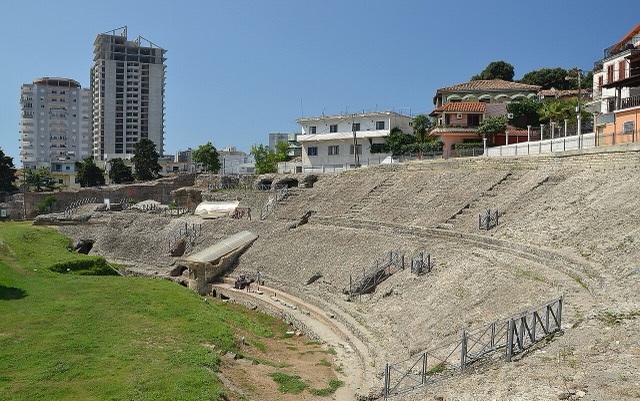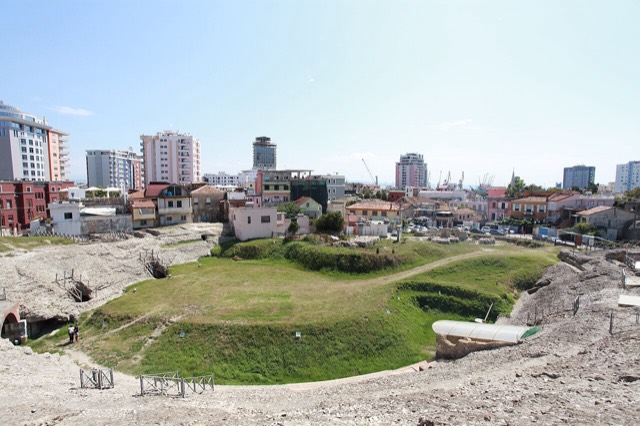
Ville · Durrës
Durrës
Albania's principal port and its oldest continuously inhabited city, founded as Epidamnos in 627 BC.
Chaque comté, chaque côte, chaque siècle
Vue guidée
Nouveau en Albanie ? Chaque page s'ouvre sur une explication en langage clair, accessible à un enfant de dix ans, avant d'entrer dans le détail.
Vue expert
Vous connaissez déjà les bases. Directement à l'essentiel, les explications simples étant masquées. Il s'agit du réglage par défaut.
Site historique · Durrës County
Byzantine sea walls raised under Anastasius I, later strengthened by Venice and the Ottomans.
Enregistrer
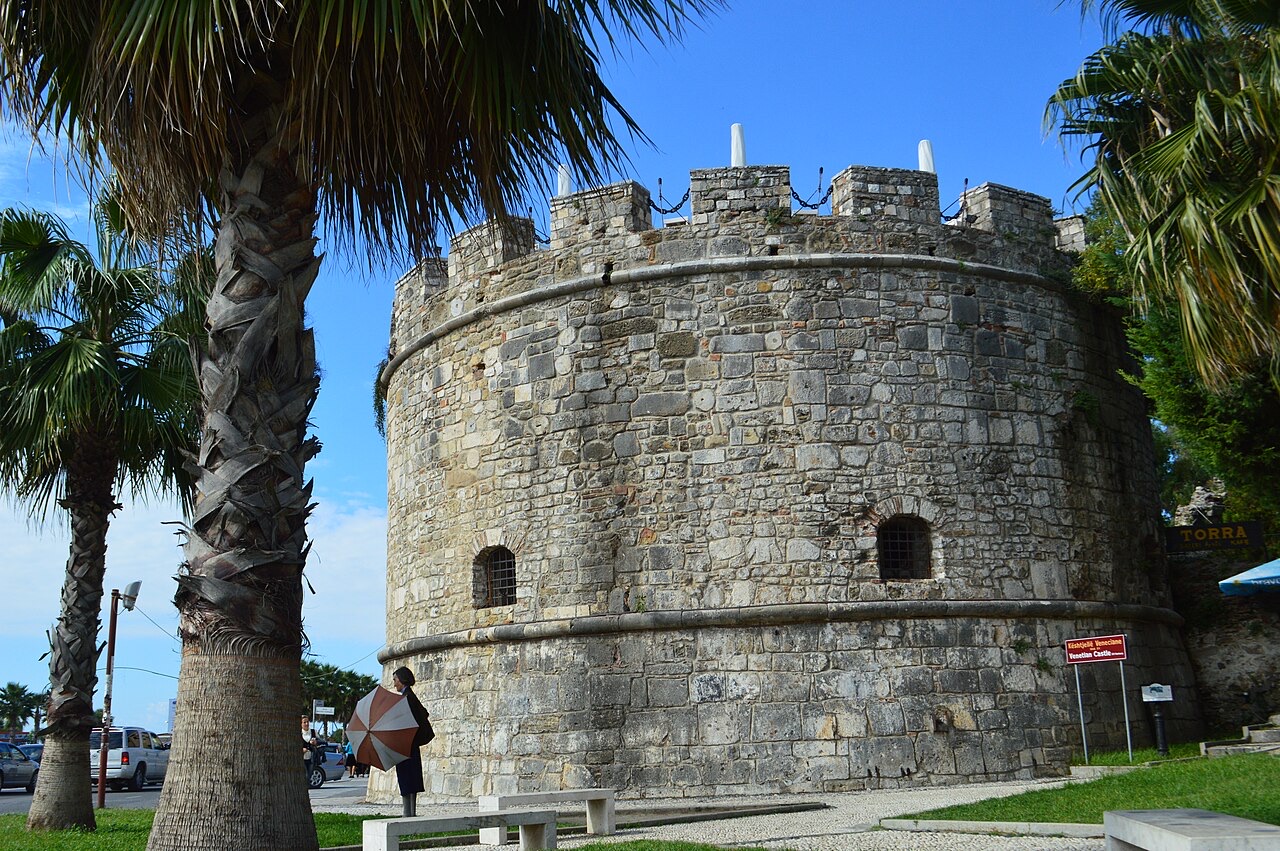
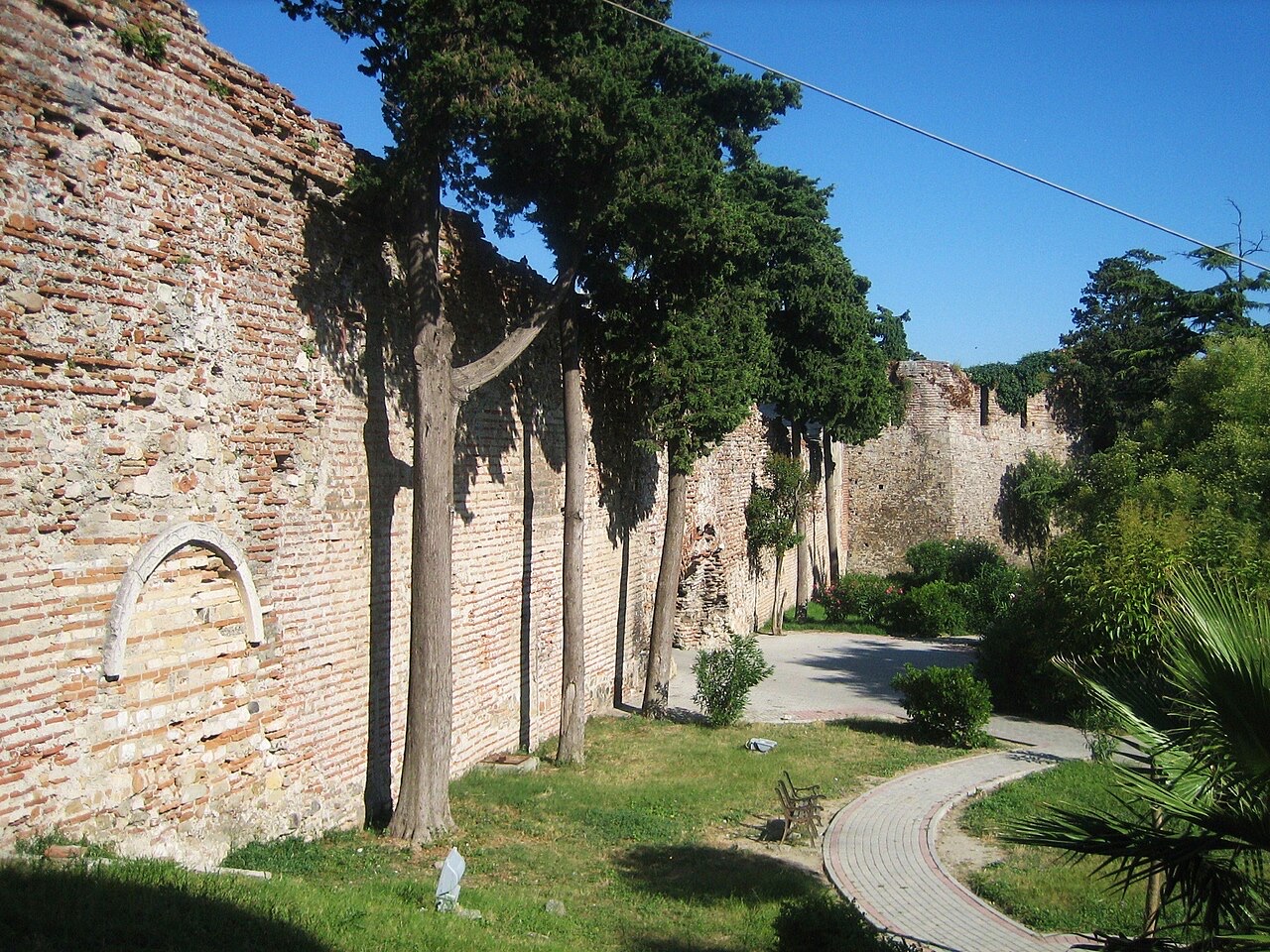
Parts of the old city walls of Durrës still stand, including a round Venetian tower now used as a bar. They were first built around AD 500 by an emperor who was born in the city.
Parts of the old city walls of Durrës still stand, including a round Venetian tower now used as a bar. They were first built around AD 500 by an emperor who was born in the city.
Durrës Castle — Albanian: Kalaja e Durrësit — is the fortified old city of Durrës, Albania. Its defining feature is a circuit of city walls constructed in the late fifth century under the Byzantine Emperor Anastasius I, who reigned from 491 to 518. Anastasius was a native of Durrës, the ancient city of Dyrrhachium, born into an Illyro-Roman family, and he directed particular attention to its defences.
Under Anastasius, Durrës was made one of the most fortified cities on the Adriatic coast. As part of the same programme, a second, smaller castle was constructed approximately seven kilometres north of the city, at the site known today as Porto Romano — meaning 'The Roman's Gate'.
The thickness and scale of the original walls drew comment from Byzantine princess and historian Anna Komnene, who recorded them in her chronicle the Alexiad, written in the eleventh century. She described the walls as having been so thick that four horsemen could ride abreast on top of them, a detail that gives some indication of their extraordinary dimensions relative to contemporary fortifications.
This account provides one of the earliest textual references to the castle's physical character and points to the walls' strategic importance on the Adriatic during the Byzantine period.
The ancient walls suffered severe damage in an earthquake in 1273. The destruction was extensive enough to require major repair work rather than simple maintenance. The earthquake represents a significant interruption in the continuity of the fortifications as originally built under Anastasius I, meaning that portions of what was subsequently standing reflected post-disaster reconstruction rather than purely fifth-century construction.
In 1392 the Venetians seized Durrës from Gjergj Thopia. Following their acquisition of the city, Venetian authorities undertook improvements to the existing fortifications, reinforcing the walls with several guard towers. The castle remained under Venetian sovereignty for over a century.
Venetian control ended in 1501, when Durrës fell to the Ottoman Empire. The city would remain under Ottoman rule until 1912, a period of more than four hundred years.
During the long period of Ottoman rule, the walls of Durrës Castle were reinforced again, continuing the pattern of successive powers modifying and strengthening the fortifications they inherited. The castle thus represents accumulated construction work spanning the late fifth century through to the early modern period.
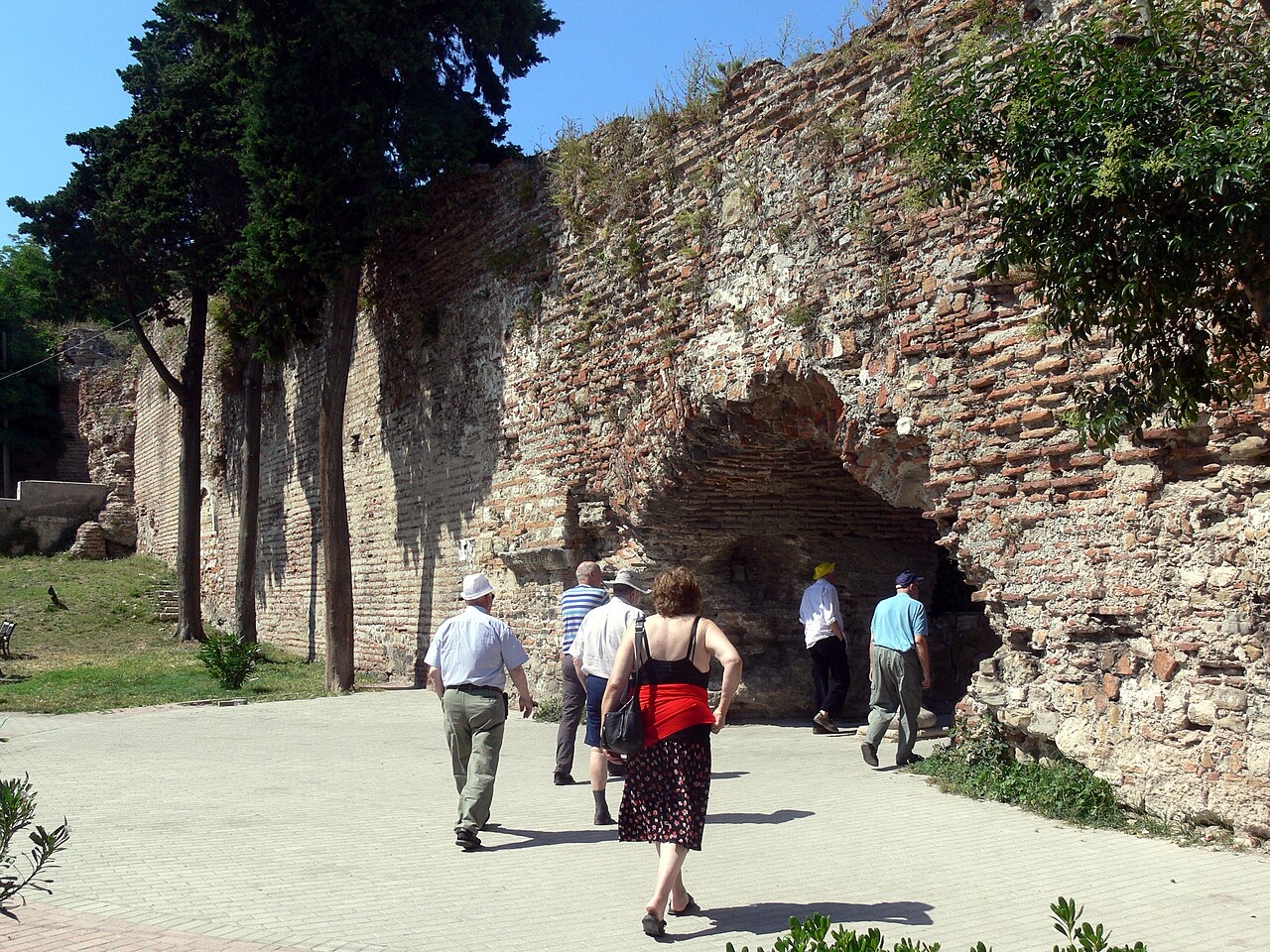
As of the time of writing, the medieval walls stand at nearly 15 feet, or approximately 4.6 metres, in height. Three entrances belonging to some of the fortification towers survive. The preserved sections amount to nearly one-third of the original total length of the city walls.
On 7 April 1939, Italian forces launched their invasion of Albania, landing at Durrës. A defending force of only 360 Albanians — composed mainly of gendarmes and townspeople — attempted to halt the advance. The defence was led by Abaz Kupi, the commander of the gendarmerie in Durrës, and Mujo Ulqinaku, a marine official.
The defenders were armed only with small arms and three machine guns. Despite the disparity in resources, they succeeded in keeping the Italian forces at bay for several hours. Resistance diminished after a large number of light tanks disembarked from Italian naval vessels. Within five hours of that development, Italian forces had captured the entire city.
The fortified area enclosed by the walls constitutes the old city of Durrës. The walls were built in the late fifth century and subsequently repaired and reinforced in the medieval and early modern periods, meaning the current fabric is the product of multiple construction phases across roughly fifteen centuries.
Three entrances associated with some of the fortification towers are preserved within the surviving one-third of the original wall length, giving visitors and researchers access to distinct segments of the circuit.
In February 2022 it was announced that the United Nations Office for Project Services (UNOPS) would begin a restoration project focused on Durrës Castle, specifically targeting the main Durrës tower. The project was organised under the EU4Cult Group in Albania.
The planned duration of the restoration was six months. The stated cost of investment for the project was 675,000 euros. The work was intended to conserve and upgrade the tower's infrastructure, incorporating both digital and conventional interpretive elements alongside other modern additions to support the structure's function as a cultural site.
A primary stated objective of the 2022 restoration project was to convert the Durrës tower into the first heritage interpretation centre in Albania. This represented a shift in the tower's role from a preserved monument to an active site of cultural interpretation.
The project combined physical conservation of the historic fabric with the introduction of new interpretive infrastructure. Whether digital or classical in form, these additions were planned to make the tower's history accessible to a general audience while preserving the integrity of the underlying structure.
Durrës Castle represents one of the earliest large-scale Byzantine fortification projects on the eastern Adriatic coast, directly commissioned by an emperor with personal ties to the city. Its walls were subsequently modified by Venetian and Ottoman administrations, making it a material record of the successive powers that controlled the city between the fifth and early twentieth centuries.
The site also carries significance for modern Albanian national history because of the 1939 battle. The defence mounted by Abaz Kupi, Mujo Ulqinaku, and the 360 defenders at the castle's approaches has entered the record of Albanian resistance to the Italian invasion, anchoring the site in both ancient and twentieth-century history.
Ville · Durrës
Albania's principal port and its oldest continuously inhabited city, founded as Epidamnos in 627 BC.
Site historique · Durrës
The largest Roman amphitheatre in the Balkans, found by accident in 1966 under the modern city.
Une erreur sur cette page ? Les corrections sont les bienvenues et sont vérifiées par rapport au document source. Indiquer ce qui est erroné et, si possible, d'où provient le chiffre correct.