Onderwerp
The Albanian Language
An independent branch of the Indo-European family with no close living relative, written in a 36-letter Latin alphabet.
Elke provincie, elke kust, elke eeuw
Begeleidende weergave
Nieuw in Albanië? Elke pagina begint met een uitleg in eenvoudige taal die u aan een tienjarige zou kunnen voorlezen, voordat de details beginnen.
Expertweergave
U kent de basis al. Meteen naar de kern, met de eenvoudige uitleg verborgen. Dit is de standaardinstelling.
Toelichting
Why the same town appears as Vlorë and Vlora, and what the endings tell you.
Opslaan
Albanian nouns have a form with 'the' built into them. That is why you see Vlorë and Vlora, Berat and Berati, Shkodër and Shkodra. Both are correct; one just means 'the' town.
Albanian nouns have a form with 'the' built into them. That is why you see Vlorë and Vlora, Berat and Berati, Shkodër and Shkodra. Both are correct; one just means 'the' town.
Albanian marks definiteness with a suffix rather than a separate word. Vlorë is 'Vlorë'; Vlora is 'the Vlorë'. Both appear constantly, including on road signs, and neither is wrong.
This Atlas uses the indefinite form as the page title (Vlorë, Shkodër, Berat) and gives the Albanian definite form alongside it, because that is the form you will most often see locally.
Some places have long-established Greek names in the south (Himarë/Himara, Dhërmi/Drimades) and Italian forms inherited from the interwar period (Durrës/Durazzo, Vlorë/Valona). Older maps and books often use these.
Albanian place names are layered like an archaeological site. The oldest go back to antiquity: Shkodër continues the Illyrian and Roman Scodra, Durrës comes from Dyrrachium, and Vlorë from the Greek Aulon. Slavic settlement from the 6th and 7th centuries left names such as Pogradec and the many places called Bistricë or Gorica, and five centuries of Ottoman rule added Turkish words for markets, inns and bridges.
The 20th century renamed things too. The communist state gave places ideological names — the oil town of Kuçovë was called Qyteti Stalin, 'Stalin City', from 1950 to 1990 — and after 1991 most of those reverted. Elsewhere villages were merged, renamed or given official Albanian forms in place of Greek, Slavic or Turkish ones, which is why an old map and a modern road sign can disagree.
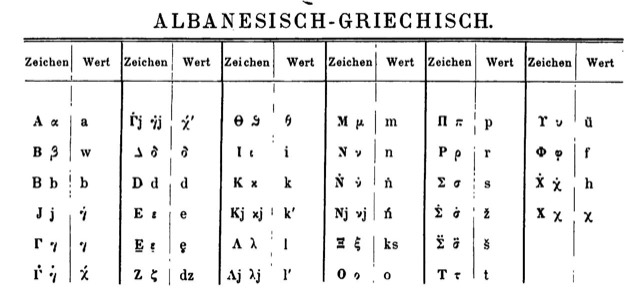
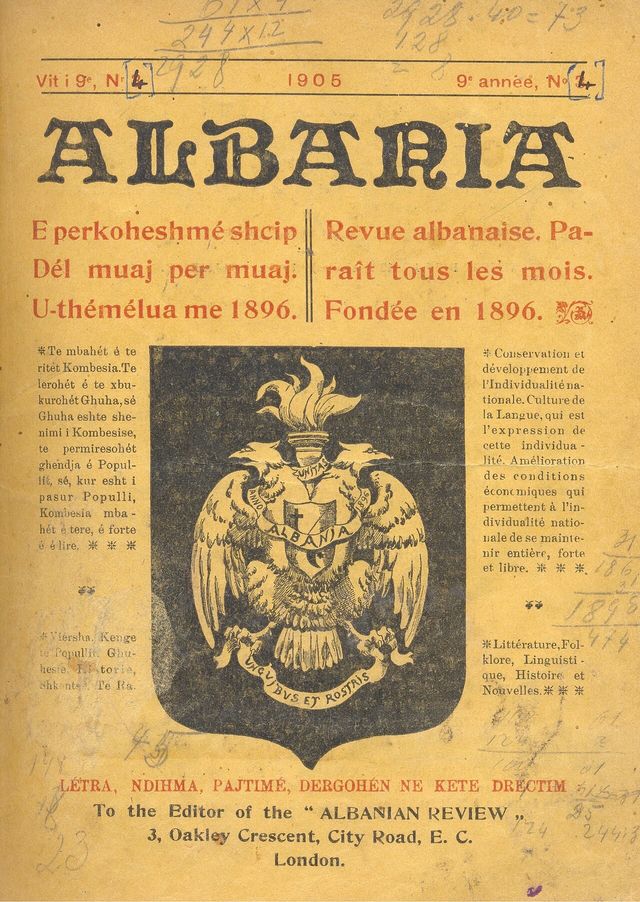
Albanian was written late and in many scripts. The earliest surviving printed book, Gjon Buzuku's Meshari (a Catholic missal), dates from 1555 and uses the Latin alphabet; Orthodox writers in the south used Greek letters, Muslim writers Ottoman Arabic script, and there were even home-grown alphabets such as the Elbasan script.
The Congress of Manastir in 1908 settled on the Latin alphabet used today, with its digraphs (dh, gj, xh and the rest) in place of special letters. A unified literary standard, based mainly on the southern Tosk dialect, was fixed at the Congress of Orthography in 1972; it is the form on signs and in newspapers, while northerners and Kosovars speak the Gheg dialect at home.
Onderwerp
An independent branch of the Indo-European family with no close living relative, written in a 36-letter Latin alphabet.
Onderwerp
Thirty-six letters agreed at the Congress of Monastir in 1908, replacing competing Arabic, Greek and Latin scripts.
Onderwerp
The two dialect groups, divided by the Shkumbin river: Gheg to the north, Tosk to the south.
Iets onjuist op deze pagina? Correcties zijn welkom en worden gecontroleerd aan de hand van de bronregistratie. Laat ons weten wat onjuist is en, indien mogelijk, waar het juiste cijfer vandaan komt.