Onderwerp
The Albanian Language
An independent branch of the Indo-European family with no close living relative, written in a 36-letter Latin…
🧭 Begeleidende weergave
Nieuw in Albanië? Elke pagina begint met een uitleg in eenvoudige taal die u aan een tienjarige zou kunnen voorlezen, voordat de details beginnen.
⚡ Expertweergave
U kent de basis al. Meteen naar de kern, met de eenvoudige uitleg verborgen. Dit is de standaardinstelling.
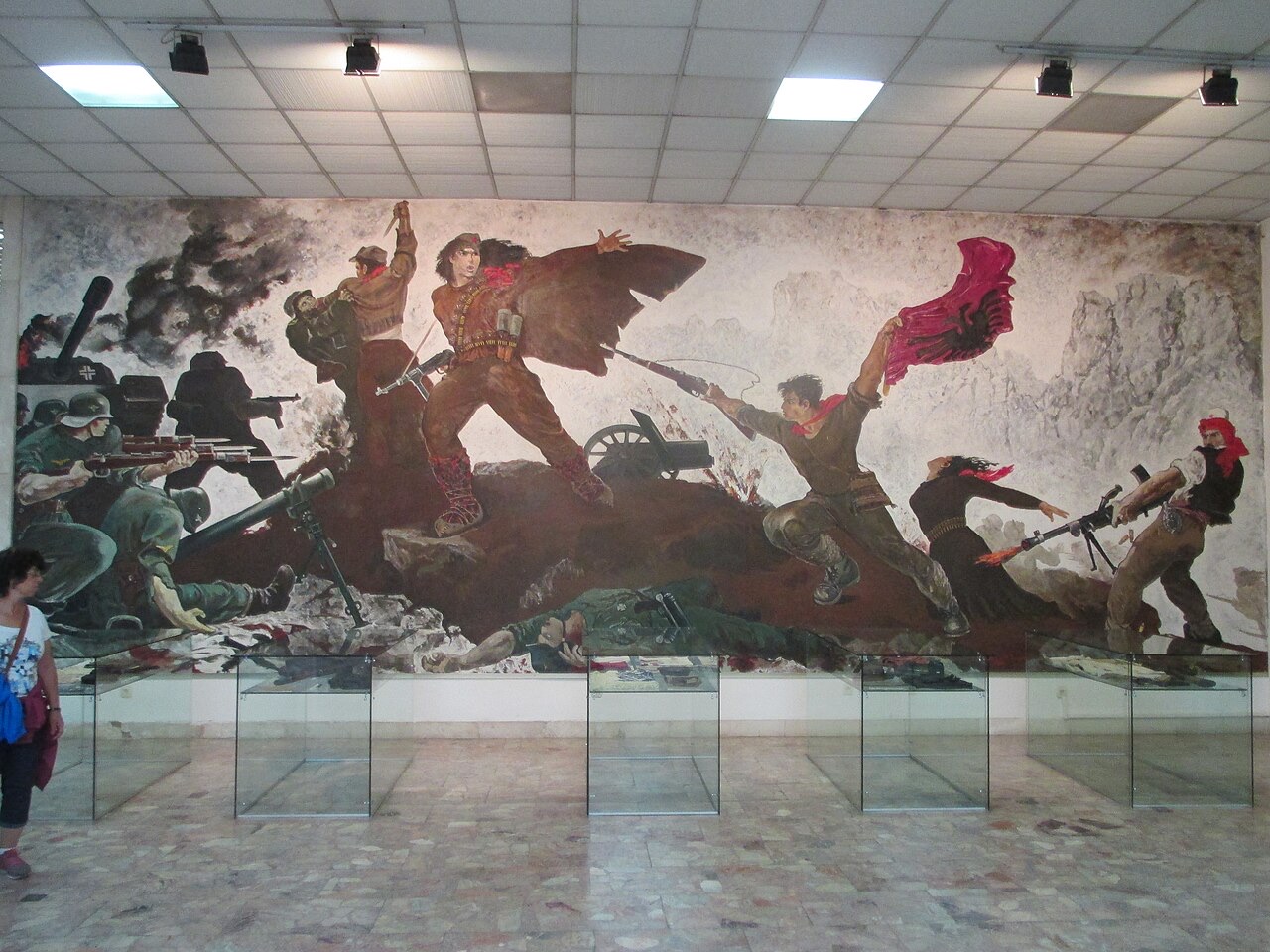
The mosaic on the National History Museum, Tirana · Avi1111 dr. avishai teicher · CC BY-SA 4.0 · Wikimedia Commons
Albanian first names come from several places: old Illyrian and Albanian words, Islam, Christianity, and national heroes. Surnames often come from a place, a job or an ancestor.
Albanian first names come from several places: old Illyrian and Albanian words, Islam, Christianity, and national heroes. Surnames often come from a place, a job or an ancestor.
Albanian given names draw on four traditions at once, which is unusual: indigenous names (Agron, Teuta, Genti — Illyrian rulers), Muslim names (Ardit, Besnik, Fatmir, Arben), Christian names (Gjergj, Pjetër, Marie), and names revived during the national awakening.
Skënder and Gjergj are both after Skanderbeg. Many modern names are transparently Albanian words: Besnik means 'faithful', Fatmir 'lucky', Drita 'light', Lule 'flower'.
Family names often derive from a place (Shkodrani, Korçari, Dibra), from an ancestor, or from an occupation. The suffix -aj is common in the north and typically indicates descent from a named ancestor. The great medieval families — Kastrioti, Dukagjini, Thopia, Arianiti, Balsha, Muzaka — survive as surnames.
Under the communist government some names were changed to remove religious associations, and a 1975 decree required citizens with names deemed unsuitable to change them.
Albanian uses ë and ç, and names are frequently written without them abroad — Berisha for Berisha, Hoxha for Hoxha, but Çela becomes Cela and Përparim becomes Perparim. Both forms refer to the same person.
Dit zijn echte verbanden in de Atlas — plaatsen die dicht bij deze liggen en onderwerpen waar deze pagina werkelijk bij hoort. Niets hier is een algemene aanbeveling.
An independent branch of the Indo-European family with no close living relative, written in a 36-letter Latin…
Gjergj Kastrioti: an Ottoman commander who changed sides and held Albania against the empire for twenty-five years.
A culture shaped by mountain isolation, five centuries of Ottoman rule, and fifty years of enforced separation.
Deze pagina is uitsluitend gebaseerd op de gecureerde inventaris; er is nog geen externe bron aan gekoppeld.
Iets onjuist op deze pagina? Correcties zijn welkom en worden gecontroleerd aan de hand van de bronregistratie. Laat ons weten wat onjuist is en, indien mogelijk, waar het juiste cijfer vandaan komt.