نهر · Gjirokastër
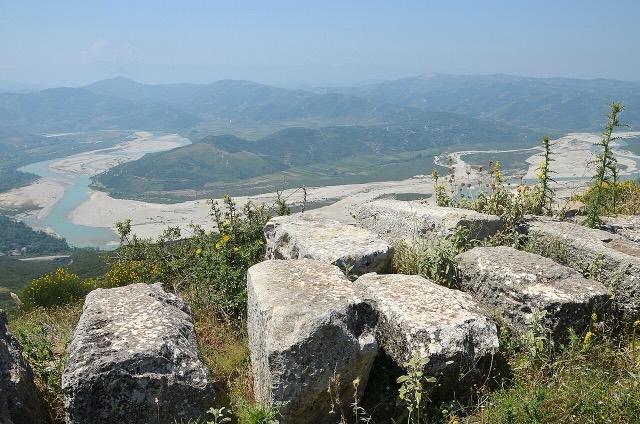
The Vjosa
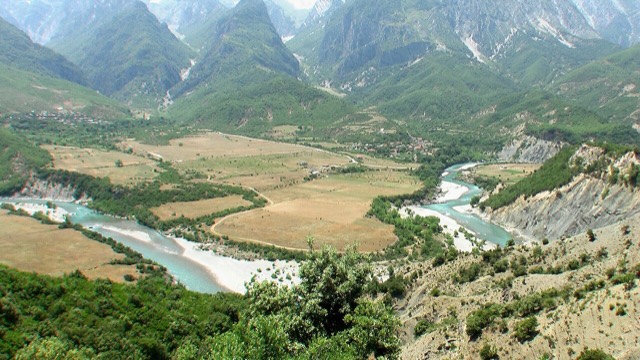
One of the last large free-flowing rivers in Europe, declared a Wild River National Park in March 2023.
كل مقاطعة، كل ساحل، كل قرن
عرض إرشادي
هل أنت جديد على ألبانيا؟ تفتتح كل صفحة بشرح مبسّط يمكن قراءته لطفل في العاشرة من عمره، قبل أن تبدأ التفاصيل.
عرض للمتخصصين
أنت تعرف الأساسيات بالفعل. مباشرةً إلى الجوهر، مع إخفاء الشروح المبسّطة. هذا هو الوضع الافتراضي.
صناعة
Electricity almost entirely from hydropower — which makes supply depend on rainfall.
حفظ
Almost all of Albania's electricity comes from water running through dams. That is clean, but it means that in a dry year the country has to import power. Albania has started building solar farms to reduce that risk, and a big gas pipeline crosses the country.
Almost all of Albania's electricity comes from water running through dams. That is clean, but it means that in a dry year the country has to import power. Albania has started building solar farms to reduce that risk, and a big gas pipeline crosses the country.
Albania is one of only two countries in the world — the other being Paraguay — whose entire electricity production depends on hydroelectric power. In 2021, the country consumed 6.51 billion kWh of electricity while producing 5.31 billion kWh domestically, with the remainder imported from abroad. Hydroelectric generation accounted for 99.4% of electricity production as of 2021.
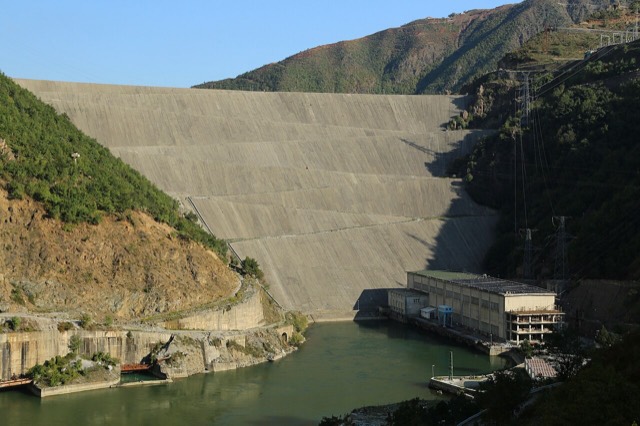
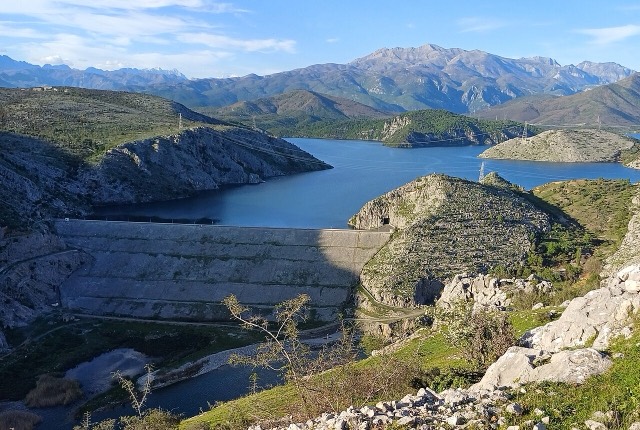
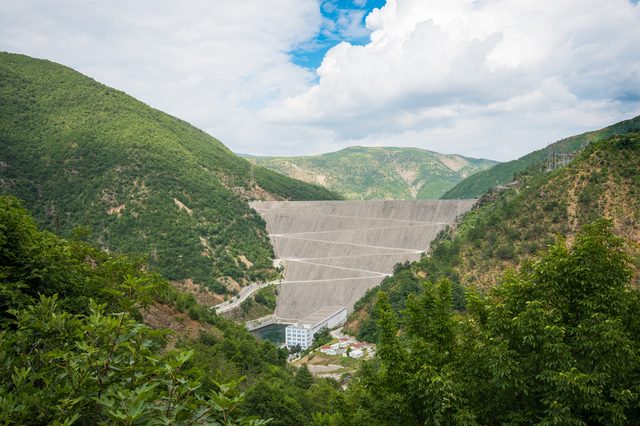
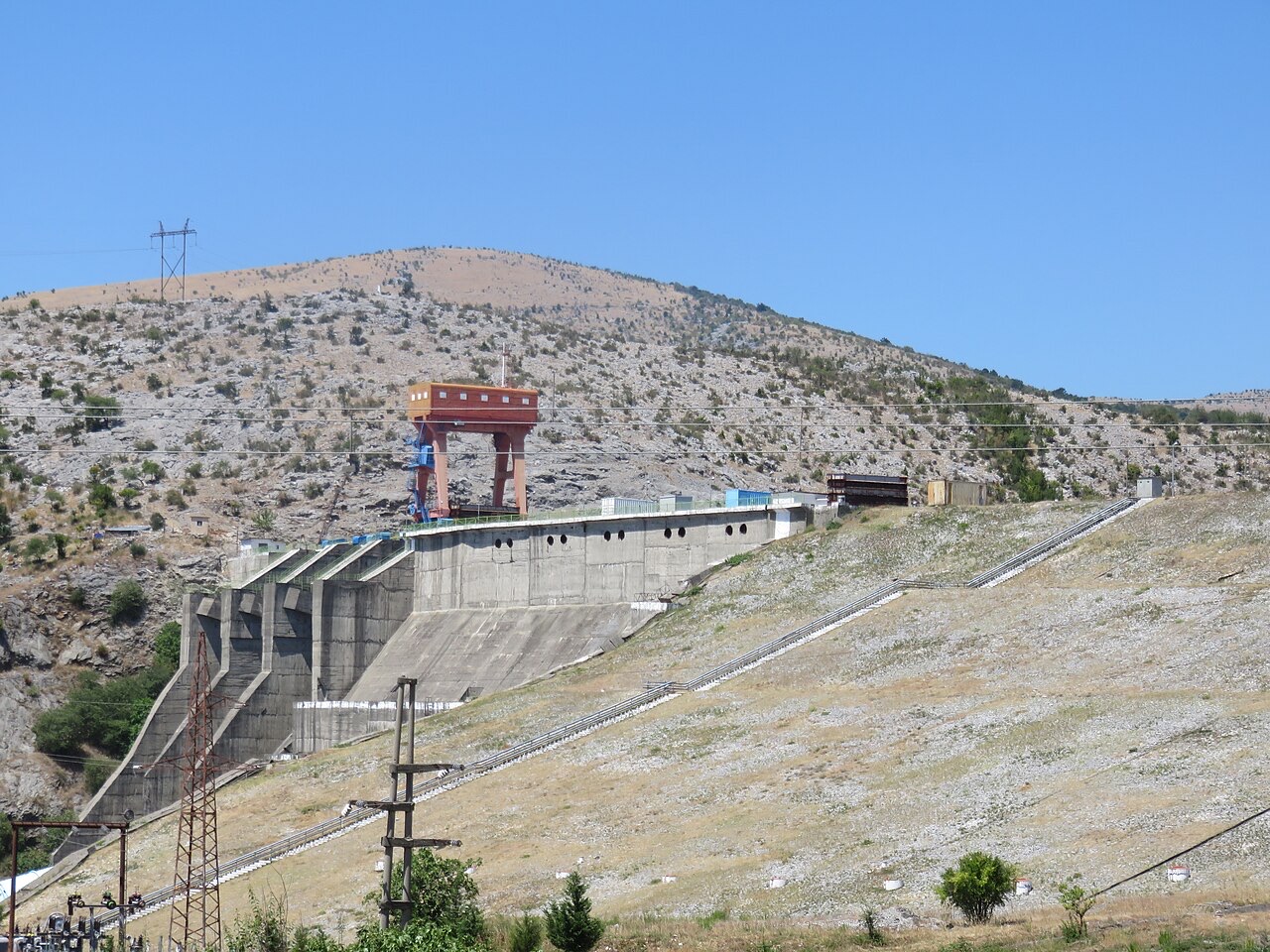
The principal hydroelectric stations operate on two river systems. On the Drin river, the Fierza, Koman, and Vau i Dejës plants are in operation, alongside the planned Skavica dam. On the Devoll river, the Banjë and Moglicë plants were planned to increase Albania's total electricity production by almost 17%. This concentration of generation on river systems makes supply vulnerable to drought and seasonal variation, a factor the article identifies as contributing to energy shortages that damage the business environment and deter foreign investment.
To reduce this vulnerability and expand cross-border electricity trade, a new 400 kV interconnector between Albania and North Macedonia commenced construction in December 2023, intended to improve regional grid integration. An earlier plan — discussed in 2007 — to build a nuclear power plant at Durrës, partly for electricity export to neighbouring Balkan countries and Italy via an underwater cable, was not pursued; by 2016 Albania had no plans to build any nuclear facility.
Albania has begun to diversify its electricity mix beyond hydropower through renewable energy projects. In December 2023, a 140 MW solar park covering 200 hectares of land at Karavasta, operated by French company Voltalia SA, began operations. This represents the most significant addition of non-hydro generation capacity in the country's recent history.
In the same year, an auction process awarded 222.48 MW of onshore wind capacity, signalling a policy commitment to expanding wind generation alongside solar. Together, these developments mark the first substantial steps toward reducing Albania's near-total dependence on hydroelectric sources, though the overall share of electricity from these new sources remains small relative to hydro generation.
The Trans Adriatic Pipeline (TAP) became operational in 2020. Within Albania, the pipeline runs approximately 215 kilometres onshore and 37 kilometres offshore in the Albanian section of the Adriatic Sea. It originates at Qendër Bilisht in the Korça region, at the Albanian border with Greece, and reaches the Adriatic coast 17 kilometres north-west of Fier, 400 metres inland from the shoreline.
Infrastructure built along the Albanian section includes a compressor station near Fier, eight block valve stations, one landfall station, approximately 51 kilometres of new access roads, 42 refurbished bridges, and three new bridges. An additional compressor near Bilisht is planned if capacity is expanded to 20 billion cubic metres. Albania itself produces and consumes an estimated 42.05 million cubic metres of natural gas annually (2019 estimate), with proven reserves estimated at 5.692 billion cubic metres as of 2012. The country neither exports nor imports natural gas, according to available data.
A separate pipeline project — the US$1.2 billion AMBO pipeline, planned to carry crude oil between the Bulgarian port of Burgas and the Albanian port of Vlora — was scheduled to begin construction in 2007 but did not advance.
Albania holds the second largest oil deposits in the Balkan Peninsula and the largest onshore oil reserves in Europe. Commercial oil exploitation began in 1928 at the Kuçovë oil field, expanding one year later to Patos in sandstone reservoirs. During the periods 1929–1944 and 1945–1963, production came entirely from sandstone reservoirs; extraction from carbonate reservoirs began after 1963. By that year, the sandstone reservoirs had cumulatively produced 400,974,649 tonnes of oil.
Crude output in 2013 amounted to more than 1.2 million tonnes. Canada's Bankers Petroleum accounted for 1.06 million tonnes of this total, Canada's Stream Oil contributed 87,063 tonnes, and state company Albpetrol produced 37,406 tonnes on its own, with three other foreign firms responsible for the remainder.
Oil and gas reserves remain the legal property of the Albanian state, which grants rights for evaluation, exploration, production, refining, and transport through agreements with private companies. In March 2016, affiliates of China's Geo-Jade Petroleum purchased drilling rights for the Patos-Marinzë and Kuçovë fields from a Canadian company, paying €384.6 million. The sector has attracted foreign investors since the early 1990s, when reforms transferred exploration and exploitation rights from exclusive public control to the private sector.
Albania's reliance on hydropower creates chronic vulnerability to energy shortages, which the article identifies as one of the principal factors behind the country's poor business environment and its difficulty in attracting foreign direct investment. Antiquated and inadequate transmission infrastructure compounds the problem by limiting the ability to import power when domestic generation falls short.
Planned improvements to transmission links between Albania and Montenegro and Kosovo were identified as measures that would help relieve these shortages. The completion of a thermal power plant near Vlorë was noted as having helped diversify generation capacity, though the primary dependence on hydropower remained intact at the time of the article's data.
Energy shortages intersect with broader infrastructure deficiencies — particularly the road and rail network — that have long constrained economic growth. The government has been taking steps with EU funding to improve the national road and rail network, which the article describes as a long-standing barrier to sustained economic development.
Energy is identified as one of Albania's strongest industries alongside mining, metallurgy, agriculture, and tourism. The sector forms part of an economy that the article classifies as a developing mixed economy, with industry accounting for 24.2% of GDP. The economy is also bolstered by hydro power and petroleum extraction among its key productive activities.
The energy sector's structural weaknesses — particularly the dependence on hydropower — have had direct consequences for industry and investment. Power cuts and supply uncertainty increase operating costs for manufacturers and deter capital-intensive projects. The article notes that these factors contribute to an overall business environment that has historically limited Albania's competitiveness relative to other European economies.
Foreign investment in energy infrastructure, including the TAP pipeline, the Voltalia solar park, and the Chinese acquisition of oil field drilling rights, represents some of the largest individual capital commitments made in Albania in recent decades. The TAP pipeline alone traverses 215 kilometres of Albanian territory and required substantial civil engineering works including new roads and bridge construction.
Albania's geographic position at the western edge of the Balkan Peninsula gives it potential significance as an energy transit country. The Trans Adriatic Pipeline, which became operational in 2020, uses Albanian territory as its final overland and offshore corridor before delivering gas to Italy, making Albania a physical link in one of Southern Europe's main natural gas supply routes.
Cross-border electricity interconnection has developed more slowly. The December 2023 commencement of a 400 kV interconnector to North Macedonia represents a concrete step toward integrating Albania more fully into the regional electricity grid, which would reduce dependence on domestic hydro generation alone. Earlier discussions about connecting Albanian and Italian electricity networks via an underwater cable — raised in the context of the proposed but abandoned Durrës nuclear plant — illustrated the long-standing interest in electricity export as a revenue source.
Plans to improve transmission links with Montenegro and Kosovo, identified in the article as a means of relieving domestic energy shortages, remained under discussion at the time of the source material. Realising these connections would require capital investment and bilateral or multilateral agreements with neighbouring states.
International assessments have identified Albania's construction sector — closely linked to the energy infrastructure boom — as heavily infiltrated by illicit funds. The United States Department of State's 2025 International Narcotics Control Strategy Report stated that criminal proceeds in Albania are laundered through real estate purchases, construction projects, virtual assets, and business development. The 2025 Global Organized Crime Index described Albania as a prominent destination for money laundering, with criminal organisations exploiting the real estate, tourism, and construction sectors.
The Global Organized Crime Index stated that construction sector infiltration by illicit funds causes market distortions, and that high levels of economic informality make detection difficult. Reuters reported in 2025 that experts consider Albania a hub for gangs laundering billions of euros from drug and weapons trafficking, a phenomenon linked to the prevalence of luxury vehicles and new but often empty apartment blocks in Tirana. Critics have argued that public-private partnerships, strategic-investor status, public tenders, and weak regulatory safeguards have allowed politically connected business interests and illicit capital to gain influence over major infrastructure and development contracts.
In 2026, Reuters reported a corruption investigation into Deputy Prime Minister Belinda Balluku concerning allegations of interference in two construction contracts worth more than €200 million. Balluku denied wrongdoing. The case followed earlier investigations including the Albanian incinerators scandal, which prosecutors alleged involved illegal contract awards, corrupt payments, and fake invoices. Albania was removed from the Financial Action Task Force grey list in 2023, and the Special Structure against Corruption and Organised Crime (SPAK) has seized assets in related cases, though international reports continue to describe money laundering and criminal influence over major economic sectors as structural vulnerabilities.
نهر · Gjirokastër
One of the last large free-flowing rivers in Europe, declared a Wild River National Park in March 2023.
منطقة محمية · Gjirokastër
Declared in March 2023, Europe's first national park built around a whole free-flowing river system.
موقع طاقة · Kukës
The uppermost and largest of the Drin dams, creating a reservoir shared with Kosovo.
الموضوع
An upper-middle-income economy of roughly $30 billion, led by services and tourism, with remittances and construction close…
موقع طاقة · Fier
The 878 km gas pipeline from the Greek border to Italy, of which 215 km crosses Albania.
موقع طاقة · Shkodër
The lowest station of the Drin cascade, just upstream of Shkodër.
شركة · Tiranë
The state generator that runs the Drin cascade and supplies most Albanian electricity.
ثمة خطأ في هذه الصفحة؟ نرحب بالتصويبات وتُراجَع في مواجهة سجل المصدر. أخبرنا بما هو خاطئ، وإن أمكن، بالمكان الذي يأتي منه الرقم الصحيح.