विषय
The Albanian Economy
An upper-middle-income economy of roughly $30 billion, led by services and tourism, with remittances and construction close…
हर काउंटी, हर तट, हर सदी
निर्देशित दृश्य
Albania में नए हैं? हर पृष्ठ एक सरल-भाषा स्पष्टीकरण के साथ खुलता है जिसे आप किसी दस वर्षीय बच्चे को पढ़ कर सुना सकते हैं, इससे पहले कि विस्तृत जानकारी शुरू हो।
विशेषज्ञ दृश्य
आप मूल बातें पहले से जानते हैं। सीधे मूल विषय पर, सरल स्पष्टीकरण छिपे हुए। यह डिफ़ॉल्ट है।
उद्योग
A euroised, foreign-owned banking sector supervised by the Bank of Albania.
सहेजें
Albania's banks are supervised by the Bank of Albania. Most of them are owned by foreign groups. Many prices, especially rents and property, are quoted in euros even though the official currency is the lek.
Albania's banks are supervised by the Bank of Albania. Most of them are owned by foreign groups. Many prices, especially rents and property, are quoted in euros even though the official currency is the lek.
Albania declared independence on 28 December 1912, but the new state entered its first years without a central bank, and several early attempts to create one failed. Under Ismail Qemali's leadership, a first institution called the National Bank of Albania was established on 4 October 1913, but its structure was dominated by foreign banks including the Austrian Wiener Bankverein and the Banca Commerciale Italiana. Domestic opposition to that foreign control contributed to a revolt in mid-May 1914 against the regime nominally led by Wilhelm von Wied, and the banking venture collapsed after only a few months.
Monetary conditions deteriorated further during World War I, when Albania was occupied by various foreign powers. Into the early 1920s, all transactions were conducted in foreign currency. By 1923 the dysfunction had reached the point where Albanian municipalities were permitted to issue their own banknotes. The Economic and Financial Organization of the League of Nations floated a proposal for a cooperative central bank co-sponsored by several European governments, with Albania itself owning only 10 percent of its share capital. That proposal was not implemented.
The consolidation of power by Ahmed Zogu and the proclamation of the Albanian Republic created conditions in which a more durable banking institution could be established, though at the price of heavy external dependence. British and, above all, Italian diplomatic involvement shaped the outcome. On 15 March 1925, a convention was signed between Albanian Foreign Minister Mufid Libohova and Mario Alberti of the Italian bank Credito Italiano, establishing the framework for a new National Bank of Albania with its legal seat in Rome and operations inside Albania. The Albanian legislature ratified the text on 22 June 1925, and the bank was formally established in Rome on 2 September 1925.
The convention stipulated that initial share capital of 12.5 million gold francs would be held by a mix of Italian, Albanian, Yugoslav, Swiss, and Belgian partners, with Albanian interests notionally controlling half. In practice, Albanian investors lacked the capacity or willingness to take up their allocation, leaving Italian interests with more than half. The bank was founded with 100,000 founders' shares entirely in Italian hands and largely controlled by Credito Italiano, alongside 495,000 common shares distributed among multiple investors. Named shareholders included Eqrem Vlora (11.7 percent), Nexhat Pasha Vlora (10.5 percent), Basler Handelsbank (10.1 percent), a Yugoslav consortium comprising the Belgrade Cooperative Bank, Serbian Bank in Zagreb, Adriatic-Danubian Bank, and Serbo-Albanian Bank (10.1 percent collectively), Ajet Libohova and Ugo Viali (8.1 percent each), Banca Commerciale Italiana, Banca Nazionale di Credito, Banco di Roma, and Massimo Aurelio (6.1 percent each), Vincenzo Azzolini and Banque Belge pour l'Étranger (5 percent each), with the remaining 7.1 percent mostly held by smaller Italian banks.
Despite its name, the National Bank of Albania was described at the time as a 'real death-knell for any further Albanian economic independence.' Its legal headquarters and governing meetings (of the consiglio di amministrazione) were in Rome, where the Albanian government's gold reserves were also transferred. Its Roman office was located on Piazza dell'Esedra at the corner with the Via Nazionale, near the Bank of Italy. The bank's first director-general in Italy was the economist Amedeo Gambino. The arrangement was modelled on the State Bank of Morocco, whose central functions were divided between Paris and Tangier. Zogu used political backlash against the bank's foreign character to sideline Foreign Minister Mufid Libohova, whom he had come to view as a rival; Libohova was forced to retire from Albanian political life.
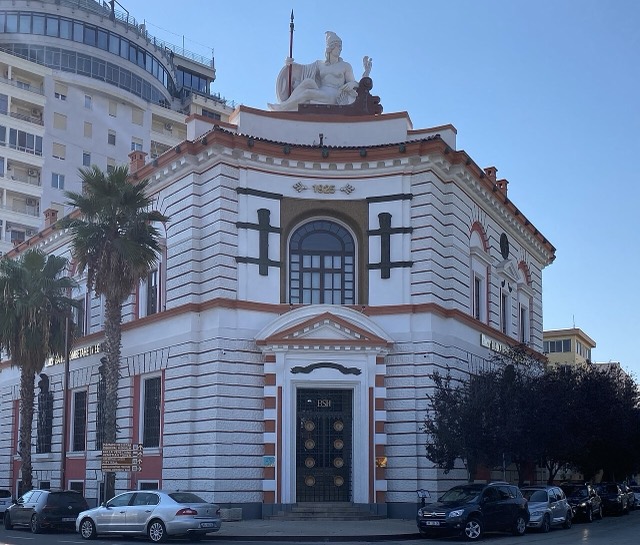
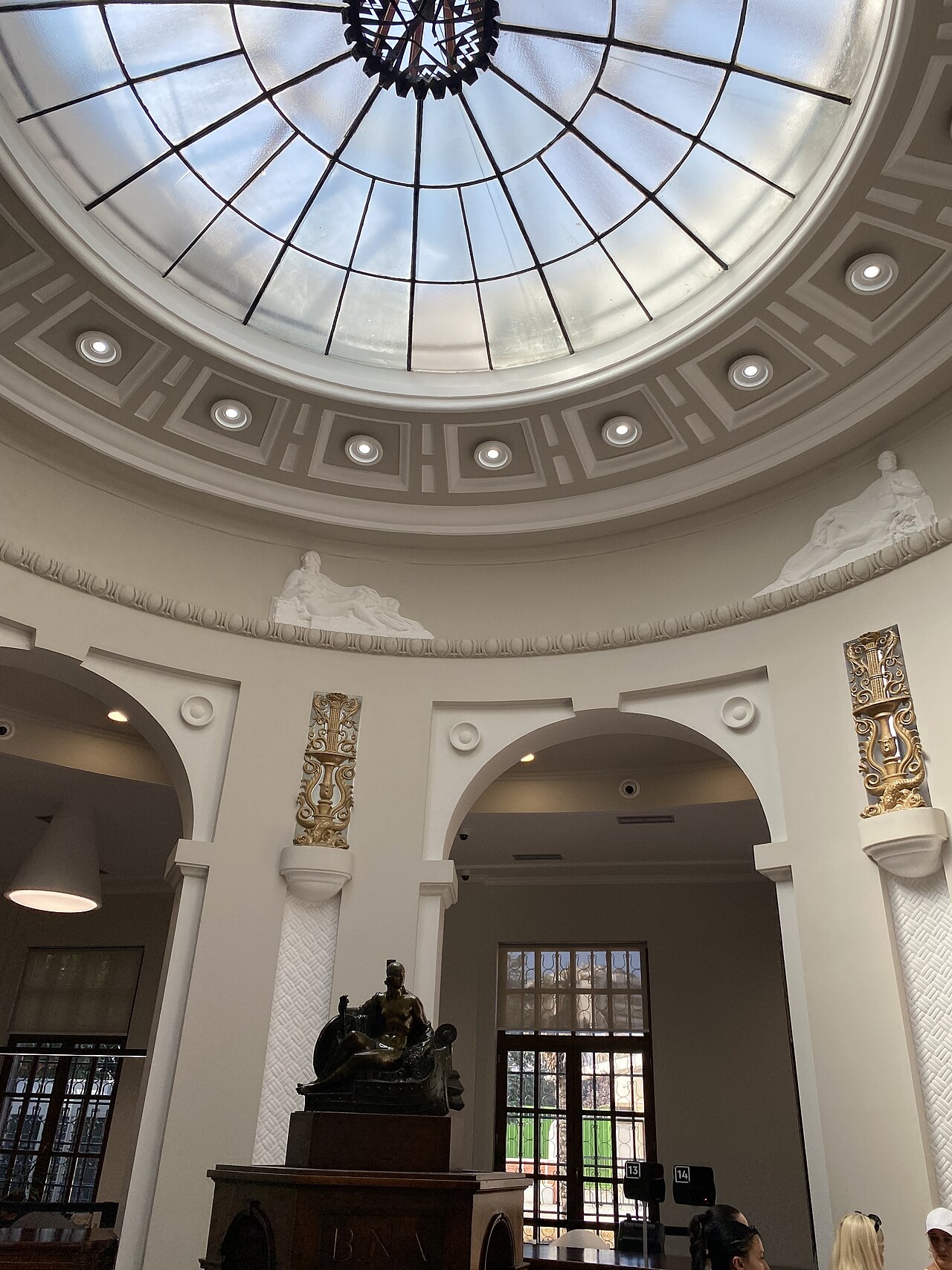
The National Bank opened its first Albanian office in Durrës on 29 November 1925, followed by Shkodër on 1 November 1926 and Vlorë on 15 November 1926. Subsequent branches opened in Berat, Elbasan, Korçë, and Sarandë. From 1925 to 1938 the Durrës office served as the bank's operational centre in Albania. A prominent building facing the port was erected for it, designed by architect Vittorio Ballio Morpurgo and completed in November 1928. Morpurgo also designed the bank's branches in Korçë, Shkodër, and Vlorë.
On 30 October 1938 the bank inaugurated a new Albanian central office on what is now Skanderbeg Square in Tirana, transferring the central functions previously held in Durrës. That Tirana building was likewise designed by Morpurgo, who worked on it between 1930 and 1936. Under the Italian protectorate of Albania (1939–1943), the National Bank continued to operate but faced growing commercial competition from Banco di Napoli and Banca Nazionale del Lavoro. A branch was opened in Prizren, which had been annexed to Albania. An extension of activity to Montenegro was considered but not carried out.
The bank's monetary policy during the Italian protectorate was severely inflationary. Aggregate issued money stood at 11.1 million francs at end-1937 and 10.5 million at end-1938. It then rose sharply: to 26.3 million at end-1939, 80.2 million at end-1940, and 108.4 million at end-1941. Under the German occupation that began in September 1943, the National Bank continued operating under increasingly difficult conditions. The occupiers forced the transfer of its gold reserves from Rome to Berlin.
Following Albania's liberation from German occupation in late 1944, the National Bank's Albanian operations were nationalised on 13 January 1945 and renamed the Albanian State Bank (Banka e Shtetit Shqiptar, BSS). The Italian legal entity of the former National Bank was not liquidated until 1957. The State Bank operated under a strict monobank system. An internal department handling retail savings was created in 1949 and was later renamed the Institute of Saving Accounts and Insurance, though it remained housed within the State Bank.
On 1 January 1970, a separate Agricultural Bank was established, but it remained within the concept of a single-tier banking system. Throughout this period the State Bank continued to use the buildings that had been constructed for the National Bank during the interwar years. Kostandin Boshnjaku served as the first director-general of the State Bank from 17 January 1945. A succession of directors-general followed; the post was last held under the communist system by Niko Gjyzari, who served from 1 January 1991 to 31 August 1991.
Shortly after the fall of communism in Albania in December 1990, a broad reform of the financial sector began. On 1 January 1991, the Albanian Commercial Bank (Bankës Tregtare Shqiptare, BTSH) was established as a spin-off of the State Bank's commercial banking activities; it took over the State Bank's branches outside Tirana. On 1 January 1993, BTSH merged with another State Bank spin-off, the Albanian National Bank (Banka Kombëtare e Shqipërisë, established 1992), to form Banka Kombëtare Tregtare (BKT, meaning National Commercial Bank). BKT was privatised in 2000 and subsequently came under the control of Çalık Holding.
The Institute of Saving Accounts and Insurance was renamed the Savings Bank and spun off in 1991, and was eventually privatised in 2004 as Raiffeisen Bank Albania. In 1992, the State Bank itself was renamed the Bank of Albania and confined to a central banking role appropriate to the newly established two-tier banking system. The same year, Ilir Hoti became the bank's first Governor, serving from 1 May 1992. In 1993, the newly formed BKT took over the former regional branch buildings of the National Bank era, while the Bank of Albania retained the Tirana head office. In 1996, an agreement was reached to return most of the former National Bank's gold reserves to Albania.
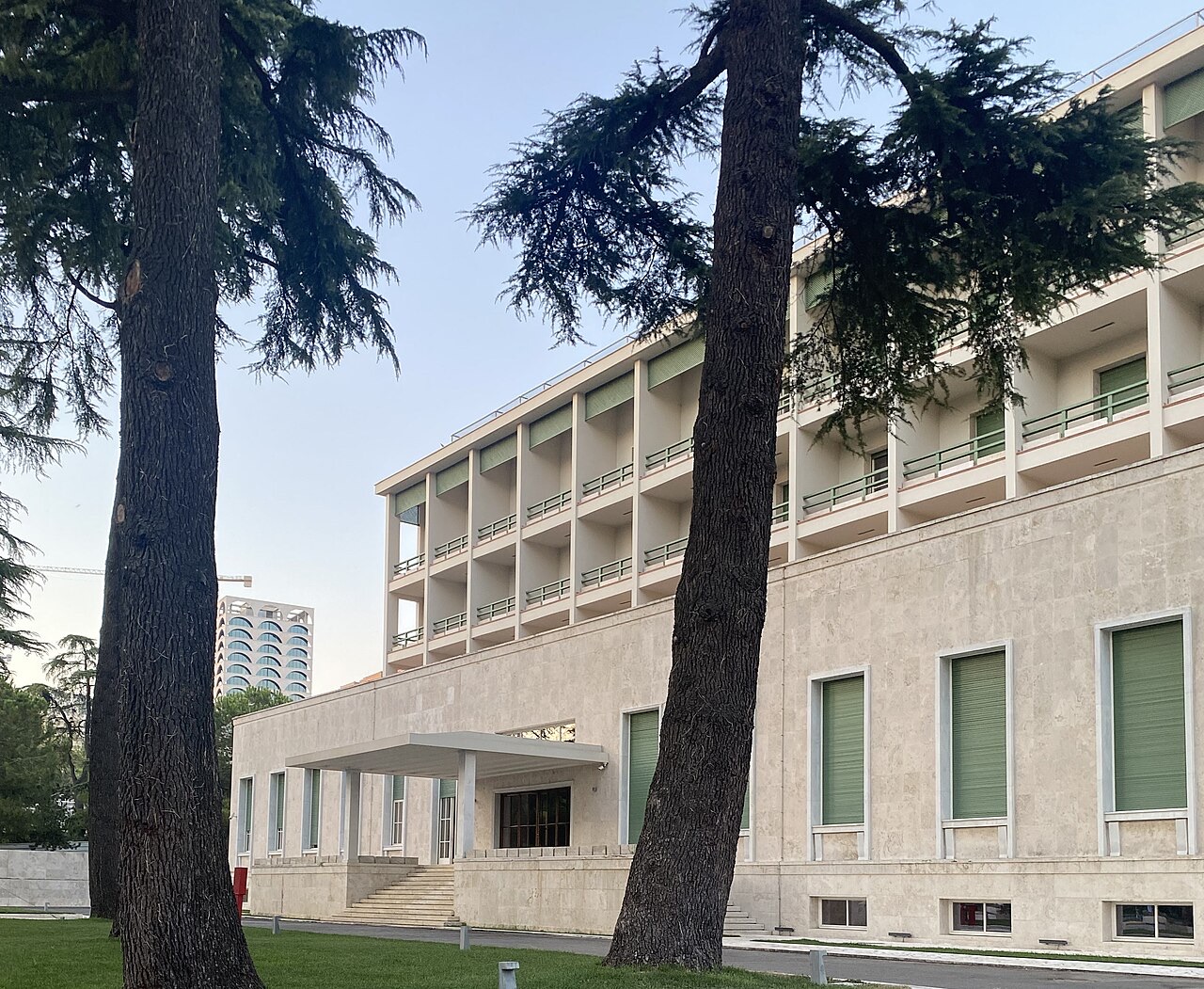
The Bank of Albania is headquartered in Tirana, in the building on Skanderbeg Square inaugurated by the National Bank in October 1938 and designed by Vittorio Ballio Morpurgo. In the early 2010s the head office was renovated and expanded to a design by the Italian firm Petreschi Architects. The bank maintains five regional branches: in Shkodër, Elbasan, Gjirokastër, Korçë, and Lushnjë.
On 10 February 2010, the Bank of Albania opened a Research and Training Center in Berat, in a building originally constructed in the 1970s and remodelled in the late 2000s to suit the historic city's environment. In June 2010 the bank purchased the former Hotel Dajti, a prominent building in central Tirana near the head office, to host functions open to stakeholders and the public.
The Bank of Albania holds the exclusive right to conduct monetary policy in Albania. Its primary stated objective is achieving and maintaining price stability. The bank targets annual inflation of 3.0 percent, with a tolerance band of plus or minus one percentage point. As of the third quarter of 2014, annual inflation stood at 1.7 percent.
The bank manages liquidity in the banking system through open market operations — the purchase or sale of securities — which also serve to stabilise short-term market interest rates. Standing facilities are available to commercial banks at their own initiative without restriction under normal circumstances; they provide and absorb overnight liquidity, and their interest rates set the corridor within which money market rates may fluctuate. The minimum reserve requirement ratio is set at 10 percent of each commercial bank's reserve base, applied equally to lek and foreign currency liabilities. Banks may use averaging provisions and are permitted to use up to 40 percent of their required reserves, provided the average balance over the maintenance period does not fall below the reserve requirement. Required reserves held in Albanian lek are reimbursed at a rate derived from the Bank of Albania's base rate; those held in foreign currency are reimbursed at a rate derived from the base rates of the European Central Bank and the Federal Reserve.
The Bank of Albania supervises and regulates all banks and institutions conducting banking activity in Albania. It licenses institutions, enforces rules governing their establishment, and monitors ongoing compliance with laws and regulations. The stated purposes of this supervisory function are to promote stability of the banking system, protect depositors and the general public, ensure transparency consistent with a market economy, and provide confidence for investors while enabling industry profitability.
In practice, banking supervision involves a licensing process requiring that owners and management meet legal, professional, and ethical standards, and that institutions hold adequate capital relative to the risks they undertake. Ongoing supervision verifies that banks maintain adequate capital and liquidity, satisfactory asset quality, and adherence to international best-practice standards. The supervisory function also includes drafting and revising prudential regulations, developing supervisory procedures consistent with international practice, and ensuring that banking problems are resolved in a manner that protects depositors and minimises costs to the government and the public.
The Bank also acts as fiscal agent for the Albanian government, which holds an account with the bank through which domestic and international financial transactions are made. Day-to-day treasury operations — government receipts and expenditures — are, however, conducted through commercial banks rather than directly through the Bank of Albania.
विषय
An upper-middle-income economy of roughly $30 billion, led by services and tourism, with remittances and construction close…
मार्गदर्शिका
Among the lowest cost bases in Europe — with Tirana and the summer coast as the two big exceptions.
मार्गदर्शिका
A foreign-owned banking sector, a partly euroised economy, and a country where cash still matters.
कंपनी · Tiranë
One of Albania's largest commercial banks, part of Turkey's Çalık Holding.
इस पृष्ठ पर कुछ गलत है? सुधार स्वागतयोग्य हैं और स्रोत अभिलेख के विरुद्ध जाँचे जाते हैं। हमें बताएँ क्या गलत है और, यदि संभव हो, तो सही आँकड़ा कहाँ से आता है।