Historic site · Fier
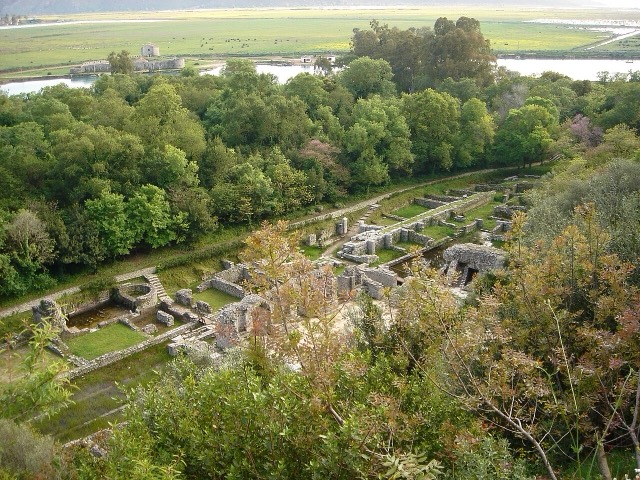
Apollonia
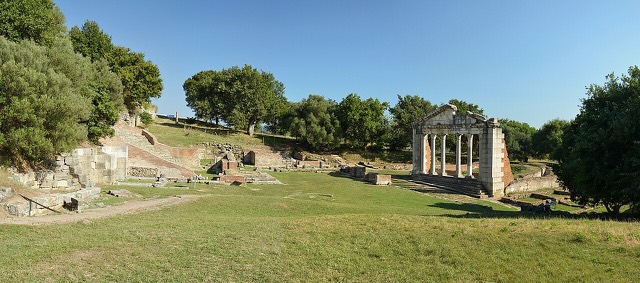
A Corinthian colony that became a Roman university town — Octavian was studying here when Caesar was killed.
Every county, coast and century
Guided view
New to Albania? Every page opens with a plain-language explanation you could read to a ten-year-old, before the detail begins.
Expert view
You already know the basics. Straight to the substance, with the simple explanations hidden. This is the default.
Historical period
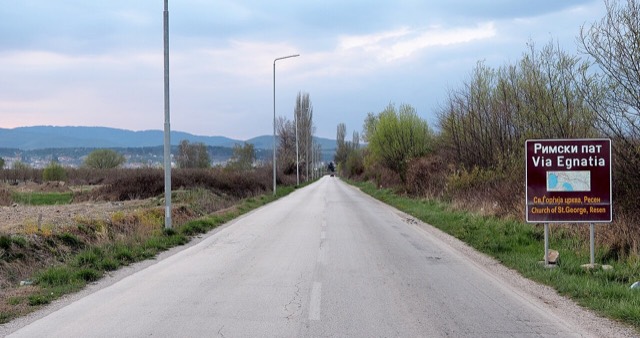
The Via Egnatia crossed here, making the coast Rome's gateway to Greece and the East.
Save
After Rome defeated the Illyrians, the land became part of the Roman Empire. Rome built the Via Egnatia, a great road that started at Durrës and ran east all the way to Byzantium. That road made the Albanian coast important for centuries.
After Rome defeated the Illyrians, the land became part of the Roman Empire. Rome built the Via Egnatia, a great road that started at Durrës and ran east all the way to Byzantium. That road made the Albanian coast important for centuries.
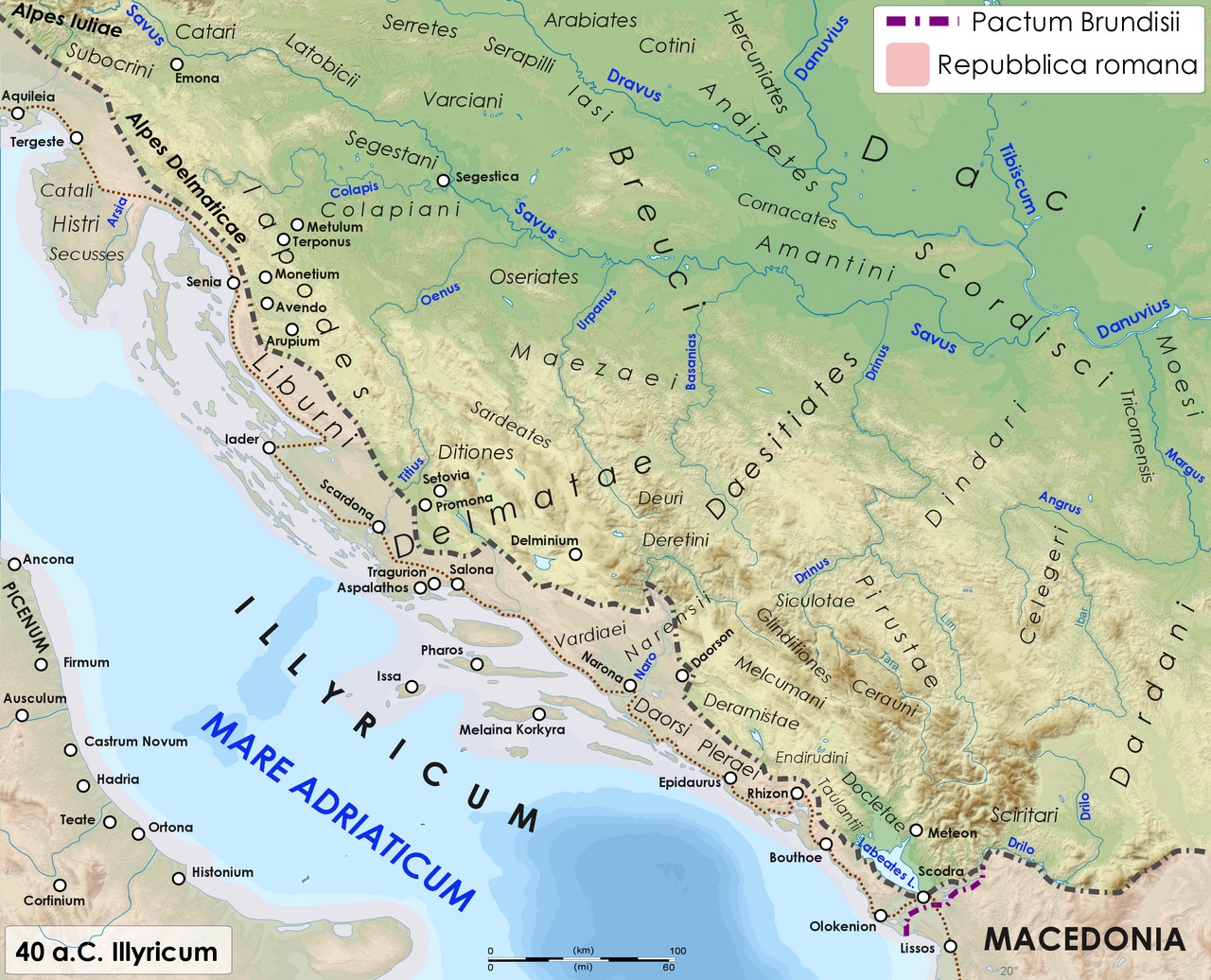
Illyricum as a Roman administrative entity comprised two broad regions: Illyria/Dalmatia in the south and Pannonia in the north. The southern region stretched from the River Drin (Drilon) in modern northern Albania to the Istrian Peninsula in the northwest and the River Sava in the north, covering the Dinaric Alps coastline along the eastern Adriatic for approximately 645 kilometres with a width of about 150 kilometres. The territory corresponded roughly to modern northern Albania, Kosovo, Montenegro, Serbia, Slovenia, Bosnia and Herzegovina, and coastal Croatia. The northern Pannonian region occupied the plain from the Illyrian mountains to the westward bend of the River Danube, encompassing modern Vojvodina, northern Croatia, and western Hungary.
The coastal zones of Illyria included many islands, though these lacked drinking water. The mountains were cultivated toward the coast but were largely barren. Poor or arid soils and scarce water made much of Illyria a poor agricultural region, a condition that contributed to endemic piracy. The interior of the southern part—corresponding to central and southern Albania—was more fertile. The Pannonian plain to the north was also more fertile than the Illyrian uplands. As the province developed, Salona (near modern Split, Croatia) became its capital.
Illyria was inhabited by dozens of independent tribes, most grouped under the label Illyrians. Celtic tribes were present in the north. The Pannonians of the northern plain differed culturally from the Illyrians and the eastern Celts to their west, as shown by archaeological finds and toponyms. They were subsequently Celticised following a Celtic invasion of the northern part of the region at the beginning of the 4th century BC. Certain tribes—the Eravisci, Scordisci, Cotini, Boii, and Anartii—were Celtic. Iron mining and production formed an important part of the pre-Roman Pannonian economy.
Rome fought three distinct Illyrian Wars between 229 BC and 168 BC. The First Illyrian War (229–228 BC) began because of Ardiaei pirate attacks on ships of Rome's Italian confederates in the Adriatic and the growing power of the Ardiaei, an Illyrian tribe based in what is now Montenegro and northern Albania. The Ardiaei had invaded the Greek cities of Epidamnos (modern Durrës, Albania) and Pharos (Stari Grad, Croatia), occupied the island of Corfu, attacked Elis, Messenia in the Peloponnese, and Phoenice in Epirus—a hub of Roman trade. Rome deployed a powerful fleet, freed the Greek cities, attacked the Ardiaei, and concluded peace.
The Second Illyrian War (219–218 BC) followed renewed Ardiaei attacks on the Greek coast and on Roman allies in southern Illyria in 220 BC; Rome won this conflict as well. The Third Illyrian War (168 BC) arose when the Ardiaei joined the Kingdom of Macedon in the Third Macedonian War (171–168 BC) against Rome. They were quickly defeated. The peace terms imposed on them required payment of a tribute equivalent to half the taxes previously paid to the deposed king, with exemptions for towns and tribes that had allied with Rome.
Subsequent Roman operations in the region were episodic rather than part of a systematic conquest. In 156–155 BC the consul Gaius Marcius Figulus campaigned against the Dalmatae after they attacked Illyrian subjects of Rome and refused to receive Roman ambassadors; he was initially driven from his camp but later besieged Delminium. The following year, 155 BC, the consul Scipio Nasica Corculum subdued the Dalmatae, according to Livy's Periochae. In 135 BC the Ardiaei and the Palarii raided Roman Illyria while Rome was occupied with the Numantine War in Hispania and the First Servile War in Sicily; the consul Servius Fulvius Flaccus marched against them in what Appian characterised as a minor expedition.
In 59 BC the lex Vatinia assigned the consul Julius Caesar the proconsulship of Gallia Cisalpina and Illyricum together with command of three legions based at Aquileia, for five years. When the proconsul of Gallia Narbonensis died, the senate added that province and a further legion. Caesar took up his proconsulships in 58 BC. Illyricum and Gallia Cisalpina were not formal administrative provinces but areas of military command. Aquileia had been founded in 180/181 BC as an outpost defending north-eastern Italy against the Carni, Taurisci, Histri, and Iapydes. Caesar visited Illyricum briefly in 57 BC after the defeat of the Belgae in Gaul, then returned to deal with renewed Gallic unrest. In 54 BC he responded to raids by the Illyrian Pirustae tribe, levied troops from Illyrian peoples, received hostages, and appointed arbitrators to assess damages.
When Caesar's civil war against Pompey began in January 49 BC, Illyricum became a contested theatre. In 48 BC Caesar landed at Palaeste (Palasë, southern Albania) having crossed the Adriatic despite Pompey's naval superiority. The Pompeian admiral Marcus Octavius took Salona under siege with five camps but was stormed by the town's inhabitants, who seized and destroyed the camps. Octavius withdrew to Dyrrachium (Durrës, Albania) to rejoin Pompey. Caesar sent Quintus Cornificius to Illyricum as quaestor; Cornificius defended the region and recovered it for Caesar, capturing Pompeian ships with the help of loyalists at Iadera (Zadar).
Caesar then dispatched Aulus Gabinius to Illyricum with fifteen cohorts (approximately 7,800 men) and 3,000 cavalry. Gabinius marched in winter without adequate supplies because locals were hostile and Adriatic storms blocked supply ships. After suffering reverses, he retreated to Salona, was attacked en route, and lost 2,000 soldiers. He reached Salona with the remainder of his force and died there of illness shortly afterward. Marcus Octavius subsequently attempted to seize Illyricum by allying with locals and attacking Caesarian garrisons. Publius Vatinius sailed from Brundisium (Brindisi) with improvised armed civilian ships and defeated Octavius in a naval engagement fought at close range, capturing 85 ships. The Adriatic was thereby cleared of Pompeian forces.
In 45 BC, planning his Parthian campaign, Caesar sent Vatinius with three legions to impose a tribute on the Illyrians and receive hostages. After Caesar's assassination in 44 BC, the Illyrians ignored Vatinius, routed five cohorts under his lieutenant Baebius (who was killed), and Vatinius fled to Dyrrachium. Appian observed that Caesar had deferred resolving the Illyrian question for fourteen years, despite holding the command of Illyria alongside the two Gauls for ten years, because of the Gallic Wars, the civil war, and the planned Parthian expedition.
After the end of Caesar's civil war, the Liberators' Civil War, and Sextus Pompey's Sicilian Revolt (44–36 BC), instability persisted in Illyricum and neighbouring north-eastern Italy. The Iapydes had raided Aquileia, plundered Tergestus (Trieste), and destroyed Pola (Pula). In 35 BC Octavian marched against the Iapydes along a steep and rugged road, using flanking contingents to defeat their ambush. He took the town of Terponus without burning it. He then besieged Metulus (near Ogulin), defended by 3,000 men. When the walls crumbled the defenders built an inner wall; Octavian's troops bridged the mound but three of four bridges were destroyed and the troops panicked. Octavian crossed the remaining bridge alongside his lieutenants Agrippa and Hiero and a bodyguard; the bridge collapsed under their weight and he was injured in the right leg and both arms. The Metulians nonetheless surrendered. When the Roman garrison ordered them to disarm, they set fire to the council chamber where their women and children were held; many women killed themselves and their children. The city burned completely.
Octavian then marched against the Segestani, a Pannonian tribe that had previously submitted but was not required to furnish hostages and had rebelled. He ravaged the countryside for eight days before reaching their town, Segesta, on the River Sava, which was protected by the river and a ditch. Octavian intended to use Segesta as a base for a potential campaign against the Dacians and Bastarnae across the Danube, and began building a fleet on the Sava for provisions. After a thirty-day siege he imposed only a fine, garrisoned the town with twenty-five cohorts (roughly two and a half legions), and returned to Rome. Segesta was later known as Siscia, now Sisak in Croatia. Cassius Dio records that after this city fell, the rest of Pannonia surrendered.
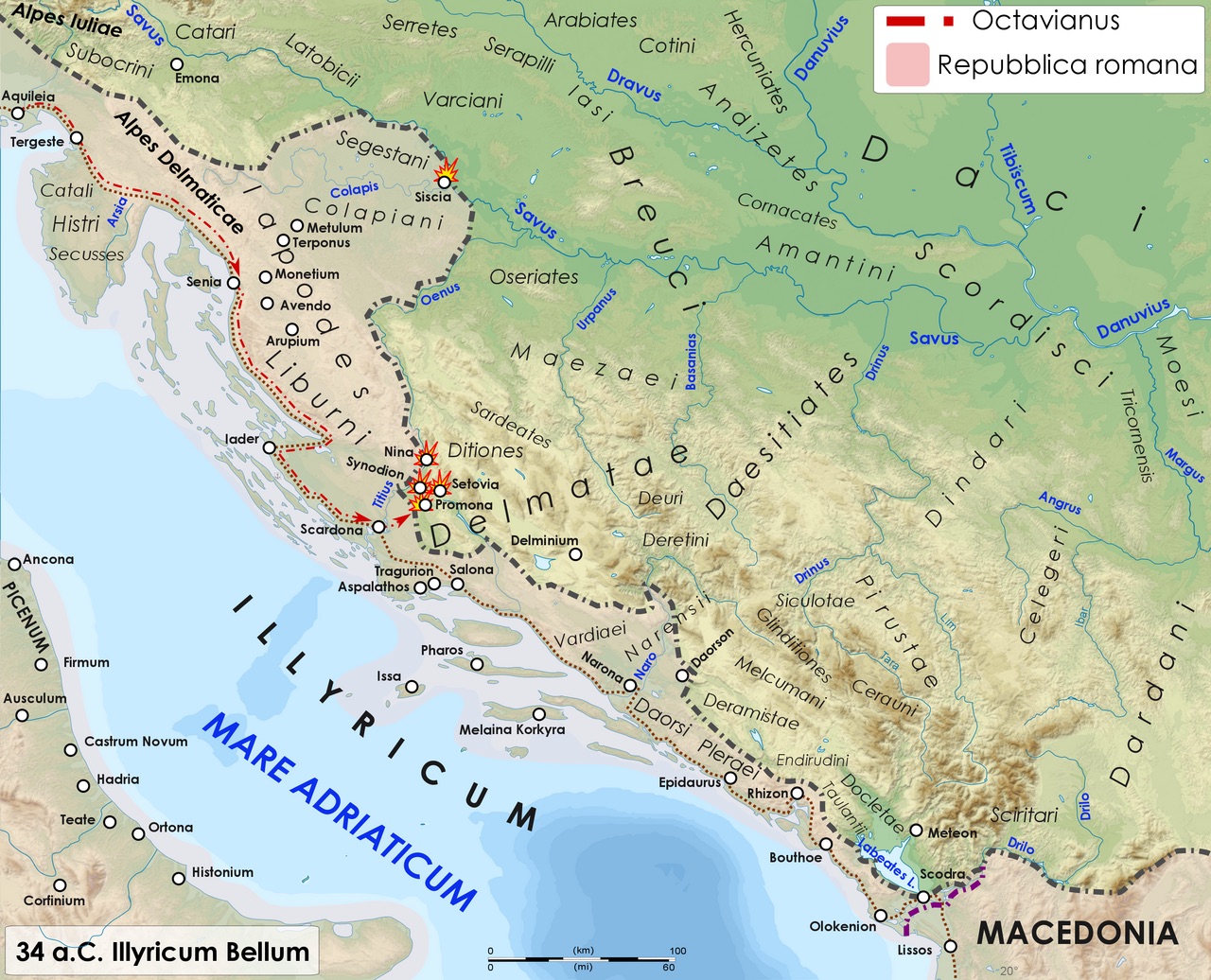
In 34 BC a revolt broke out among newly conquered Pannonian peoples and the Dalmatians. Octavian turned against the Dalmatians, who had been in arms since the rout of Gabinius in 48 BC. Their commander Versus had seized and fortified Promona (south of modern Knin, Croatia). Octavian built a circumvallation wall seven kilometres long around the town and two hills held by the enemy. A relief army under the Dalmatian commander Testimus was driven back to the mountains. Promona fell before the circumvallation was complete. The cohort that had fled during a night sortie was punished by decimation; the survivors were required to subsist on barley instead of wheat for the remainder of the summer.
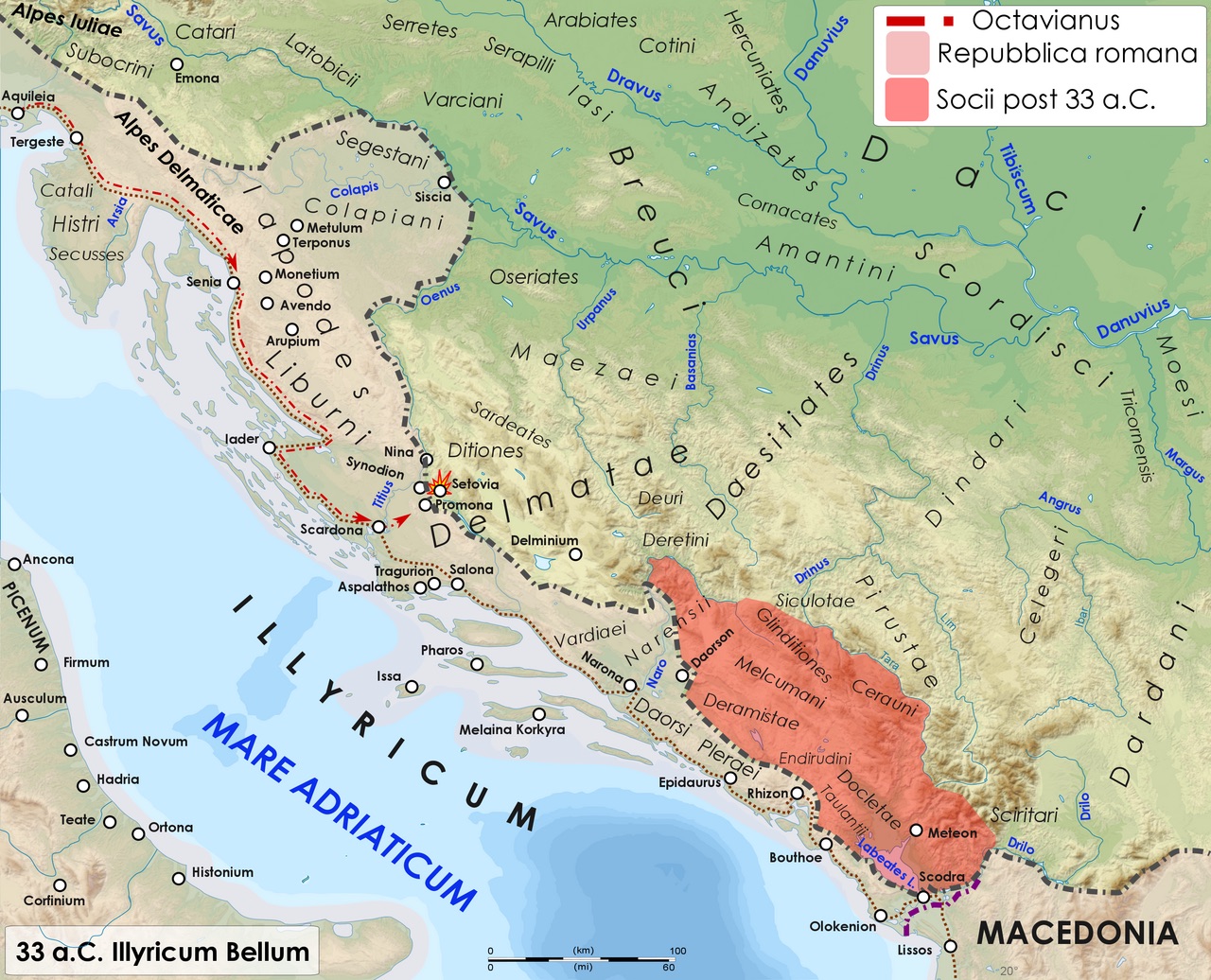
In 33 BC Octavian besieged Setovia. Struck by a stone on the knee, he was confined for several days, returned to Rome to take up his consulship, and left Titus Statilius to continue the siege before returning to Dalmatia. Facing starvation from blockade, the Dalmatians surrendered. Octavian demanded 700 of their children as hostages and the return of the standards captured from Gabinius in 48 BC; they also promised to pay tribute in arrears since Julius Caesar's time. Several other tribes submitted on his approach. Appian concluded that Octavian subdued the whole Illyrian country, including tribes that had never previously been under Roman rule, though the article notes that Appian may have been referring only to Illyria/Dalmatia rather than the full future province of Illyricum.
After defeating Mark Antony and Cleopatra VII of Egypt in 31/30 BC, Octavian became sole ruler of Rome and instituted governmental reforms establishing what modern historians call the Principate. Illyricum became a province as a formal administrative unit in 27 BC as part of the settlement by which the Roman senate formalised Octavian's personal rule under the honorary title Augustus. The settlement distinguished between senatorial provinces, governed by senators chosen by the senate, and imperial provinces, governed by appointees of Augustus. Augustus retained control of the frontier provinces, which held the bulk of Roman troops.
Initially Illyricum was a senatorial propraetorial province. Continued rebellions demonstrated that a strong military force was necessary, and in 11 BC it became an imperial province under the governorship of Publius Cornelius Dolabella. Administrative organisation was carried out late in the reign of Augustus (27 BC–14 AD) and early in the reign of Tiberius (14–37 AD), with arrangements interrupted by a troop mutiny in 14 AD and subsequently resumed. The historian Pliny the Elder provides the most detailed surviving picture of the administrative structure.
The coastal area was subdivided into three juridical districts (conventus juridicus): the conventus Salonitanus (5 civitates and 927 decuriae), the conventus Naronitianus (13 civitates and 540 decuriae), and the conventus Scardonitanus (14 civitates; decuriae not recorded). In the more urbanised coastal zone, towns with large Greek-speaking populations and many inhabitants from Italy were organised as municipia or coloniae with their own councils. Some Liburnian communities held Italian rights. In the less urbanised interior, administration relied exclusively on the civitates, each governed by praefecti civitatum. Pannonia was subdivided into 14 civitates and also constituted a military district under a prefect who commanded the legions stationed there. The provincial governor resided in Salona and governed the coastal area, while Pannonia's military prefect effectively acted as a deputy governor.
Dalmatia held considerable strategic and economic value. Its coastline included important commercial ports, and the province contained gold-mines administered through an imperial bureau in Salona. Dyrrachium (Durrës, modern Albania) and Brundisium (Brindisi, southern Italy) were the standard crossing points for travel across the Adriatic between Rome and the eastern Mediterranean. Dyrrachium also served as the starting point of the Via Egnatia, the Roman road running east to Byzantium. The capital Salona was protected by military camps at Burnum and Delminium.
From 14 BC to 10 BC a series of rebellions in southern Pannonia and northern Dalmatia, referred to by Roman writers as the bellum Pannonicum, constituted what is collectively called the Pannonian War. Sources are limited, consisting mainly of brief accounts in Cassius Dio and passing references by other writers; the causes are not recorded. Cassius Dio noted that in 17–16 BC the governor Publius Silius Nerva left for the Italian Alps to deal with an unguarded situation there, allowing Pannonians and Noricans to enter Istria and pillage it. He quickly brought this under control. Simultaneously, a small rebellion broke out in Dalmatia, and the Dentheletae together with the Scordisci attacked the Roman province of Macedonia, while a civil war broke out in Thrace, generating widespread instability across the eastern Alps and the Balkan Peninsula.
In 15 BC Rome conquered the Scordisci and annexed Noricum, and conducted further operations against the Rhaeti and Vindelici in the Alps. Military operations in Illyricum may have begun under the governor Marcus Vinicius (14–13 BC). Velleius Paterculus credits Vinicius and Marcus Vipsanius Agrippa with initiating the Pannonian War, with Tiberius eventually ending it. Florus records a victory of Vinicius over Pannonians between the rivers Sava and Drava. Cassius Dio reports in separate passages that a Pannonian rebellion in 14 BC was suppressed quickly, and that in late 13 BC Augustus gave Agrippa supreme command in Pannonia—an indication that the problem was serious. Agrippa resolved matters through negotiations and personal influence.
After Agrippa's sudden death the Breuci refused to observe their treaty with him. Tiberius was given command and defeated the Pannonians with the assistance of the recently conquered Scordisci. Suetonius records that Tiberius subsequently subdued the Dalmatians and the Breuci. In 11 BC Tiberius defeated both the Dalmatians and the Pannonians; later that same year Illyricum became an imperial province. In the winter of 11/10 BC the Dacians crossed the frozen Danube and plundered Pannonian territory, and some Dalmatian communities rebelled against paying tribute. In 10 BC repeated uprisings in both Pannonia and Dalmatia were suppressed by Tiberius. The historian Dzino argues that these conflicts are better understood as rebellions against treaty obligations rather than as wars of conquest, and notes that Augustus's own propagandistic writing on extending Roman reach to the Danube is contradicted by Suetonius, who implies this extension only followed the later Batonian War.
The Batonian War (bellum Batonianum) was a large-scale rebellion lasting four years (6–9 AD), named by the Romans after its two leaders who shared the name Bato: Bato the Daesitiate and Bato the Breucian. In 6 AD, as Rome was assembling forces for a second expedition against the Marcomanni in Germania—drawing most of the legions from Illyricum—native auxiliary troops raised for this purpose rebelled under the leadership of Bato the Daesitiate. Cassius Dio described his force as Dalmatian, indicating men drawn from various Dalmatian tribes. Bato the Breucian, leading the Breuci—the largest tribe in southern Pannonia—marched on Sirmium (Sremska Mitrovica, Serbia) but was defeated by Aulus Caecina Severus, governor of the neighbouring province of Moesia. Bato the Daesitiate marched on Salona but was defeated by the governor of Illyricum, Marcus Valerius Messalla Messallinus. The two Batos then united and occupied Mount Alma (Mount Fruška Gora, Serbia), where they were defeated by a Thracian cavalry detachment supporting Rome under Rhoemetalces, king of the Odrysian Kingdom in Thrace.
Velleius Paterculus recorded that the rebels divided their forces into three parts: one to invade Italy (which lay close to the Roman fort of Nauportus in modern Slovenia), one that entered the Roman province of Macedonia, and one that fought in their home territories. They massacred Roman civilians and veteran soldiers and pillaged Macedonia. Cassius Dio's account differs, portraying Bato the Daesitiate as starting with few men and growing in strength before allying with the other Bato after failing to take Salona. The situation created panic in Rome: Augustus warned that the rebels could reach Rome in ten days if drastic action was not taken. Levies were held across Italy, veterans were recalled, and wealthy families were compelled to supply freedmen in proportion to their income. Tiberius, in command, conducted counterinsurgency operations against an enemy that avoided pitched battles and used guerrilla tactics.
In 7 AD Augustus sent Germanicus to Illyricum with a force of freemen and freedmen, some requisitioned from their owners with compensation paid. The rebel force in Pannonia withdrew to the Claudian Mountains (in Varaždin County, northern Croatia), while a second rebel force engaged the five legions advancing under Caecina Severus and Marcus Plautius Silvanus from Moesia and Asia. The rebels surrounded these forces and came close to inflicting a decisive defeat before being repulsed. In 8 AD, with famine and disease weakening the defenders but rebel leaders preventing surrender—having no expectation of Roman clemency—the Pannonian phase ended when Bato the Breucian was overthrown, handed over to Bato the Daesitiate, and executed. Bato the Daesitiate then withdrew into Dalmatia. Velleius Paterculus records that all of Pannonia sought peace the following summer; the Pannonians laid down their arms at the River Bathinus.
In 9 AD the war was restricted to Dalmatia. Augustus gave overall command to Marcus Aemilius Lepidus, who fought his way through unaffected territories to reach Tiberius. Two Dalmatian tribes, the Perustae and the Daesitiatae—described as nearly unconquerable because of mountain strongholds, narrow passes, and fighting spirit—were almost exterminated. Tiberius divided the army into three divisions, sending two to subdue parts of Dalmatia while he pursued Bato the Daesitiate. He finally besieged Bato at Adetrium, near Salona, a position on a rock surrounded by steep ravines. After a long siege Bato offered to surrender in exchange for pardons for himself and his followers; Tiberius agreed. Cassius Dio records that when Tiberius asked Bato why his people had rebelled, he replied: 'You Romans are to blame for this; for you send as guardians of your flocks, not dogs or shepherds, but wolves.' The article notes that this quotation's authenticity is uncertain, given the ancient habit of creating fictitious speeches attributed to historical figures.
The earliest written evidence that the province of Illyricum comprised both Dalmatia and Pannonia appears in a reference by Velleius Paterculus to Gaius Vibius Postumus as military commander of Dalmatia in AD 9. It appears that the province was officially structured as Upper (Superius) and Lower (Inferius) Illyricum, with Dalmatia constituting Upper Illyricum. An inscription on a monument honouring Publius Cornelius Dolabella at Epidaurum (Cavtat, near Dubrovnik) attests that he was appointed governor of Illyricum shortly before Augustus' death and that the statue was erected by the towns of Upper Illyricum, implying the two-part structure. No inscriptions attesting Lower Illyricum have yet been found. The provincial governor resided in Salona, governing Upper Illyricum; Lower Illyricum (Pannonia) functioned as a military district under a commander who performed administrative duties as a form of deputy governor.
The province of Illyricum was eventually dissolved and replaced by two smaller provinces—Dalmatia (the southern area) and Pannonia (the northern and Danubian area)—but the date of this division is not definitively established. An inscription on the base of a statue of Nero, erected between 54 and 68 AD and attesting a veteran of a legion stationed in Pannonia, has been cited as the first epigraphic evidence of a separate Pannonia at least since the reign of Nero. However, an inscription attests a governor of Illyricum under Claudius (43–51 AD), and a military diploma dated July 61 AD mentions auxiliary units from the Pannonian part of the province as being stationed in Illyricum, with similar diplomas from the reign of Nero confirming the same. On the basis of this evidence, Šašel-Kos supports the conclusion that the province was dissolved during the reign of Vespasian (69–79 AD).
Writing in the winter of AD 57–58, the Apostle Paul referred to Illyricum in his Letter to the Romans as the westernmost point of his missionary travels, reflecting the province's place as a recognisable geographical reference at that time.
In 293 AD the emperor Diocletian radically restructured the Roman Empire's administration by creating the tetrarchy: two senior emperors (Augusti)—Diocletian and Maximian—and two junior emperors (Caesars), Constantius Chlorus and Galerius. The number of provinces was doubled and grouped into fifteen dioceses. The former territory of Illyricum was covered by two dioceses: in the west, the Diocese of Pannonia (also known as the Diocese of Illyricum) was formed; in the east, a large Diocese of Moesia was created but was later, during the Constantinian period, divided into the dioceses of Dacia and Macedonia.
The Diocese of Pannonia (Western Illyricum) was subdivided into the provinces of Pannonia Prima, Pannonia Valeria, Pannonia Savia, and Pannonia Secunda (representing the northwest, northeast, southwest, and southeast of Pannonia respectively), along with Dalmatia, Noricum Ripense, and Noricum Mediterraneum. This western diocese encompassed modern western Hungary, almost all of Croatia and Bosnia and Herzegovina, and northern Serbia.
The eastern dioceses of Dacia and Macedonia formed the Praetorian Prefecture of Illyricum, whose capital was Sirmium (modern Sremska Mitrovica, in northern Serbia). This eastern prefecture covered modern central and southern Serbia, all of Montenegro, Albania, North Macedonia, almost all of Greece, and western Bulgaria. The Praetorian Prefecture of Illyricum survived until the early 7th century.
Roman Illyricum—encompassing Dalmatia and Pannonia—was a major source of military manpower for the empire from the 3rd to the 6th century. Troops recruited from Pannonia, Dalmatia, Moesia, and Roman Thrace were among the most capable in the Roman army during that period. Pat Southern has characterised Illyricum as holding the empire together. John Bury wrote that 'The importance of Illyricum did not lie in its revenues, but in its men.' The armies of the Praetorian Prefecture of Illyricum in the late empire were commanded by a magister militum per Illyricum based at Naissus (Niš, southern Serbia). Pannonia and the Danubian provinces were particularly important because they constituted the empire's Balkan frontier, exposed to incursions from across the Danube. The Roman general Stilicho sought to bring the region under western Roman control for its manpower.
Several Roman emperors were born within the territory of the former province. During the Crisis of the Third Century, the emperors Claudius II (reigned 268–270), Quintillus (reigned 270), Aurelian (reigned 270–275), and Probus (reigned 276–282) were all born in Sirmium (Sremska Mitrovica, Serbia); they are collectively referred to by historians as the Pannonian emperors. Diocletian (reigned 284–305) was born in Salona (Solin, Croatia). Constantine the Great and Constantius III (421 AD) were born in Naissus (Niš, Serbia); Constantius Chlorus, father of Constantine, was born in Moesia Superior.
The Byzantine emperor Anastasius I (reigned 491–518) was born in Dyrrhachium (Durrës, Albania). Justinian I (reigned 527–565) was born in Tauresium, in the province of Dardania in the Diocese of Dacia, approximately 20 kilometres southeast of Skopje in modern North Macedonia. Justinian I is described in the article as the last Latin emperor of the Byzantine Empire, after which all emperors were Greek-speaking.
Historic site · Fier
A Corinthian colony that became a Roman university town — Octavian was studying here when Caesar was killed.
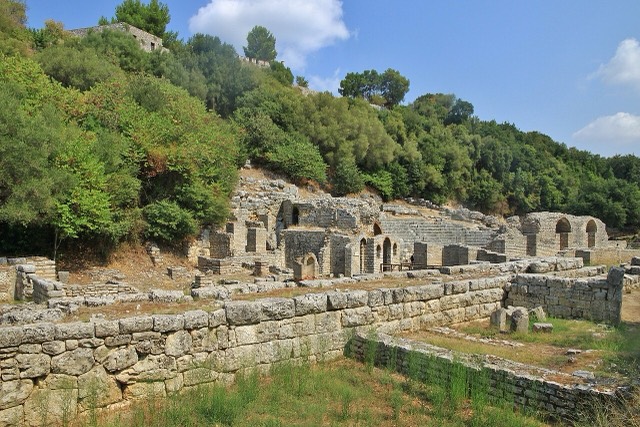
Historic site · Vlorë
A Greek, Roman, Byzantine, Venetian and Ottoman city layered on one wooded peninsula — Albania's first UNESCO site.
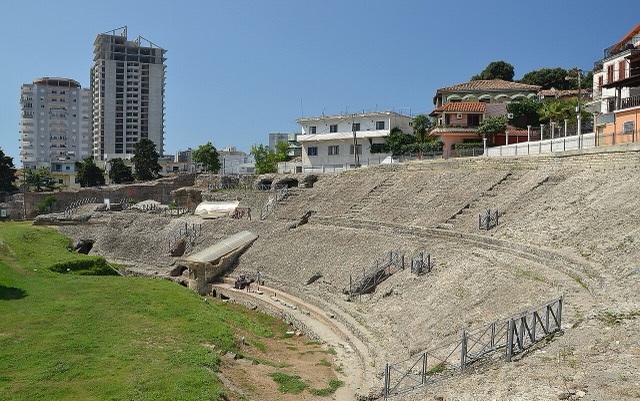
Historic site · Durrës
The largest Roman amphitheatre in the Balkans, found by accident in 1966 under the modern city.
Subject
Rome's road from the Adriatic to Byzantium, which began at Durrës and Apollonia.
Explainer
Illyrians, Greek colonists and Rome, layered on the same coastline for a thousand years.
Something wrong on this page? Corrections are welcome and are checked against the source record. Tell us what is wrong and, if you can, where the right figure comes from.