유적지 · Fier
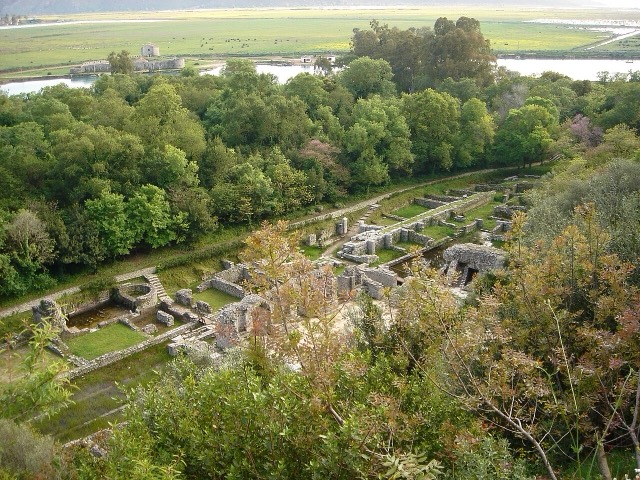
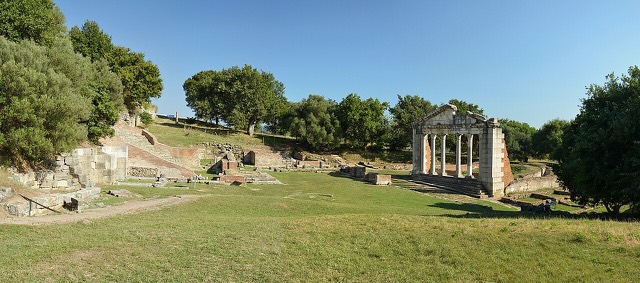
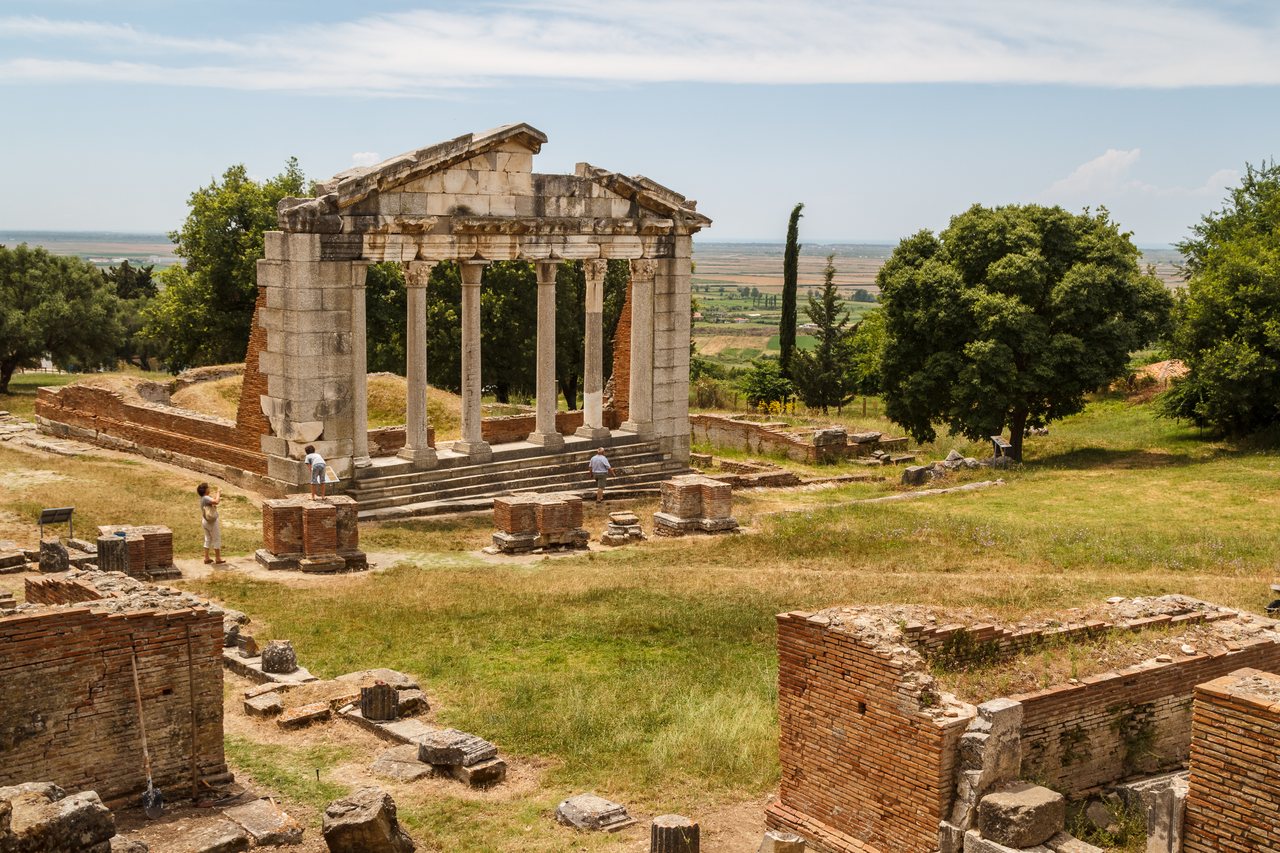
Apollonia
A Corinthian colony that became a Roman university town — Octavian was studying here when Caesar was killed.
모든 주, 모든 해안, 모든 세기
안내 보기
알바니아가 처음이신가요? 모든 페이지는 세부 내용이 시작되기 전에, 열 살짜리 아이도 이해할 수 있는 평이한 설명으로 시작됩니다.
전문가 보기
기본 내용은 이미 알고 계신가요? 간단한 설명은 숨기고 핵심 내용만 바로 확인하세요. 이것이 기본 설정입니다.
역사적 시기
Corinthian and Corcyraean foundations at Epidamnos, Apollonia and Orikum along the coast.
저장
Ancient Greeks sailed across and built cities on the Albanian coast, including Epidamnos (now Durrës) in 627 BC and Apollonia in 588 BC. These were trading cities with theatres, temples and their own coins.
Ancient Greeks sailed across and built cities on the Albanian coast, including Epidamnos (now Durrës) in 627 BC and Apollonia in 588 BC. These were trading cities with theatres, temples and their own coins.
The Greek colonisation of the 8th–6th centuries BCE placed several permanent settlements on the coastline and hinterland of what is now Albania. Ancient sources identify eight sites on modern Albanian territory as Greek colonies: Nymphaeum, Epidamnos, Apollonia, Aulon, Chimara, Bouthroton, Oricum, and Thronion. These foundations were part of the broader Archaic Greek expansion across the Mediterranean and the Black Sea, an organised movement distinct from the tribal migrations of the earlier Greek Dark Ages.
The colonisation of this Adriatic and Ionian coastline was not a random process. Greek city-states chose locations in advance for their business advantages and capacity for defence against raiders. Each mission was directed by a designated leader, the oikistes, who oversaw the parcelling of land, including farmland, and established a system of governance modelled on that of the founding metropolis.
The two most significant Greek colonies established on Albanian soil were Apollonia and Epidamnos, both founded by Corinth. The Corinthians concentrated their colonial activity on the sea lanes leading to Southern Italy and the western Mediterranean, and the Illyrian coast provided essential waypoints along these routes. Apollonia and Epidamnos evolved into important cities.
The wealth reached by Epidamnos in antiquity is documented by a specific piece of archaeological evidence: around the 6th century BCE, the citizens of Epidamnos constructed a Doric-style treasury at the sanctuary of Olympia. Such a treasury was a mark of significant civic resources, and an ancient account explicitly describes Epidamnos as 'a great power and very populated' city.
Apollonia is listed alongside Epidamnos as one of the principal Corinthian foundations in Illyria. Corinthian colonial strategy in this region was consistent: the article notes that the region of the Ionian Sea and Illyria was colonised strictly by Corinth, and the colonies there succeeded in making Corinth the foremost commercial power on the western side of the Mediterranean.
Beyond Apollonia and Epidamnos, Nymphaeum is identified as another Greek colony in Illyria, on the territory of modern Albania. No founding metropolis is specified for Nymphaeum in the article.
Thronion, also listed among the Albanian-territory colonies, was founded by the Abantes of Euboea. The Abantes were a people of Euboean origin, connecting Thronion to the same broad Euboean colonial movement that drove many of the earliest Greek settlements across the Mediterranean. Aulon, Chimara, Bouthroton, and Oricum complete the eight sites indexed under modern Albania, though the article supplies no detailed founding accounts for these specific settlements beyond their inclusion in the colonial index.
In the early 4th century BCE, the Greek tyrant of Syracuse, Dionysius I, initiated a deliberate programme of new colonial foundations along the Adriatic. As part of this programme, Lissos — now the city of Lezhë in northern Albania — was founded in 385 BCE. This makes it one of the few Albanian-territory foundations with a precise date recorded in ancient sources.
The strategic logic behind Dionysius's Adriatic programme was explicit: by establishing and controlling a chain of colonies, he secured total control over the Adriatic sea routes along which grain from the Po Valley was shipped to Greece. This allowed Syracuse, and Sicily more broadly, to compete with the Etruscans in that trade. Lissos was therefore not a product of demographic pressure or cultural expansion in the traditional sense, but a calculated move in a wider commercial and political strategy.
Evidence of coin use on the Illyrian coast, dateable to around the 4th century BCE and minted in Adriatic colonies including Issa and Pharos, documents the trading activity that underpinned this network. Lissos and other Albanian-coast settlements were embedded in this Adriatic commercial system.
The Corinthian foundations in the region of the Ionian and Adriatic seas formed an interconnected system of colonies that secured Corinth's dominance over western Mediterranean commerce. Beyond Apollonia and Epidamnos in Illyria, Corinth founded Leucada, Astacus, Anactoreum, Actium, Ambracia, and Corcyra, all in what is now western Greece, giving Corinth control of a continuous chain of strategic points along the route to Italy.
The article describes these Corinthian colonies collectively as having 'succeeded in making them the foremost emporia of the western side of the Mediterranean.' The Albanian foundations were therefore not peripheral outposts but integral nodes in a carefully maintained commercial and strategic network. The Doric treasury at Olympia built by the citizens of Epidamnos is the most concrete surviving indicator of just how much wealth this position generated.
The Greek colonies established in Illyria and elsewhere during the Archaic period differed in several respects from the colonial enterprises of early modern European states. The expansion was not centrally controlled by any single Greek state; foundations emanated from many different poleis. The oracle at Delphi functioned as a hub where information was gathered, but it did not direct colonisation in any administrative sense. Scholarship also notes that at least in some cases foundations may have been private initiatives rather than acts of state.
Crucially, the new settlements did not claim or exploit the surrounding hinterland. Greek colonisation was limited to coastal regions, and the colonists did not demand tribute from inland populations or lay claim to territory beyond their immediate settlement. The colonies also became independent of their mother cities quickly, unlike the dependent territories of the Spanish or English empires. The term 'colonisation' is therefore treated with caution in modern scholarship, since it can import misleading associations from later historical periods.
The motives behind Greek colonisation were mixed and varied by case. Demographic pressure was one documented driver: Herodotus's account of the founding of Cyrene in Libya describes severe overpopulation and prolonged drought on the island of Thera as precipitating factors. Thucydides noted that Greek city-states in the Peloponnese regularly fought violently over fertile agricultural land, placing additional strain on local populations and encouraging emigration.
Political and social instability also produced colonies. Strabo recorded that Taras was founded by the Parthenians, descendants of Spartan women who were denied full citizenship rights; after a failed conspiracy, they were directed to establish a colony rather than remain in Sparta. This pattern — resolving internal tension by dispatching a disaffected group — recurs in the ancient accounts.
Economic and strategic calculation operated alongside demographic and social factors. Many colonies were founded in locations that allowed them to control trade routes, functioning as commercial emporia. The article notes that colonies along the coasts of southern Italy and Sicily were established partly because of the abundance of natural resources and fertile land. Over time, some evolved into significant revenue sources through taxation and rents.
The founding of a colony was typically a structured enterprise directed by the originating metropolis, though collaboration with other cities was common. Before departure, the destination was chosen in advance with attention to commercial opportunity and defensibility. Each expedition was led by an oikistes, a leader nominated by the colonists, who held formal authority over the foundation process.
Once established, the colonists divided the land, allocating farms as well as urban plots. Governance in the new settlement was generally modelled on that of the mother city. Cultural and religious ties between colony and metropolis were maintained through shared heritage, and apoikiai — the most common colonial form in the 8th to 7th centuries BCE — typically remained culturally aligned with their founding city even when politically independent.
A distinction existed in Greek terminology between two types of settlement process: epoikismos (ἐποικισμός) referred to founding a new settlement, while enoikismos (ἐνοικισμός) described the settling of Greeks within existing native populations. Both processes left traces in the archaeological record of the Illyrian coast, where evidence of coinage documents Greek-Illyrian commercial contact from around the 4th century BCE.
The colonisation period is conventionally dated to the 8th–6th centuries BCE, with the process beginning when the Euboeans founded Pithecusae in Southern Italy and Olynthus in Chalcidice at the start of the 8th century. According to a summary cited in the article, the movement peaked between 750 and 500 BCE, during which Greek-speaking people from approximately twenty municipalities on the Greek mainland and the west coast of Asia Minor established several hundred trading settlements across southern Italy, the Black Sea coast, and Gaul.
At the end of the 8th century BCE, Euboea's colonial energy declined with the outbreak of the Lelantine War. Other city-states — Ionians, Corinthians, Therans, Samians — continued founding colonies through the 7th and 6th centuries. The Black Sea was colonised primarily by the Megarans and Ionian cities including Miletus, Phocaea, and Teos, with most Black Sea foundations dating to the 7th century BCE. A later, distinct colonial form, the Athenian cleruchy, appeared in the 5th to 4th centuries BCE; unlike apoikiai, cleruchies were politically dependent on Athens, and their residents retained Athenian citizenship and paid taxes to Athens.
The Greek colonies on Albanian territory were nodes in a system that carried Greek culture, material goods, and institutional forms into contact with local Illyrian populations. The broader pattern documented across the colonisation period — in which apoikiai maintained cultural ties with the metropolis and spread Greek religious, linguistic, and civic traditions — applied to the Illyrian foundations as well.
The presence of a Doric treasury at Olympia, attributed to the citizens of Epidamnos, is the most precisely documented material consequence on record for any Albanian-territory colony. It places Epidamnos within the mainstream of Greek civic culture and demonstrates a level of wealth sufficient to participate in one of the central institutions of the Greek world. Beyond this, the article records coinage evidence on the Illyrian coast from around the 4th century BCE as documentation of ongoing commercial exchange between the Illyrian population and the Greek colonial settlements.
유적지 · Fier
A Corinthian colony that became a Roman university town — Octavian was studying here when Caesar was killed.
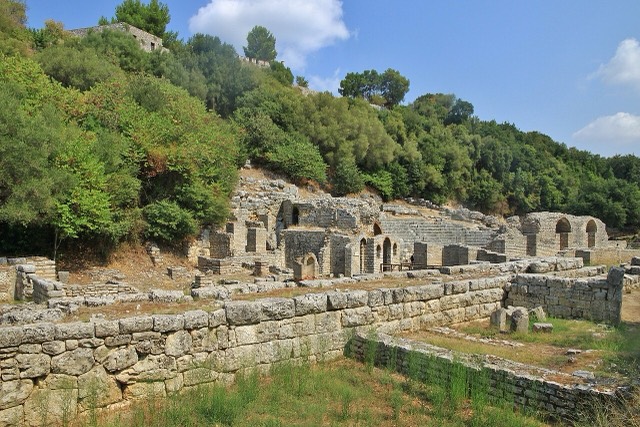
유적지 · Vlorë
A Greek, Roman, Byzantine, Venetian and Ottoman city layered on one wooded peninsula — Albania's first UNESCO site.
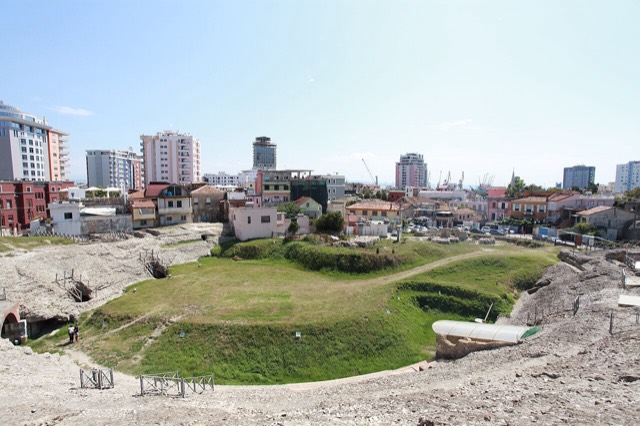
도시 · Durrës
Albania's principal port and its oldest continuously inhabited city, founded as Epidamnos in 627 BC.
해설
Illyrians, Greek colonists and Rome, layered on the same coastline for a thousand years.
이 페이지에 오류가 있습니까? 수정 제안을 환영하며, 출처 기록과 대조하여 검토합니다. 잘못된 내용과 가능하다면 올바른 수치의 출처를 알려 주십시오.