Città · Vlorë
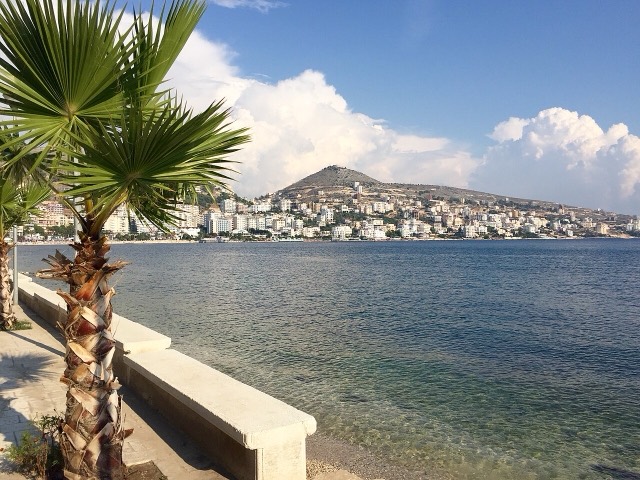
Sarandë
The Ionian resort town facing Corfu, and the arrival point for most visitors to southern Albania.
Ogni contea, ogni costa, ogni secolo
Vista guidata
Non conosci l'Albania? Ogni pagina si apre con una spiegazione in linguaggio semplice, comprensibile anche a un bambino di dieci anni, prima di entrare nei dettagli.
Vista per esperti
Conosci già le basi. Direttamente alla sostanza, con le spiegazioni elementari nascoste. Questa è l'impostazione predefinita.
Spiaggia · Vlorë County
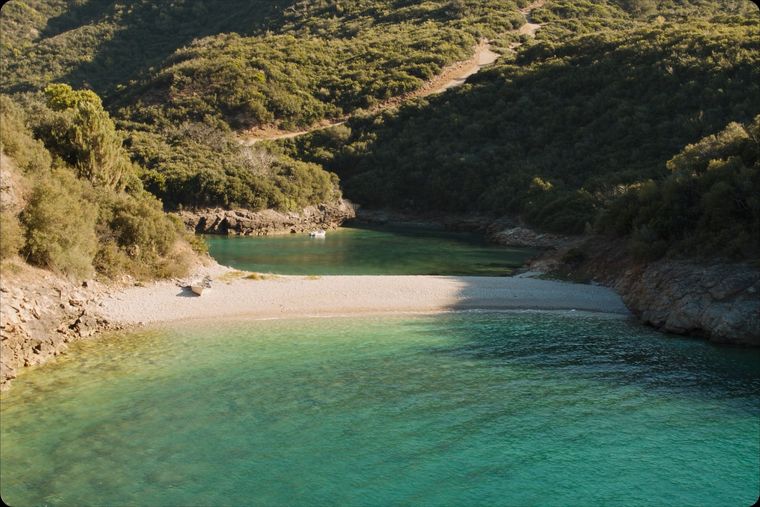
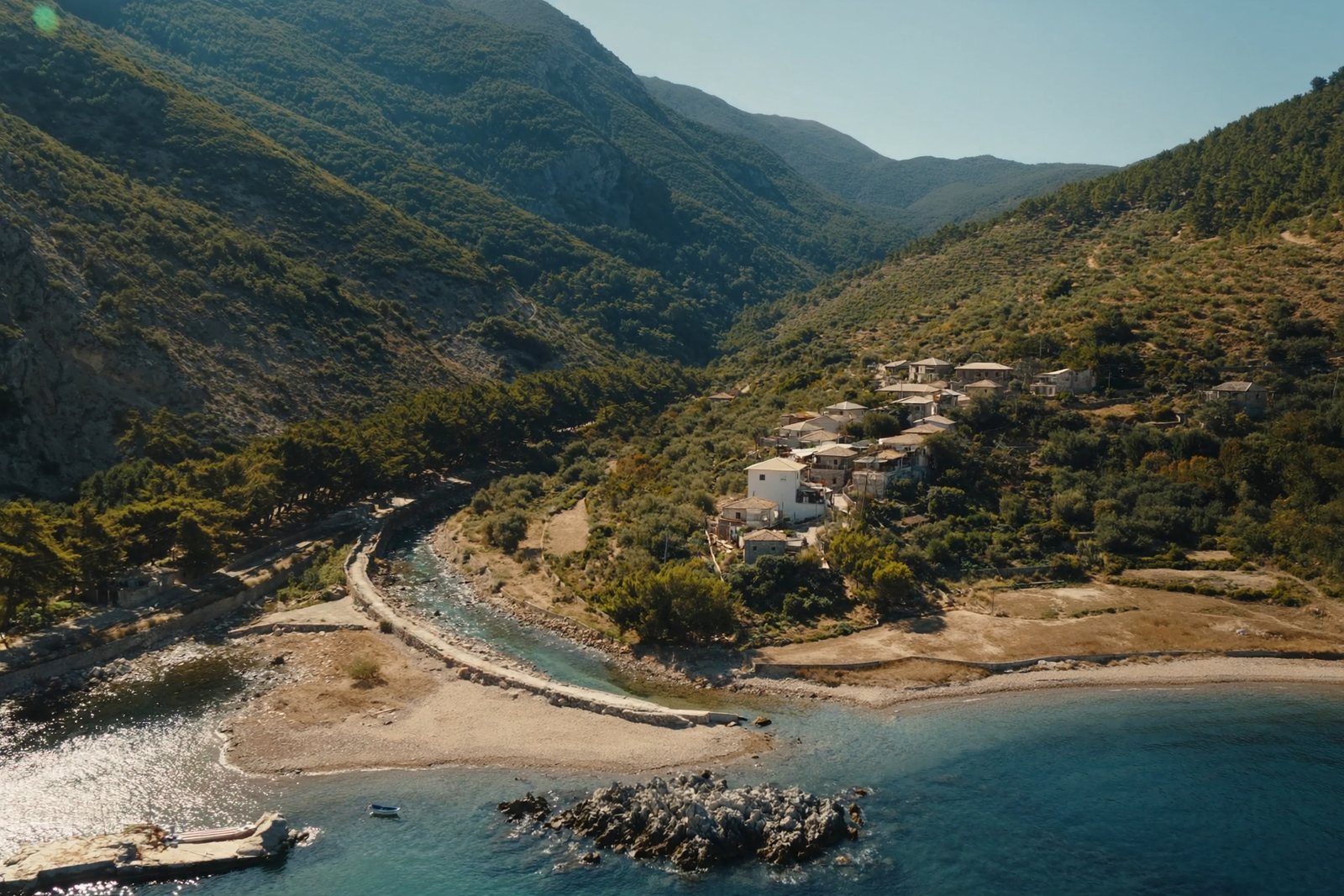
A run of small coves — Bunec, Krorëz and Shpella — below the village of Lukovë.
Salva
Lukovë is a village above several small beaches. Bunec, where a stream meets the sea, is the best known of them.
Lukovë is a village above several small beaches. Bunec, where a stream meets the sea, is the best known of them.
Lukovë is a village in Vlorë County, in southern Albania. It formerly held the status of a separate municipality but became a subdivision of the municipality of Himarë following the local government reform of 2015.
The population recorded at the 2011 census was 2,916. The village serves as the municipal seat of what was formerly the Lukovë commune, a unit that encompassed several other settlements including Borsh, Fterrë, Sasaj, Piqeras, Çorraj, Shën Vasil, Nivicë, and Qazim Pali.
The Albanian toponym Lukovë is derived from Slavic roots. Scholarly interpretation offers two possible origins: the words luk, laka, or luka, referring to water flowing nearby, meadowland, or a wet meadow along a river; or alternatively luk and luka in the sense of a place associated with onions. Both derivations are combined with the Slavic suffix -ov/-a.
In Greek the village is known as Λούκοβο (Loukovo).
During the Ottoman period, Lukovë was grouped with the nearby settlements of Piqeras and Nivicë within the Himara area, a community that held a special semi-autonomous status inside the Ottoman administrative structure. In 1570 and 1571 a short-lived rebellion broke out in the Himara region under Emmanuel Mormoris. After a prolonged siege the rebels succeeded in capturing the castle of Nivicë.
In 1722, the Italian missionary Giuseppe Schirò recorded that Lukovë was inhabited by ethnic Albanians.
In 1798, Lukovë and several adjacent villages south of Himara were attacked and plundered by Ali Pasha of Ioannina, the local Ottoman lord. In the villages of Nivicë and Shën Vasil, massacres of Orthodox inhabitants were carried out around Easter of that year. These events were followed by cases of large-scale Islamisation among the local population in the region.
By the end of the 19th century, Greek-language elementary schools were operating in the villages of Lukovë, Nivicë, Çorraj, and Shën Vasil.
According to 1991 estimates, Lukovë village itself had a majority Orthodox Albanian population of approximately 2,076 people (82%), with minorities of Muslim Albanians at around 250 (12%) and Greeks at around 150 (6%). The villages of Borsh, Fterrë, and Sasaj were exclusively populated by Muslim Albanians. Piqeras had an Orthodox Albanian majority of 991 alongside around 100 Muslim Albanians and 50 Greeks. Shën Vasil had a majority Orthodox Albanian population of 1,434, with a minority of 220 Muslim Albanians and 210 Greeks. Nivicë had an Orthodox Albanian majority of 899 and a minority of approximately 30 Greeks. Qazim Pali, established as a new village during the communist period, was populated by 861 Muslim Albanians alongside minorities of Orthodox Albanians (50) and Greeks (80). Çorraj was described as a mixed Orthodox Albanian and Muslim Albanian village.
A demographic study by Leonidas Kallivretakis conducted in the late 20th century found that across the Lukovë commune and all its villages, 54% of the population were Albanian Christians, 40% were Albanian Muslims, and 6% were Greek Christians. A separate 2016 estimate recorded the municipality as majority Albanian-speaking with a minority of Greek speakers.
Seaside settlements in the Lukovë area were among Greek minority areas that experienced a substantial decline in population following the fall of communism in Albania in the early 1990s.
The Albanian-speaking inhabitants of the Lukovë region speak the Tosk dialect, specifically the Lab regional variety.
Lukovë has a hot-summer Mediterranean climate, classified as Köppen Csa. Winters are mild and summers are hot and dry. Precipitation falls mainly in the winter months, amounting to 737 mm (29.0 inches) annually.
The average annual temperature is 15.1 °C (59.2 °F).
Several notable figures are recorded as originating from the Lukovë area. Vasil Laçi (1922–1941) was an Albanian patriot who in 1941 attempted to assassinate Victor Emmanuel III, then King of Italy, and Shefqet Bej Vërlaci, then Prime Minister of Albania. Nafiz Bezhani is noted as an Albanian jurist, politician, and writer. Muzafer Korkuti served as an Albanian archaeologist and Vice President of the Academy of Sciences of Albania. Jakup Mato, an Albanian publicist and educational administrator, served as head of the Centre of Art Studies of the Academy of Sciences of Albania.
From the village of Nivicë, Dimitrios Doulis (1865–1928) was a Greek politician who served as Minister of Military Affairs of the Autonomous Republic of Northern Epirus. Niphon of Kafsokalyvia (1316–1411) was a Greek monk venerated as a saint of the Eastern Orthodox Church.
Il mese più caldo è August (massima giornaliera media 28°C), il più freddo è January (minima giornaliera media 5°C), e il più piovoso è November (284 mm). La precipitazione annua totale è in media 1,628 mm. La temperatura del mare raggiunge il picco in agosto, intorno a 26°C.
| Mese | Massima | Minima | Pioggia | Giorni piovosi | Sole/giorno | Mare |
|---|---|---|---|---|---|---|
| January | 11°C | 5°C | 201 mm | 13 | 7.1 h | 16°C |
| February | 12°C | 6°C | 169 mm | 12 | 7.9 h | 15°C |
| March | 14°C | 7°C | 158 mm | 12 | 9.5 h | 15°C |
| April | 16°C | 10°C | 108 mm | 12 | 10.9 h | 16°C |
| May | 21°C | 14°C | 72 mm | 10 | 12.1 h | 19°C |
| June | 25°C | 18°C | 37 mm | 5 | 13.7 h | 24°C |
| July | 28°C | 21°C | 17 mm | 3 | 13.8 h | 26°C |
| August | 28°C | 22°C | 26 mm | 4 | 12.9 h | 26°C |
| September | 24°C | 18°C | 128 mm | 9 | 10.6 h | 26°C |
| October | 20°C | 14°C | 174 mm | 10 | 9.1 h | 25°C |
| November | 16°C | 10°C | 284 mm | 14 | 7.1 h | 21°C |
| December | 12°C | 7°C | 254 mm | 14 | 6.5 h | 18°C |
Fonte: ERA5 reanalysis via Open-Meteo, 1994–2023 · «Massima» e «Minima» sono la temperatura dell'aria massima e minima giornaliera media. «Giorni piovosi» conta i giorni con almeno 1 mm di precipitazione.
Città · Vlorë
The Ionian resort town facing Corfu, and the arrival point for most visitors to southern Albania.
Spiaggia · Vlorë
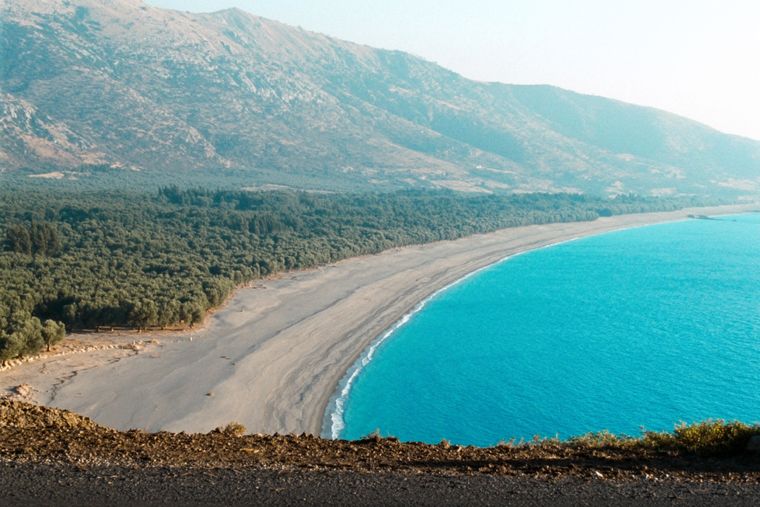
At roughly 7 km, the longest single beach on the Riviera, backed by one of Albania's largest olive groves.
Spiaggia · Vlorë
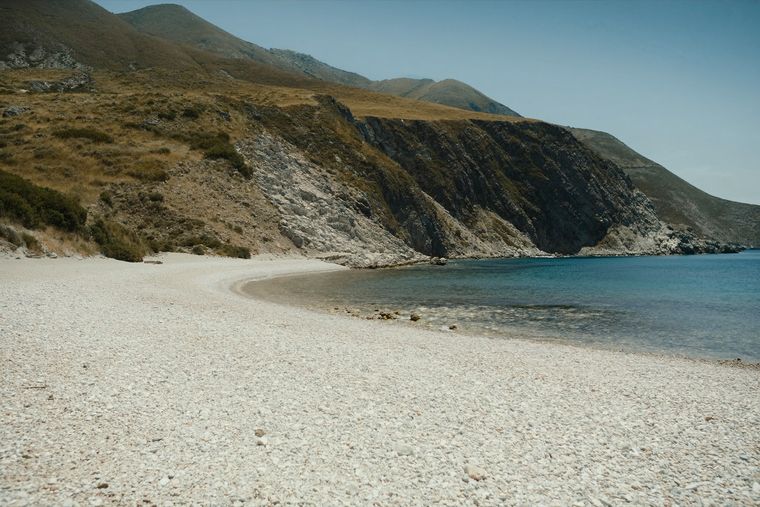
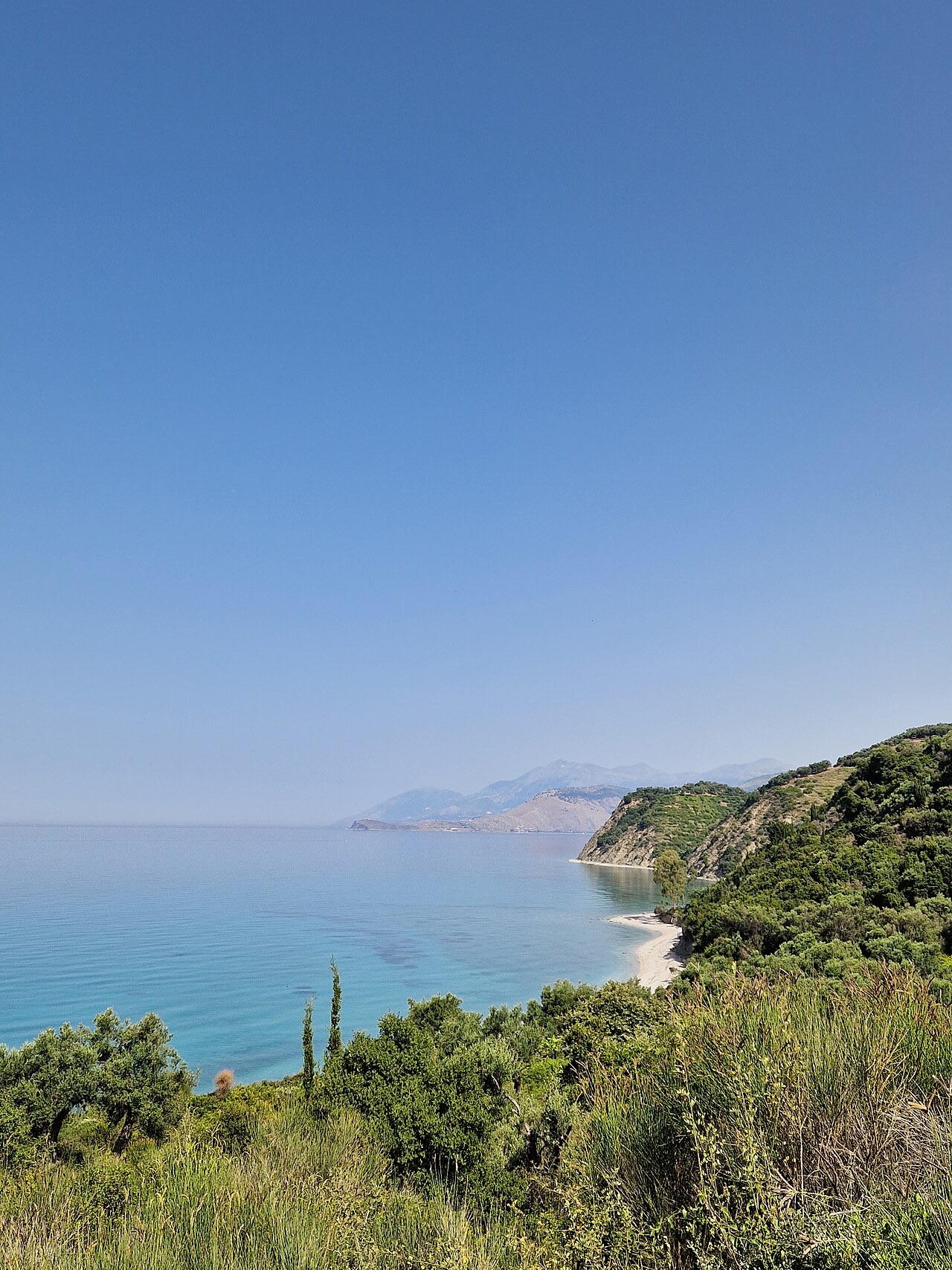
A deep, clear bay north of Sarandë, long the subject of a contested development.
Oggetto · Vlorë
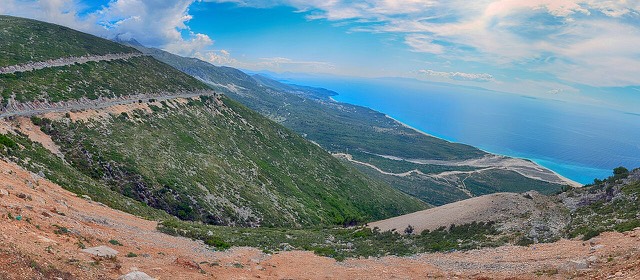
The 120 km of Ionian coast between the Llogara pass and Sarandë, where the Ceraunian mountains fall straight into the sea.
Hai notato un errore in questa pagina? Le correzioni sono benvenute e vengono verificate rispetto al record di fonte. Indica cosa è sbagliato e, se possibile, da dove proviene il dato corretto.