Historische site · Tiranë
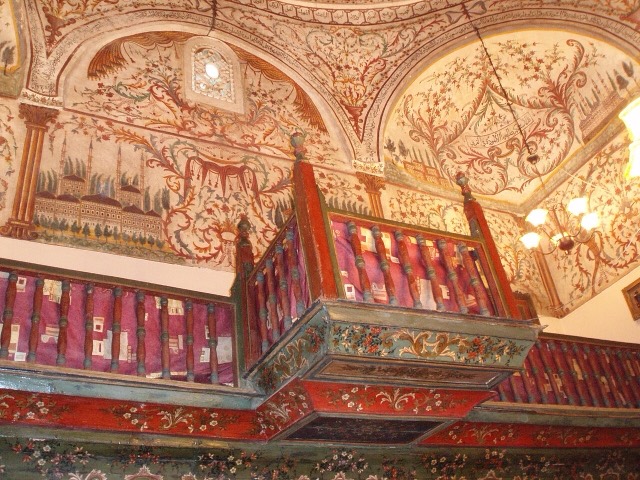
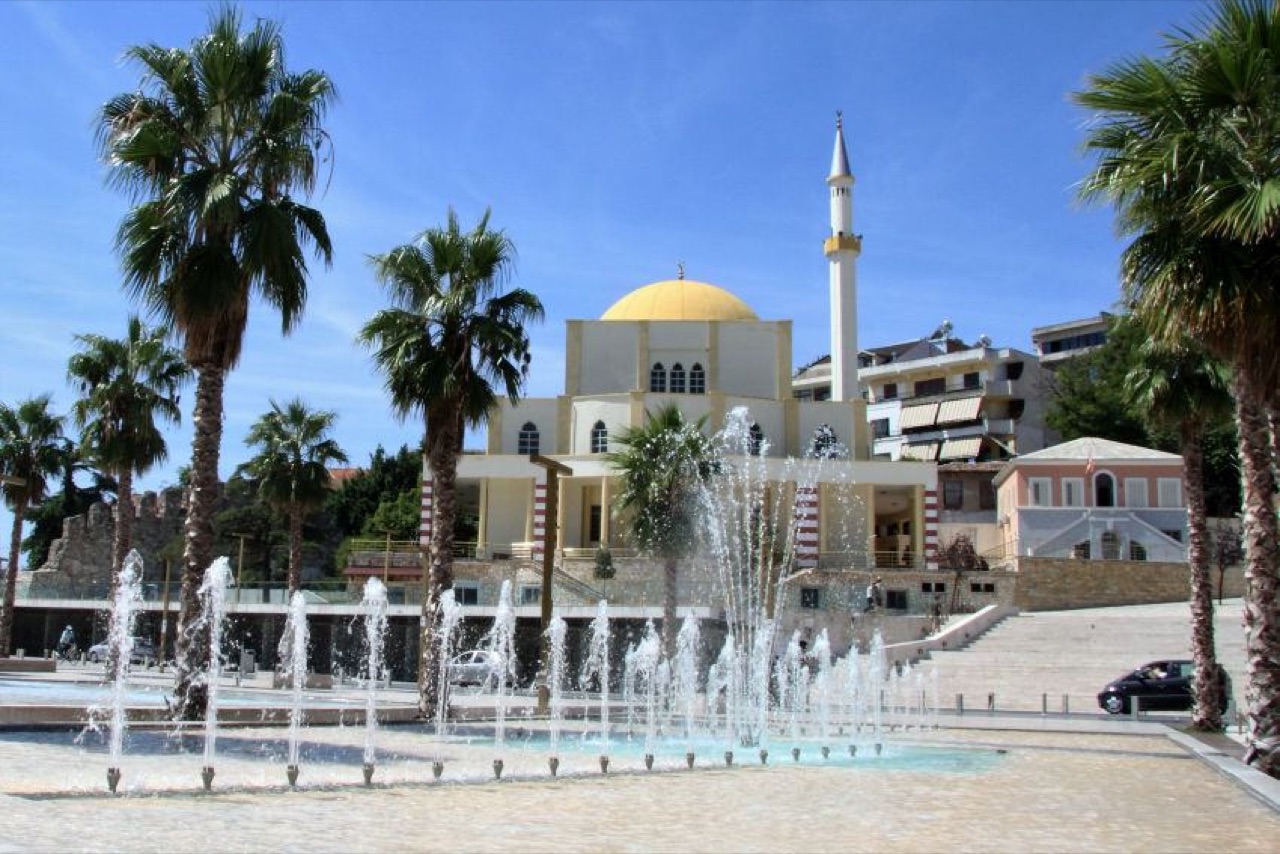
Et'hem Bey Mosque
The small mosque on Skanderbeg Square whose frescoes of trees and waterfalls are unusual in Islamic art.
Elke provincie, elke kust, elke eeuw
Begeleidende weergave
Nieuw in Albanië? Elke pagina begint met een uitleg in eenvoudige taal die u aan een tienjarige zou kunnen voorlezen, voordat de details beginnen.
Expertweergave
U kent de basis al. Meteen naar de kern, met de eenvoudige uitleg verborgen. Dit is de standaardinstelling.
Onderwerp
Four historic communities — Sunni, Bektashi, Orthodox and Catholic — and a state that banned all of them from 1967 to 1990.
Opslaan
Albania has Muslims, Bektashis, Orthodox Christians and Catholics, and they have lived side by side for a long time. In 1967 the communist government banned religion completely and closed every mosque and church, the only country ever to do so. Worship became legal again in 1990.
Albania has Muslims, Bektashis, Orthodox Christians and Catholics, and they have lived side by side for a long time. In 1967 the communist government banned religion completely and closed every mosque and church, the only country ever to do so. Worship became legal again in 1990.
Albania has been a secular state since independence in 1912. The constitution declares no official religion and requires the state to be neutral in questions of belief and conscience. Freedom of religion, belief, and conscience are constitutionally guaranteed, and all registered religious groups have the right to hold bank accounts and to own property and buildings. The government is prohibited from showing favour to any one faith in government administration or the school system.
Despite formal equality, the four historically dominant communities — Sunni Muslims, Bektashis, Catholics, and Orthodox Christians — enjoy a greater degree of official recognition, including national holidays, reflecting their continuous historical presence. Religious history and comparative religion may be taught in the context of humanities instruction in public schools, while private schools are permitted to teach religious instruction. The Ministry of Education retains the right to approve the non-religious curricula of religious schools to ensure compliance with national education standards.
Christianity reached the region that is now Albania relatively early in the Roman era. The territory was then composed mostly of Epirus Nova and part of southern Illyricum. St Paul is cited in Romans 15:19 as having preached 'even unto Illyricum', and one scholar, Schnabel, asserts that Paul probably preached specifically in Shkodra and Durrës. The steady growth of the Christian community in Dyrrhachium (Roman Epidamnus, modern Durrës) led to the creation of a local bishopric in 58 AD. Episcopal seats were subsequently established in Apollonia, Buthrotum (modern Butrint), and Scodra (modern Shkodra). Christian bishops from what would become eastern Albania participated in the First Council of Nicaea.
Notable early martyrs connected to the region include Saint Astius, Bishop of Dyrrachium, who was crucified during the persecution of Christians under the Emperor Trajan, and Saint Eleutherius, Bishop of Messina and Illyria, martyred along with his mother Anthia during the anti-Christian campaign of Hadrian. From the 2nd to the 4th centuries Latin was the main language used to spread Christianity in the region; from the 4th to the 5th centuries Greek predominated in Epirus and Macedonia while Latin continued in Praevalitana and Dardania. The following centuries saw the construction of churches in Kosine, Mborje, and Apollonia.
In 732, the iconoclast Byzantine emperor Leo III, angered by regional archbishops who had supported Rome in the Iconoclastic Controversy, detached the church of the province from the Roman pope and placed it under the Patriarch of Constantinople. When the East-West Schism formally separated Western and Eastern Christianity, southern Albanian regions retained ties to Constantinople while northern areas reverted to Roman jurisdiction. By the time Albanians first appear clearly in Byzantine sources in the 11th century, they are recorded as already fully Christianised.
After the Fourth Crusade and the fall of the Byzantine Empire in 1204, a new wave of Catholic dioceses, churches, and monasteries was founded across Albania, and various religious orders began operating in the country. The creation of the Kingdom of Albania in 1272, linked to Western Europe and the Angevins, established a decidedly Catholic political structure that facilitated further spread of Catholicism across the Balkans. Durrës became a Catholic archbishopric again in 1272. The bishopric of Vlora converted immediately following the founding of the Kingdom. Around 30 Catholic churches and monasteries were built in northern Albania and Serbia during the reign of Helen of Anjou as Queen consort of Serbia.
Between 1350 and 1370, Catholicism in Albania reached its peak. At that period there were approximately seventeen Catholic bishoprics in the country, which served not only as centres for internal Catholic reform but also as bases for missionary activity in neighbouring areas with papal permission. Catholic structures appeared as far afield as Skopje, where a local bishop was elected in 1326 with the Pope presiding, and a Dominican was appointed there the following year. At the end of the 14th century, the previously Orthodox Autocephalous Archbishopric of Ohrid was dismantled in favour of the Catholic rite.
Under the reign of Stefan Dušan, Catholics in Serbian-controlled areas were persecuted. Dušan's Code, the Zakonik, labelled the Catholic rite 'Latin heresy' and contained harsh measures against it. Persecutions of local Catholics had in fact begun before 1349 when the Code was formally declared, at least from the start of the 14th century. In consequence, relations between local Catholic Albanians and the papal curia became very close, while previously friendly relations with Serbian rulers deteriorated significantly. A Dominican priest writing in 1332 recorded that within the Kingdom of Rascia there were two Catholic peoples — Latins confined to coastal towns, and Albanians spread across the countryside — both writing with Latin letters though speaking distinctly different languages.
The Ottoman conquest from the 15th century brought Islam to Albania, though the peak of Islamisation occurred later there than elsewhere in the Balkans. Sixteenth-century Ottoman census data shows that sanjaks inhabited by Albanians remained overwhelmingly Christian, with Muslims constituting no more than 5% in most areas: Ohrid 1.9%, Shkodra 4.5%, Elbasan 5.5%, Vlora 1.8%, and Dukagjin 0%. During the same period, Muslim populations had already risen to large proportions in Bosnia (46%), Herzegovina (43%), urban Sarajevo (100%), Skopje and Bitola (both 75%), and parts of Eastern Bulgaria. Islamisation in Albania continued to make significant progress in the 19th century, particularly in the south, even as the process had largely halted elsewhere in the Balkans.
The head tax levied on Albanian Christians rose dramatically during the 17th-century Ottoman campaign of Islamisation: from approximately 45 akçes in the 1500s to 780 akçes by the mid-1600s. In the same period there were only 130 Catholic priests in the entirety of Albania, many poorly educated. In the north, while Central and Northern Albania remained firmly Catholic at the start of the 17th century with Muslims estimated at no more than 10%, by the mid-17th century 30–50% of Northern Albania had converted to Islam. By 1634 most of Kosovo had also converted. The Venetian Republic's hold on parts of the northern coast helped prevent complete Islamisation in those areas.
Specific local factors accelerated conversion in the south. In Vlora and the surrounding region, Christians converted en masse after the area was recaptured from Christian forces in 1590, fearing violent retribution for their prior collaboration. In Labëri, mass conversion took place during a famine in which the bishop of Himara and Delvina allegedly forbade the population from breaking the fast and consuming milk under threat of eternal damnation. Orthodox areas around Elbasan converted during the 1700s, passing through a stage of crypto-Christianity, though scattered Orthodox communities remained around Berat, in Zavalina, and in the region of Myzeqe including Fier and Lushnjë. Crypto-Christians in the Shpati region formally reverted to Orthodoxy as late as 1897. The region of Gjirokastra did not become majority Muslim until around 1875, and even then most Muslims were concentrated in the city itself.
After independence in 1912, Albania never adopted an official state religion either as a republic or as a kingdom. The early decades of the 20th century saw a deliberate programme of nationalising religion. In 1923 the Albanian Muslim congress convened in Tirana and decided to break with the Caliphate, established a new form of prayer standing rather than the traditional salah, banished polygamy, and abolished the mandatory veil (hijab) for women in public. In 1929 the Albanian Orthodox Church was declared autocephalous.
The first official religious census was conducted in 1930. It grouped 50% of the population as Sunni Muslim, 20% as Orthodox Christian, 20% as Bektashi Muslim, and 10% as Catholic Christian — figures described as reiterating conventional Ottoman data from a century earlier which had previously covered double the new state's territory and population. The monarchy promoted the slogan 'Religion separates, patriotism unites' and substituted Albanism for religious identity, describing officials and schoolteachers as 'apostles' and 'missionaries'. Newspaper editorials encouraged parents to give children neutral Albanian names rather than Muslim or Christian ones.
The monarchy stipulated that the state be neutral with no official religion and that free exercise of religion be extended to all faiths. Public school music classes were dominated by hymns idealising the nation, Skanderbeg, war heroes, the king, and the flag, to the exclusion of virtually every other theme. The national hymn characterised King Zogu rather than any religious figure as 'Shpëtimtari i Atdheut' (Saviour of the Fatherland).
Before the Communists took power in 1944, it was estimated that approximately 70% of Albania's population of roughly 1,180,500 persons belonged to Islamic sects and 30% to Christian sects. Among Muslims, at least 200,000 (around 17%) were Bektashis and most of the remainder Sunnis. Among Christians, 212,500 (18%) were Orthodox and 142,000 (12%) were Catholic. The Agrarian Reform Law of August 1946 nationalised most property of religious institutions, including estates of monasteries, orders, and dioceses. All foreign Catholic priests, monks, and nuns were expelled in 1946. Between 1945 and 1953, the number of Catholic churches was reduced from 253 to 100.
Beginning in 1967 the Albanian authorities launched a violent campaign to eliminate religious life entirely. By the end of 1967 all churches, mosques, tekkes, monasteries, and other religious institutions had been closed or converted into warehouses, gymnasiums, or workshops. By May 1967, religious institutions had been forced to relinquish all 2,169 churches, mosques, cloisters, and shrines in Albania. More than 200 clerics of various faiths were imprisoned; others were forced into industrial or agricultural labour; some were executed or starved to death. The monastery of the Franciscan order in Shkodër was set on fire, resulting in the deaths of four elderly monks. A major centre for anti-religious propaganda was the National Museum of Atheism (Muzeu Ateist) in Shkodër.
Article 37 of the Albanian Constitution of 1976 stipulated that 'The State recognises no religion, and supports atheistic propaganda in order to implant a scientific materialistic world outlook in the people.' The penal code of 1977 imposed prison sentences of three to ten years for 'religious propaganda and the production, distribution, or storage of religious literature.' A decree required citizens whose names did not conform to 'the political, ideological, or moral standards of the state' to change them; towns and villages with religious names were also required to be renamed. Parents were afraid to pass on their faith for fear that children would report them. Officials attempted to entrap practising Christians and Muslims during Lent and Ramadan by distributing food during fasting hours and then publicly denouncing those who refused to eat. The ban on religious observance was officially lifted in December 1990, in time for thousands of Christians to attend Christmas services. After Enver Hoxha's death in 1985, his successor Ramiz Alia had adopted a relatively tolerant stance, describing religious practice as 'a personal and family matter', and émigré clergymen were permitted to re-enter the country and officiate at services from 1988.
The 2023 census recorded the following figures for Albania's population of 2,402,113: 1,101,718 (45.86%) Sunni and non-denominational Muslims; 115,644 (4.81%) Bektashi Muslims; 201,530 (8.38%) Catholics; 173,645 (7.22%) Eastern Orthodox; 9,658 (0.40%) Evangelicals; 3,670 (0.15%) other religions; 332,155 (13.82%) believers without a religion or denomination; 85,311 (3.55%) declared atheists; and 378,782 (15.76%) who did not provide an answer. Islam in aggregate forms a narrow absolute majority of approximately 51% of the population. Between 2011 and 2023 the resident population fell by 398,025 persons; in absolute terms Muslims declined by 428,874, Christians by 90,696, while believers without denomination increased by 178,525 and declared atheists by 15,316.
From 1923 to 2023 the Muslim share of the population declined from 68.5% to approximately 50.67%. Christians decreased from around 31% to 16% overall. The combined non-religious total — atheists plus believers without denomination — increased from 8.0% in 2011 to 17.37% in 2023, during a period of overall population decline. A December 2024 survey by the Konrad Adenauer Foundation found that 41.5% of Albanians believe in God without following a specific religion (33.8%) or identify as atheist or agnostic (7.2%), with Sunni Muslims at 36.0% and Christians at 17.2%.
The Orthodox Church of Albania contests the official census figures, which recorded 6.75% Orthodox in 2011 and 7.22% in 2023, describing them as fundamentally incorrect and attributing the low percentages to alleged methodological problems, including the optional nature of the religion question. Independent demographic analyses note that no empirical evidence from surveys or administrative data has been provided to substantiate the claim that most atheists or unaffiliated believers are misclassified Orthodox Christians, and argue that a substantial part of the decline from historical levels — 20.7% in 1942 — reflects genuine demographic change, particularly historically high emigration and lower fertility among Orthodox Christians. A similar long-term decline is visible among Bektashis, falling from 14.7% of the population in 1923 to approximately 2.1% in 2011 before recovering to 4.81% in 2023.
According to 2008 statistics from religious communities, Albania had 1,119 churches and 638 mosques. The Catholic mission declared 694 Catholic churches; the Orthodox community, 425 Orthodox churches; the Muslim community, 568 mosques; and 70 Bektashi tekkes.
Religious observance is generally low even among those who identify with a faith. A 2018 UNDP survey found that 62.7% of respondents said they do not actively practise religion, while 37.3% said they do. A 2022 poll commissioned by Euronews Albania found that 50.7% of respondents never visit places of worship, 27.6% visit them only for religious festivities, and 19.2% visit at least once a month. Between 2018 and 2024, religious engagement among young people declined significantly according to FES Youth Studies: those who never attended religious services or did not belong to a religion rose from 31.3% to 43.7%, while regular monthly attendance dropped from 18.3% to 11.0%.
A 2024 Konrad Adenauer Foundation survey found that 16.4% fast regularly during Ramadan, 21.1% fast occasionally, and 62.1% do not fast. The same survey found that 38.7% stated that they or their parents or grandparents continued to practise religious rites secretly during the period when religion was banned, while 50.8% stated they did not. A Pew Research study of August 2012 found that only 15% of Albania's Muslim population considered religion to be a very important factor in their lives, reported as the lowest percentage in the world among countries with significant Muslim populations. A Gallup Global Reports 2010 survey lists Albania as the thirteenth least religious country in the world, with religion playing a role in the lives of 39% of respondents.
A WIN/Gallup International study in 2016 recorded that 80% of Albanians believed in God, 57% believed people have a soul, 42% believed in heaven, 40% believed in hell, and 40% believed in life after death. The World Values Survey wave 6 (2017–2022) recorded Albania as having the lowest belief in life after death in Europe, at 22.7%. Regarding circumcision, the article notes Albania is described as unique in that only 36.8% of males are circumcised overall; even among Muslims the rate is 46.5%, and among Bektashis it is lower at 21%, contrasting with near-universal practice among Muslim populations worldwide. When asked about religion, Albanians generally refer to their family's historical religious legacy rather than to their own choice of faith.
Interfaith marriages between Muslims and Christians are described as common and regarded as unremarkable in Albania. During the communist period, recorded rates of mixed-background marriages ranged from 1.6% in Shkodër and 4.3% in Gjirokastra to 15.5% among textile workers in Tirana during 1950–1968; in the district of Shkodër they reached 5% by 1980. A December 2024 Konrad Adenauer Foundation survey found that 79% of respondents had no objection to a family member marrying or cohabiting with someone from a family of a different religious background, and that such marriages and partnerships represented 21.5% of all unions in the survey sample. A 2024 national survey by the Institute for Democracy and Mediation reported that 59.9% would certainly support a family member marrying someone of another religion and 19.6% would accept it without actively encouraging it.
The four-way division of Albanians between Sunnis, Orthodox Christians, Bektashis, and Catholics — supplemented later by Albanian Uniates, Protestants, and atheists — meant that Albanian nationalism as it emerged could not tie itself to any single faith. Instead, the nationalist movement promoted harmony between confessions and used shared Albanian language, history, and ethnic customs as unifying themes. Bektashi tekkes in the south and Catholic churches in the north were both used by the nationalist movement as places for the dissemination of nationalist ideals. Especially in the tribal regions of the north, religious differences were often mitigated by common cultural and tribal characteristics and knowledge of family lineages connecting Christian and Muslim Albanians.
In December 1992 Albania became a full member of the Organisation of the Islamic Conference (now the Organisation of Islamic Cooperation). The Albanian constitution provides for equality of all religions; however, the four historically predominant communities — Bektashi, Sunni Muslim, Catholic, and Orthodox — enjoy a greater degree of official recognition based on their historical presence. Religious freedoms have in large part been maintained by the generally amicable relationship among the religious communities. Albania is categorised as having no official state religion, and the government is secular.
Historische site · Tiranë
The small mosque on Skanderbeg Square whose frescoes of trees and waterfalls are unusual in Islamic art.
Historische periode
Forty-six years under Enver Hoxha and his successor: total collectivisation, the banning of religion, successive breaks with…
Onderwerp
An autocephalous church since 1937, rebuilt almost from nothing after 1991.
Onderwerp
A culture shaped by mountain isolation, five centuries of Ottoman rule, and fifty years of enforced separation.
Onderwerp
A Sufi order whose world headquarters has been in Tirana since 1925, with a major shrine on Mount Tomorr.
Persoon
Born in Skopje to an Albanian family from Prizren and Shkodër; canonised in 2016 and now a national symbol.
Plaats · Lezhë
An industrial town and the site of the Saint Anthony pilgrimage church at Shëngjin i Vogël.
Toelichting
Four communities, centuries of coexistence, twenty-three years of total prohibition, and a census question nobody agrees about.
Iets onjuist op deze pagina? Correcties zijn welkom en worden gecontroleerd aan de hand van de bronregistratie. Laat ons weten wat onjuist is en, indien mogelijk, waar het juiste cijfer vandaan komt.