Ville · Vlorë
Vlorë
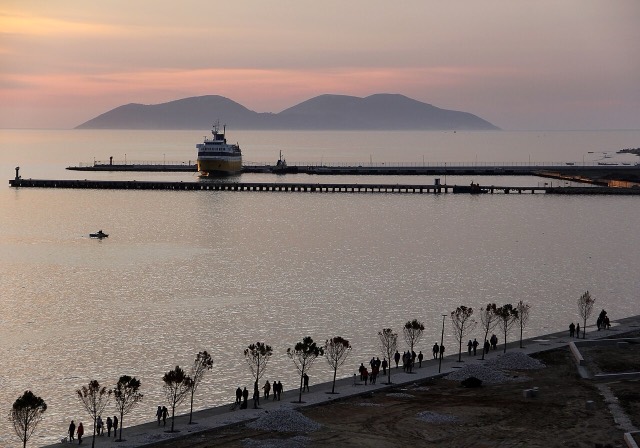
Where the Adriatic meets the Ionian, and where Albanian independence was declared in 1912.
Chaque comté, chaque côte, chaque siècle
Vue guidée
Nouveau en Albanie ? Chaque page s'ouvre sur une explication en langage clair, accessible à un enfant de dix ans, avant d'entrer dans le détail.
Vue expert
Vous connaissez déjà les bases. Directement à l'essentiel, les explications simples étant masquées. Il s'agit du réglage par défaut.
Objet
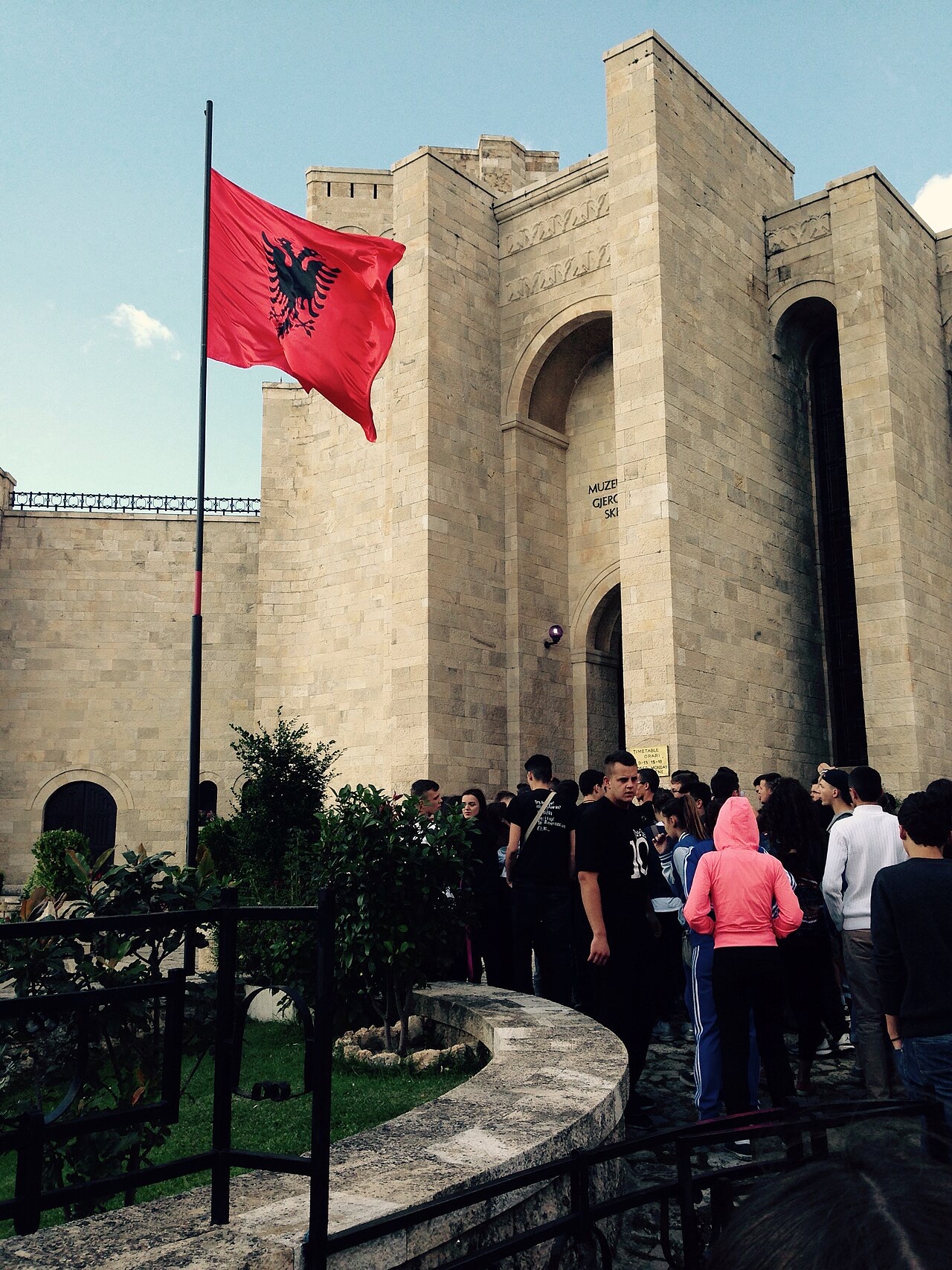
A black double-headed eagle on red — Skanderbeg's standard, and one of the oldest continuously used national symbols in Europe.
Enregistrer
Albania's flag is a black eagle with two heads on a red background. It comes from Skanderbeg's family emblem in the 1400s. Albanians call their country Shqipëria, which is often linked to the word for eagle.
Albania's flag is a black eagle with two heads on a red background. It comes from Skanderbeg's family emblem in the 1400s. Albanians call their country Shqipëria, which is often linked to the word for eagle.
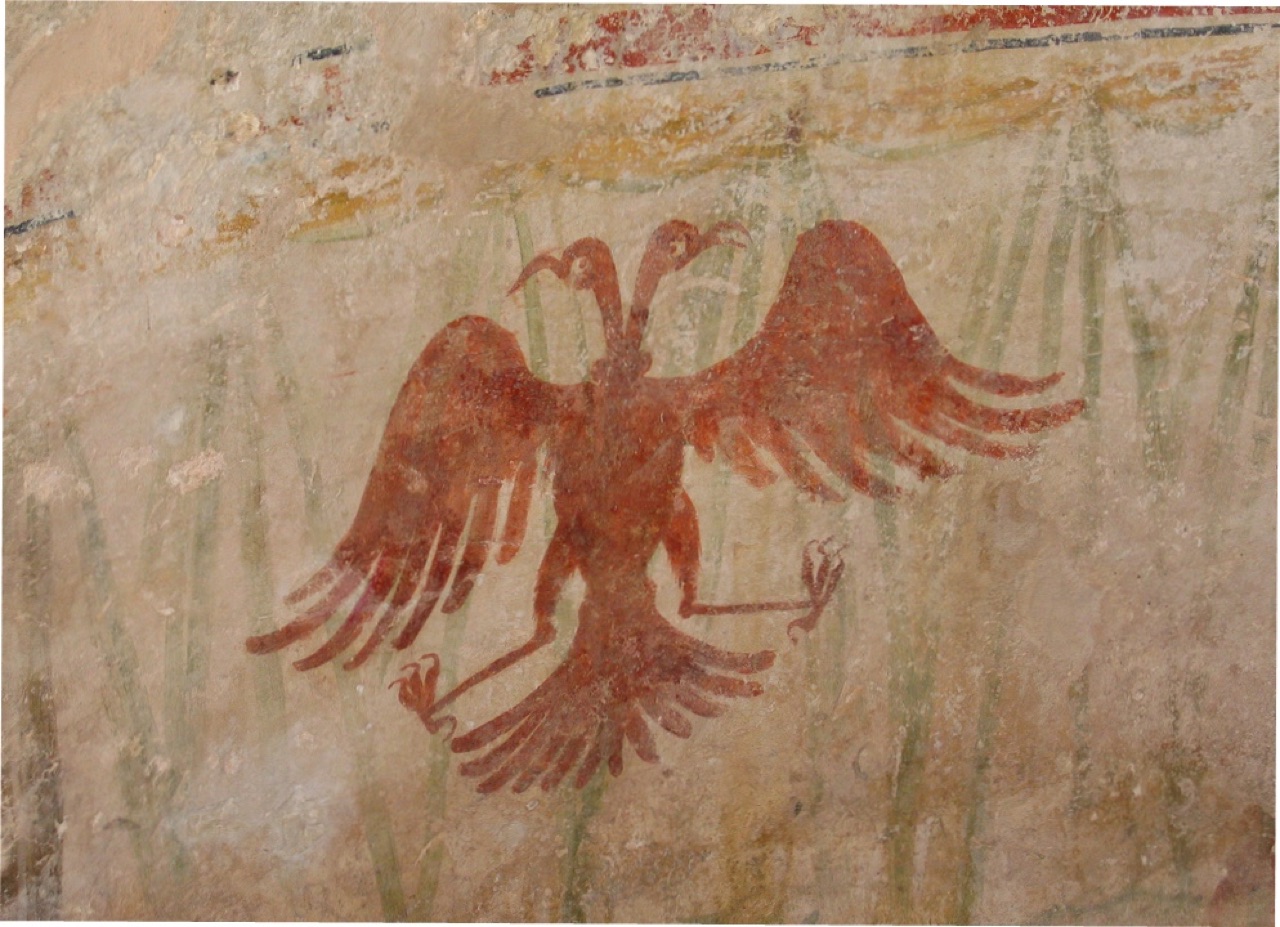
The black double-headed eagle on a red field has served as the defining symbol of Albanian identity since the medieval period. In the Middle Ages it was used for heraldic purposes by a number of Albanian noble families, gradually becoming the emblem of the Albanian people as a whole rather than any single dynasty. Its most prominent early use was on the coat of arms of the House of Kastrioti, whose most famous member, Gjergj Kastrioti Skanderbeg, brought the symbol to wider European recognition through his military campaigns against the Ottoman Empire between 1443 and 1479.
Skanderbeg adopted the double-headed eagle and red background from the Eastern Roman imperial flag during his defection from Ottoman ranks at Niš in 1443. The League of Lezhë, which he led and which represented the first unified Albanian state in the Middle Ages and the oldest representative political body in the country with extant records, flew this design as its flag. His sustained resistance against the Ottomans, which lasted twenty-five years and earned him the papal title Athleta Christi, embedded the eagle firmly in Albanian collective memory.
After the fall of Skanderbeg's resistance in 1479, the symbol largely disappeared from public use in Ottoman-controlled Albanian territories. Albanian nationalists revived it during the 19th and early 20th centuries as the emblem of their campaign for independence from the Ottoman Empire. Its re-emergence as a physical banner after what participants described as roughly 450 years of absence occurred at the Battle of Deçiq on 6 April 1911, during the Albanian revolt of that year.
The first documented raising of the black double-headed eagle on a red background in Ottoman territory in the modern era took place at the peak of Bratila, in present-day Tuzi Municipality, on 6 April 1911 during the Albanian revolt of 1911. The flag was raised by the rebellion leader Ded Gjo Luli following a victory at the Battle of Deçiq. The phrase attributed to him by later memoirs of those present — 'Now brothers you have earned the right to see that which has been unseen for 450 years' — reflects the symbolic weight contemporaries placed on the moment.
The flag was one of three banners brought to the region of Malësia by Palokë Traboini, a student in Austria. The other two banners were used by Ujka of Gruda and Prelë Luca of Triepshi, indicating that multiple groups participated in the symbolic restoration of the emblem during the same uprising. The episode established the flag as an active instrument of Albanian national politics rather than merely a historical memory.
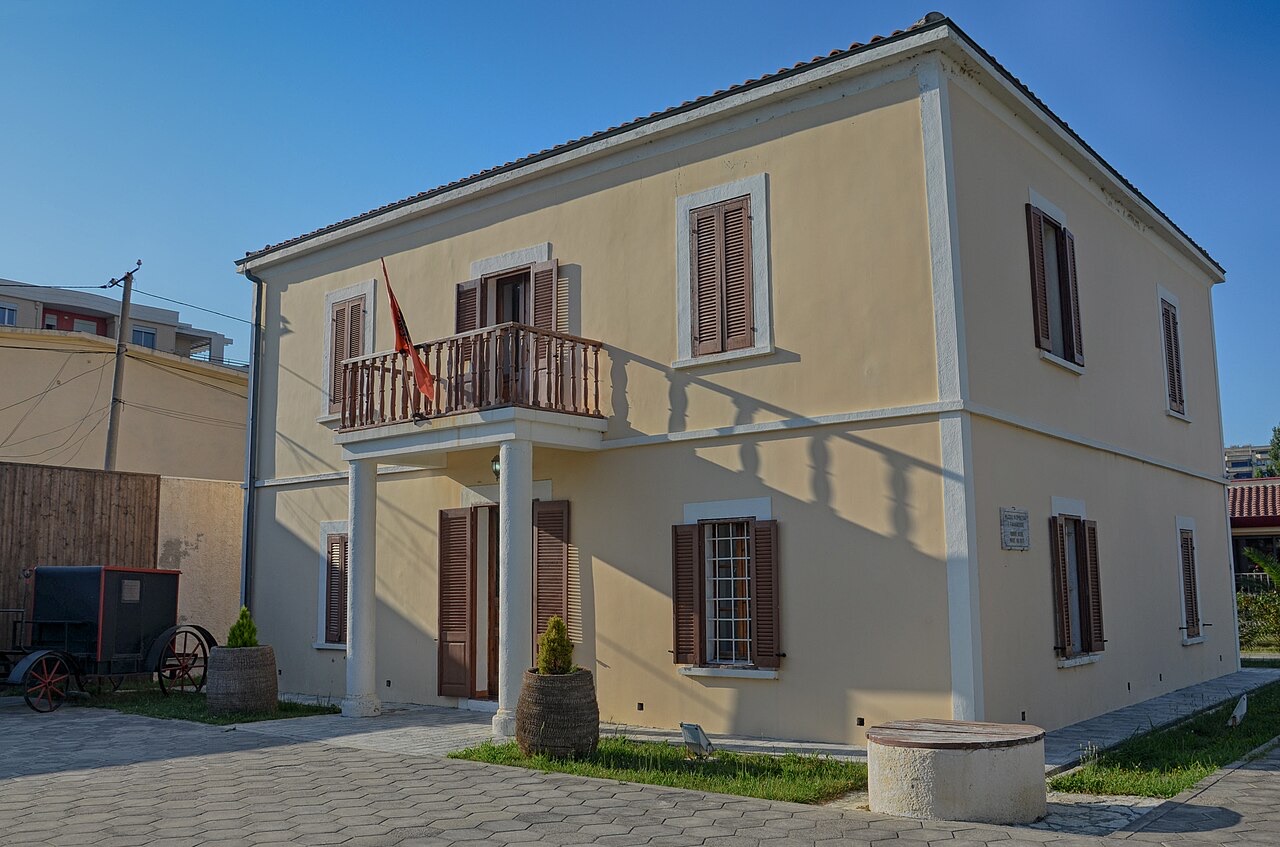
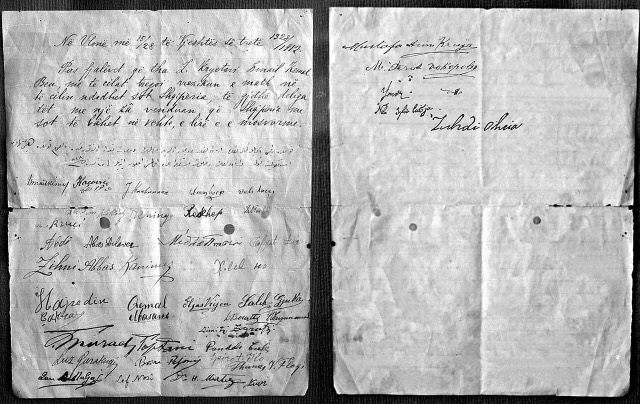
No physical trace of the original flag raised in Vlorë on 28 November 1912 has been confirmed. Researcher and art conservator Frederik Stamati and ethnographic fund specialist Ariola Prifti, both working with the Center for Albanological Studies, have stated there is no trace evidence of it. A 2012 editorial by Top Channel, titled 'The mystery of the first Albanian flag', concluded that 'there is no definitive proof' of how the flag raised that day looked, while presenting ten competing hypotheses.
One leading account identifies the flag as the one given to Eqrem bey Vlora by Don Aladro Kastriota, a wealthy Spanish-Basque diplomat who claimed descent from the House of Kastrioti through his paternal grandmother. Eqrem bey Vlora's posthumously published memoirs, 'Lebenserinnerungen' (Munich, 1968–1973), describe a dinner in Paris around 1909 at which Don Aladro presented him with 'a black double-headed eagle on the red field' inside a red velvet box. Vlora kept the flag in his bedroom for five years until, on 28 November 1912, a friend recalled it was hanging there and it was retrieved and handed to Murad bey Toptani to be displayed outside. This account is corroborated by Syrja bey Vlora's own memoir, 'From the End of Ottoman Rule to the War of Vlora', which states that the flag raised that day was 'taken from our house, which my son Eqrem had been guarding with full respect since 1908(?)'. The flag was subsequently reported to have been confiscated and burned in 1915 by the government of the Autonomous Republic of Northern Epirus.
A second hypothesis, reported by Kristo Floqi in the newspaper Arbënia in 1936, attributes the flag to Marigo Posio, who reportedly made it from cloth purchased from a merchant named Diamanti, based on a model drawn by Dom Mark Vasa and Petro Fotografi. Floqi described it in a 1937 letter as 'a thin red woven cloth, 3 metres long and 2 metres wide, on which a black double-headed vulture was branded'. Posio's assistant, Thina Ferra, supported this account, stating that Posio painted the eagle herself and that Ferra warmed the flag near a brazier to dry it. Floqi had personal connections to both the event and Posio: his brother Thanas signed the Declaration of Independence, and Floqi was married to Urani Poçi, Posio's sister.
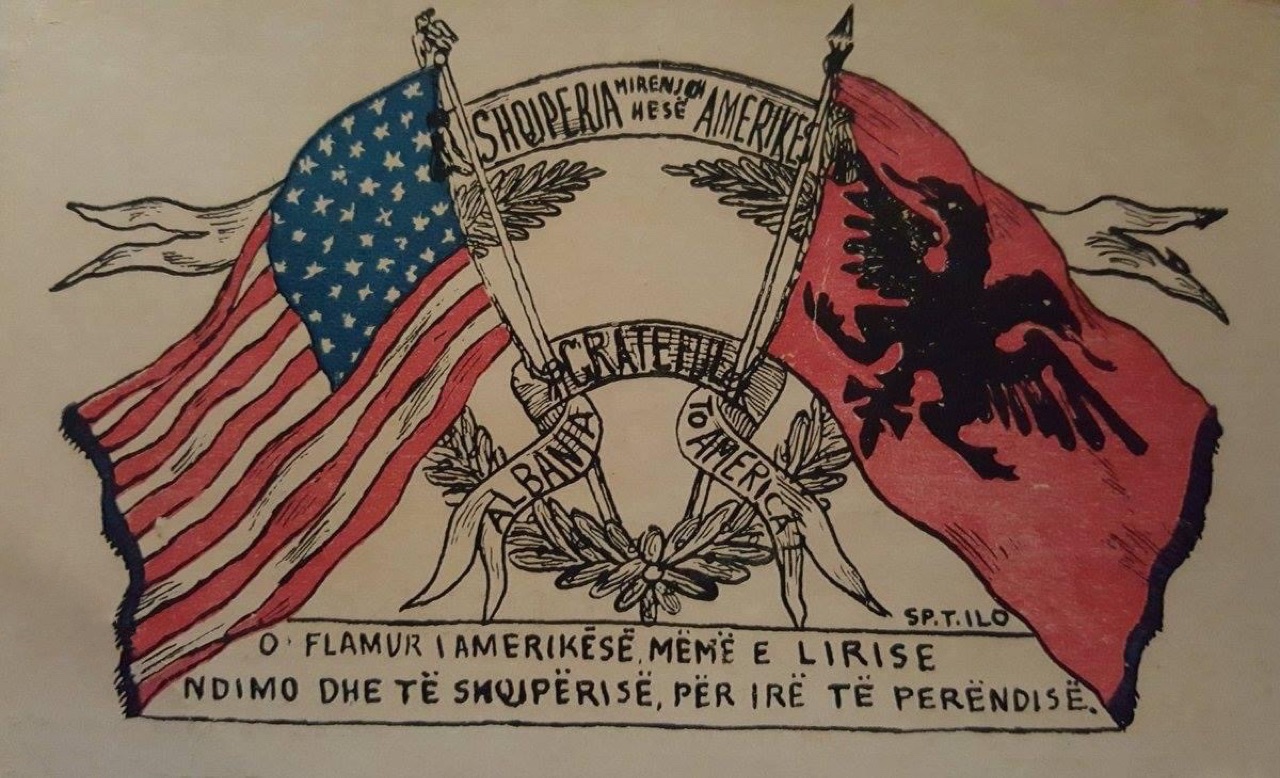
The weekly Albanian-language newspaper Zër' i Popullit, based in New York City, published a colour illustration of the Albanian flag on the cover of its 7th issue dated 17 December 1912. This illustration closely resembles one published on the cover of the 16th issue of the newspaper Perlindja e Shqipëniës, the official publication of the newly formed Albanian state, dated 7 March 1914, providing documentation of the flag's appearance during the Provisional Government period.
During the short-lived Principality of Albania under Prince Wilhelm of Wied (1914–1920), the flag retained a red field with a black double-headed eagle. The National History Museum holds in its archive 15 flags dating as far back as 1880, one of which belongs to the period of Prince Wilhelm's reign. It was donated to the museum by diplomat Rauf Fico, who found it abandoned in the prince's palace. The flag survives in a poor state. A physically intact example of the principality's flag was unveiled at a 2012 auction in Genoa, Italy, displayed inside a square laminated wooden frame. It had been found in Durrës on 20 December 1915 and removed by Italian diplomat Baron Carlo Aliotti aboard the Austrian destroyer SMS Lika.
The flag used at the Congress of Lushnjë (1920) was identified for the first time on 25 November 2011 inside the archives of the Ethnographic Fund at the Center for Albanological Studies. It is made of dark red silk or taffeta (xanthocellulose artificial silk) and carries a black double-headed eagle in its centre, stylised in the manner of the provisional government's flag, as no national flag had yet been formally standardised. It measures 121 cm by 70 cm and has three metal rings on one side for attaching to a pole. It was carried into the congress building by patriot Veli Vasjari and donated to the National History Museum in 1928.
Article III of the Fundamental Statute of the Albanian Kingdom, during the reign of King Zog (r. 1928–1939), described the flag as red with a black two-headed eagle in the centre, and a crown was added to the design. A square-shaped example of this flag, in the possession of the Royal Family, was produced in the latter part of Zog's reign and is visible in archived film footage being replaced by fascist officers at the unveiling of the new fascist flag on 4 December 1939.
During the Italian occupation of Albania (1939–1943), the crown was replaced by two fasces. Title I, Article II of the Constitutional Charter, as published in the Yearbook of the Kingdom of Albania (1940–XVIII edition), states: 'The Albanian flag is red, charged at the center with the black double-headed eagle and the sign of the lictor fasces.' Images of this flag at public events — including the inauguration of a school by Prime Minister Shefqet Vërlaci and the opening session of the Albanian Fascist Party congress at the Palace of the Superior Fascist Corporative Council — are preserved in the Istituto Luce archive. In October 1943, following the dissolution of the union with Italy, the country reverted to the decrees of September 1928, and the pre-Italian flags and symbols were reinstated.
The Democratic Government of Albania, the first ruling government after the war of liberation, published its flag for the first time in War Bulletin of National Liberation issue no. 51, dated 28 November 1944. A change adopted in early 1946 added a golden five-pointed star above the eagle. Law nr. 5506, dated 28 December 1976, of the constitution of the People's Socialist Republic of Albania formally described the flag as 'a red field with a black double-headed eagle in the center, on top of which is a red star with five corners, embroidered all around in gold', with an aspect ratio of 1:1.40. The flag symbols were designed by painter Sadik Kaceli.
On 7 April 1992, the Assembly formed after early elections voted in its afternoon session to remove the communist emblem as the official symbol of the state and to strip the golden star from the flag. It simultaneously initiated a parliamentary commission to study proposals for a new state emblem. This date marks the return of the flag to the plain red field with the black double-headed eagle, the form it had taken at independence in 1912.
The current national flag of Albania was standardised by Law Nr. 8926, dated 22 July 2002. Articles II, III, and IV of that law define its nature, dimensions, and permissible uses. Article III specifies that the flag represents a blood-red field with a black double-headed eagle in the centre with open wings; each wing has nine feathers and the tail has seven feathers. The aspect ratio is set at 1:1.4.
Article IV establishes usage rules: every Albanian citizen has the right to hold, raise, or use the flag; all public institutions are obliged to display it; foreign flags may be raised only at receptions, protocol ceremonies, or other legally provided occasions, and must always be accompanied by the national flag, which may not be smaller than any other flag present. In cases of national mourning declared by the Council of Ministers, the flag is raised at half-mast.
The red of the flag represents bravery, strength, valour, and bloodshed. The double-headed eagle represents the sovereign state of Albania. The civil ensign, which differs from the national flag, consists of three horizontal bands of red, black, and red. The naval ensign resembles the national flag but places the eagle on a white field and adds a red stripe along the lower portion. The eagle also appears on the reverse of the Albanian five-lekë coin issued in 1995 and 2000.
Beginning in 1969, the Albanian flag was widely and unofficially flown in Kosovo by the territory's ethnic Albanian population. During the 1990s it served as the symbol of the self-declared proto-state Republic of Kosova. When Kosovo subsequently adopted its own flag, the design was deliberately chosen to avoid symbols associated with any particular ethnic group, in a pattern similar to the flags of Bosnia and Herzegovina and Cyprus.
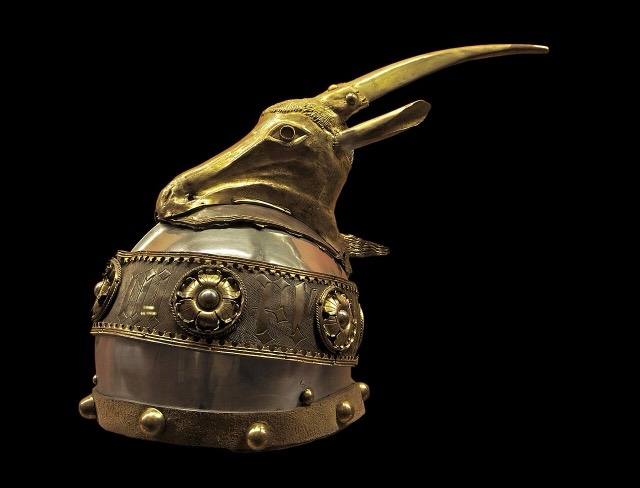
Albania's presidential flag was approved by a presidential decree dated 10 July 2014, signed by President Bujar Nishani, alongside the presidential emblem and the 'Mother Teresa' Decoration. The presidential flag uses the red background and black eagle of the national flag, supplemented with gold. Its symbolic elements include the black eagle from the coat of arms of the House of Kastrioti, the Skanderbeg helmet in frontal stance, and oak leaves described as derived from symbols used by the Illyrian King Gentius. The flag measures 140 cm by 100 cm.
The early documentary record of the Albanian flag is fragmentary and in several respects contested. No physical original of the 1912 independence flag survives, and multiple conflicting accounts compete to describe it. The two principal hypotheses — the Don Aladro flag preserved by Eqrem bey Vlora, and the flag handmade by Marigo Posio — are each supported by memoirs and testimonies, but neither can be definitively verified given the destruction of material evidence.
A separate complication arose in 1913–1914, when Essad Pasha Toptani's self-proclaimed Republic of Central Albania used a flag recently identified in the German Ministry of Foreign Affairs archives: a piece of cloth approximately 20 by 30 cm in light red with a white star polygon at the lower right corner, resembling the Ottoman flag with the crescent removed. This was presented by Essad Pasha as the 'national flag' in a letter dated 7 May 1915, transmitted through the Austro-Hungarian royal imperial embassy in Berlin.
The protocol agreement governing the Autonomous Province of Korçë (1916–1920) specified in Article IX that its flag would be 'the traditional standard of Skanderbeg with the tricolor tie in the colors of the French flag.' Official surviving flags of this period are housed at the Flag Museum in Korçë. These episodes illustrate that throughout the decade following independence, multiple competing authorities each claimed legitimacy through their own version of the national symbol, and the archival record remains incomplete.
Ville · Vlorë
Where the Adriatic meets the Ionian, and where Albanian independence was declared in 1912.
Période historique
Declared at Vlorë on 28 November 1912 as the Ottoman Empire collapsed in the Balkan Wars.
Personne
Gjergj Kastrioti: an Ottoman commander who changed sides and held Albania against the empire for twenty-five years.
Objet
A culture shaped by mountain isolation, five centuries of Ottoman rule, and fifty years of enforced separation.
Une erreur sur cette page ? Les corrections sont les bienvenues et sont vérifiées par rapport au document source. Indiquer ce qui est erroné et, si possible, d'où provient le chiffre correct.