都市 · Korçë
Korçë
The highland city of serenades, the first Albanian-language school, and the country's oldest brewery.
すべての県、すべての海岸、すべての世紀
ガイドビュー
アルバニアを初めて知る方へ。各ページは、詳細に入る前に、10歳の子どもにも読み聞かせられる平易な説明から始まります。
エキスパートビュー
基本知識はすでにお持ちの方向け。平易な説明を非表示にし、内容を直接表示します。これがデフォルトです。
史跡 · Korçë County
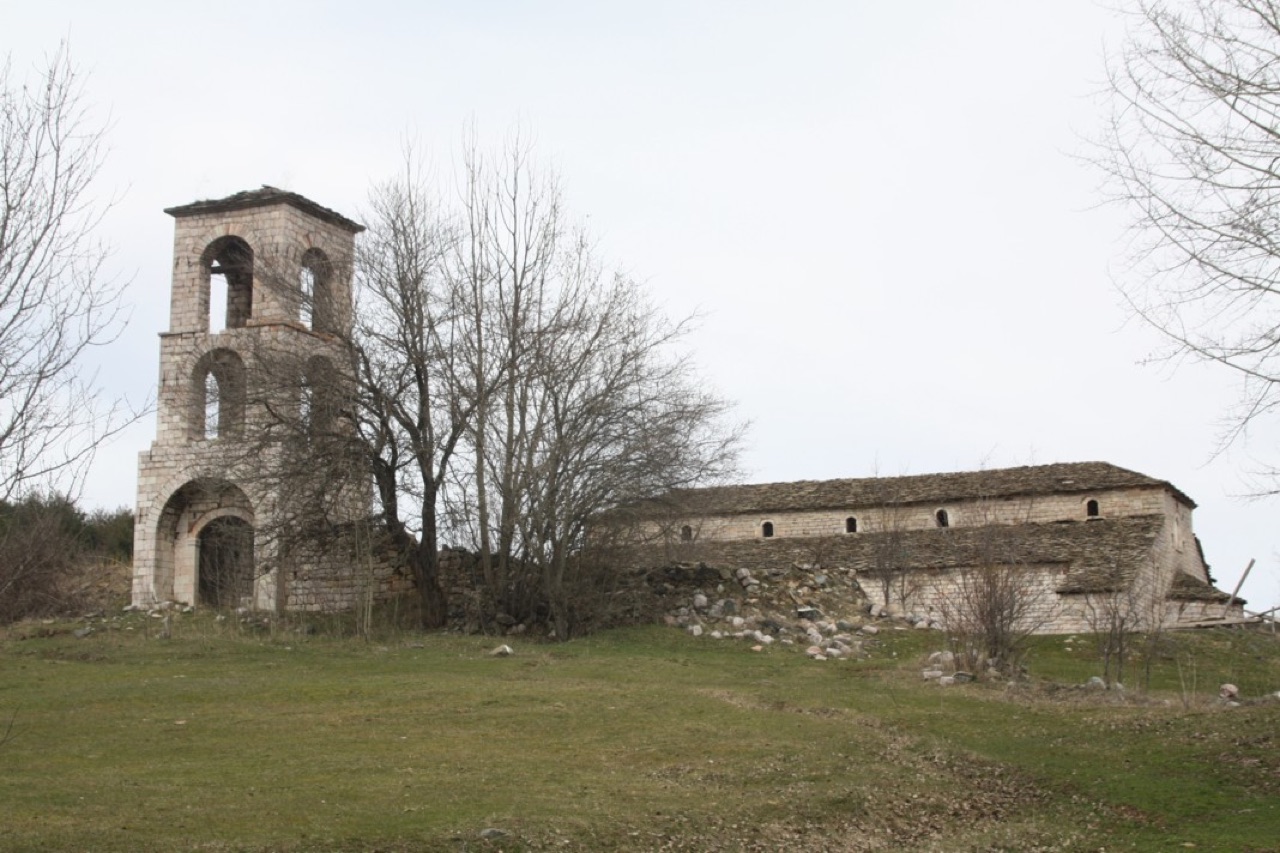
Six surviving basilicas of a town that once rivalled any city in the Balkans, covered inside with frescoes.
保存
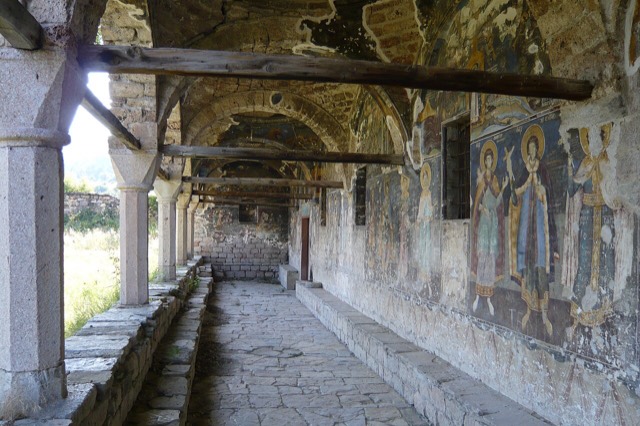
Voskopojë was once a very rich town with dozens of churches and its own printing press. Six churches survive, painted inside from floor to ceiling.
Voskopojë was once a very rich town with dozens of churches and its own printing press. Six churches survive, painted inside from floor to ceiling.
The precise origins of Moscopole remain uncertain. The Codex of the monastery of Saint-Prodrome, in its introductory section, states that the monastery was built in 1630, 'two hundred and fifty or three hundred years after the foundation of the town of Moscopole itself', placing the founding of the town around 1330. A separate claim, recorded by Austrian consul Johann Georg von Hahn after consulting an unidentified codex in 1843, attributes the founding to the head of the Muzaka family in 1338. The codex Hahn consulted is unknown and possibly lost, and the Codex of Saint-Prodrome does not corroborate the Muzaka connection. Subject to these reservations, it is likely that Moscopole existed at least since the 14th century, initially as a pastoral settlement.
The chronicler Gjon Muzaka, writing in 1510 after leaving Albania in 1478, describes a place called Voskop as abandoned — 'una terra che si chiama Vescop, la quale è distrutta' — which most likely refers to the modern village of that name at the foot of the heights leading to Moscopole proper. A separate passage in Muzaka's chronicle mentions 'Voscopebeci', which, given its association with Beci in the Opar zone and other named settlements such as Dushkar, Lavdar, Marian and Opar, may refer to Moscopole in the mountains rather than Voskop in the plain. This apparent duplication is consistent with a broader pattern in the region, where two nearby settlements share the same name, as with Upper Goskova and Lower Goskova to the east of the settlement.
The register for the year 1568/9 is the first document to place Moscopole with certainty, recording it as a rural settlement with 330 household heads in the Great Register bonds of the kaza of Korça, Bilisht and Krupishta. Two firmans of Sultan Ibrahim from 1647, preserved in the Sigils of Berat, describe the inhabitants as 'nomadic shepherds' who had, 'since their elders, each year, arrived with their sheep to the winter pastures of the sanjak of Vlora'. This confirms that even in the mid-17th century the settlement retained a predominantly pastoral character.
The settlement is known by a range of names in different languages. In Albanian, the standard form is Voskopojë, with the definite form Voskopoja. Aromanian variants include Moscopole, Moscopoli, Muscopuli, Voscopole, Voscopoli and Voshopole. The Greek name varies between Μοσχόπολις (transliterated as Moschópolis, Moscopolis or Moskopolis) and its vernacular form Μοσχόπολη (Moschópoli); the variant Βοσκόπολη/Βοσκόπολις (Voskópoli/Voskópolis/Voscopolis) also appears in Greek usage. Turkish sources use İskopol or Oskopol, Bulgarian uses Москополе (Moskopole), and Romanian sources use Moscopole or Voscopole.
The etymology of the name is disputed. The forms Voskopolis and Voskopoja are generally linked to the Greek word vosko, meaning shepherd, reflecting the Aromanian population's historically dominant occupation. The suffix -poja or -polis is interpreted either as deriving from the Greek polis (city or citadel) or from the Slavic polje (plain). Scholar Peyfuss strongly supports the Slavic derivation, arguing it suits the high-plateau terrain. Xhufi counters that it is difficult to describe as a 'plain' an isolated settlement at an altitude of 1,220 metres above sea level, and prefers the connection to the Greek polis.
In historical records, the Albanian rendering Voskopoja appears in Ottoman documents from the 16th and 17th centuries. Venetian and French commercial documents use both Voscopolis and Moschopolis interchangeably. The edicts of the Patriarch of Ohrid use Moschopolis. The Codex of the Monastery of St. John the Baptist frequently uses the Aromanian form Moschopolis, though its scribe, Michel — a native of the neighbouring village of Shipskë — also used Voskopoja when transcribing archival decisions. Albanian surnames including Ngushta, Vrusho and Krunde appear among signatories of agreements representing the town's three districts, suggesting an Albanian-inhabited district existed within the settlement.
In the middle of the 17th century, the inhabitants of Moscopole were still largely nomadic herders who moved seasonally with their flocks between summer pastures at Moscopole and winter pastures in the Sanjak of Avlona (Vlora). Disputes with the sanjak's authorities over arbitrarily increased taxes led the inhabitants to complain to the Sublime Porte. By 1700, the nature of complaints had shifted: the inhabitants were now objecting to the looting of their commercial caravans in the Kaza of Tomorrica, indicating that pastoral activity had been supplemented and increasingly overlaid by long-distance trade.
Historically, livestock farming remained the primary economic foundation. It gave rise to wool processing, carpet manufacturing, tanneries, metalworking, and silversmithing and coppersmithing. By the middle of the 18th century, Moscopole's commercial influence extended beyond the boundaries of the Archbishopric of Ohrid into the wider Ottoman-ruled Eastern Orthodox world, and reached as far as the Archduchy of Austria, the Kingdom of Hungary and Upper Saxony. Until 1769, the town traded with Venice, Vienna and Leipzig. Even during the town's peak as a commercial and craft centre, animal husbandry continued: the Codex of the monastery of Saint-Prodrome attests that at the end of the 17th century, butter, cheese and other livestock products were still used to pay dues and make donations to the monastery.
Estimates of Moscopole's population at its peak, generally placed in the period 1730–1760, vary widely and are disputed. Some writers claimed as many as 70,000 inhabitants; other estimates placed the figure closer to 35,000. Historian Max Demeter Peyfuss considered a figure closer to 3,500 more realistic, noting that 'Moschopolis was certainly not among the largest Balkan cities of the 18th century'. Swedish historian Johann Thunmann, who visited Moscopole and wrote a history of the Aromanians in 1774, reported that everyone in the city spoke Aromanian and that many also spoke Greek, which was used for writing contracts. A 1935 analysis of family names confirmed that in the 18th century the majority of the population were Aromanians, with Greeks, Albanians and Bulgarians also present.
The question of ethnic affiliation is complicated by the fluid nature of identities at the time. Greek historians have claimed the population as Greek; Romanian historians have claimed it as Romanian. However, the town's merchants were primarily Aromanian-speakers who used Greek as the regional language of commerce. When refugees from Moscopole moved to Austria in 1769, they declared themselves Macedonians — a geographic rather than an ethnic designation. In the 18th century, someone could simultaneously identify as Aromanian, Roman (meaning Eastern Orthodox Christian), Ottoman and Moscopolitan.
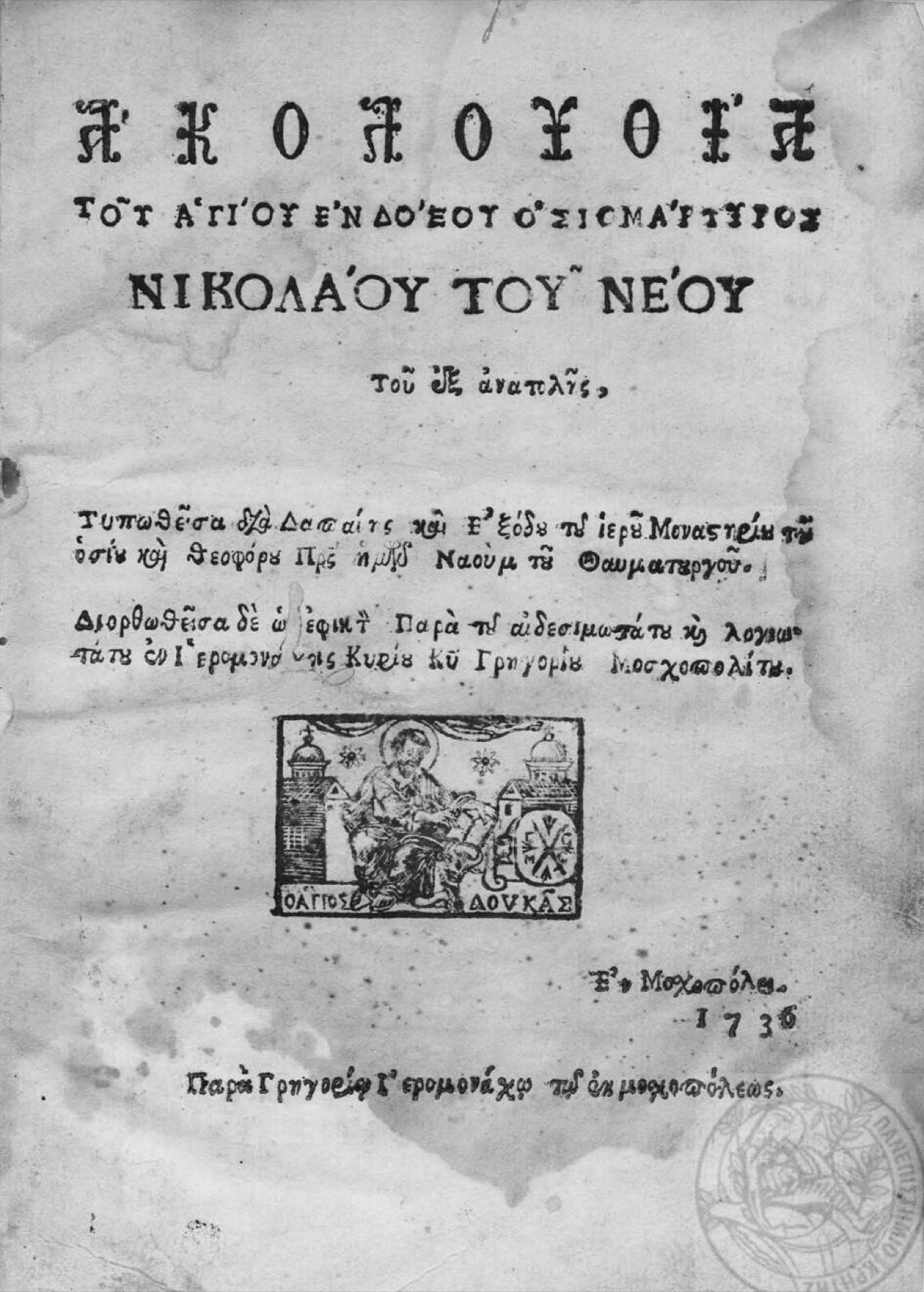
A printing press was established at Moscopole by the hieromonk Georgios Konstantinidis. It was the second printing press in Ottoman Europe, after that of Constantinople. The press produced a total of nineteen books, all in Greek with the designation En Moschopolei. These were principally collections of Services to the Saints, along with the Introduction of Grammar by local scholar Theodore Kavalliotis. Claims by some Balkan scholars about possible multilingual prints or prints in Albanian, Aromanian or Slavic have not been verified.
From 1744, the town's leading educational institution was known as the New Academy or Hellenikon Frontistirion. Sponsored by wealthy foreign merchants, it became one of the principal centres of learning for Orthodox Christians in the western Balkans. Instruction was conducted in Greek, and prominent Greek teachers were brought in to teach. Kavalliotis served as the institution's director. The town also hosted an orphanage called the Orphanodioiketerion — described as possibly the first in the post-Byzantine Orthodox world — along with a hospital and a total of 24 churches.
In 1770, the first dictionary of four modern Balkan languages — Greek, Albanian, Aromanian and Bulgarian — was published in Moscopole. It was compiled by Daniel Moscopolites, an Aromanian native priest, as a quadrilingual lexicon intended to promote the Hellenization of non-Greek-speaking Christian communities in the Balkans. Given this level of intellectual activity, the city came to be nicknamed New Athens and New Mystra, and is regarded as an important 18th-century centre of the modern Greek Enlightenment. The Aromanian Missal, an 18th-century liturgical book in Aromanian, was likely written in Moscopole, and the authors of the Codex Dimonie, a collection of Aromanian-language biblical texts translated from Greek, may also have originated there.
The first major attack on Moscopole occurred in 1769, carried out by Muslim Albanian bashi-bazouks. The attack was a reprisal for the participation of residents in preparations for the Orlov Revolt, a Greek uprising supported by the Russian Empire. The city was attacked and almost destroyed. Following this blow, the city was reduced to a degraded settlement of some 200 houses.
The final destruction came in 1788, when the troops of Ali Pasha of Ioannina razed Moscopole. The city was practically destroyed by this attack, with some of its commerce shifting to nearby Korçë and Berat. An alternative or complementary interpretation attributes the decline primarily to the relocation of trade routes in central and eastern Europe following the raids, rather than to the raids themselves.
The survivors were forced to flee. Most emigrated to Thessaly and Macedonia. Orthodox Albanians from Moscopole who migrated to Kruševo in the early 19th century founded the neighbourhood known as Ohtul di Arbinesh (Hill of the Albanians), which subsequently assimilated into the Aromanian population. Some Albanian families also settled in Prilep, before eventually assimilating into the Bulgarian and, to a lesser extent, Greek population. Part of the commercial elite relocated to the Archduchy of Austria and the Kingdom of Hungary, including Vienna, Budapest and Transylvania, where they had a notable role in the early national awakening of Romania. A new school was established at the end of the 18th century; Daniel Moscopolites served as its headmaster in 1802, and the school continued to operate through subsequent decades thanks to donations by Baron Simon Sinas.
In 1914, Moscopole was part of the Autonomous Republic of Northern Epirus. In 1916, during World War I, the village was destroyed by the Albanian çeta band led by Sali Butka, who set Moscopole on fire and killed a number of local civilians. This was followed by the looting of the village's churches by French soldiers belonging to the administration of the Autonomous Province of Korçë. Butka is regarded as a criminal in Aromanian circles because of this event.
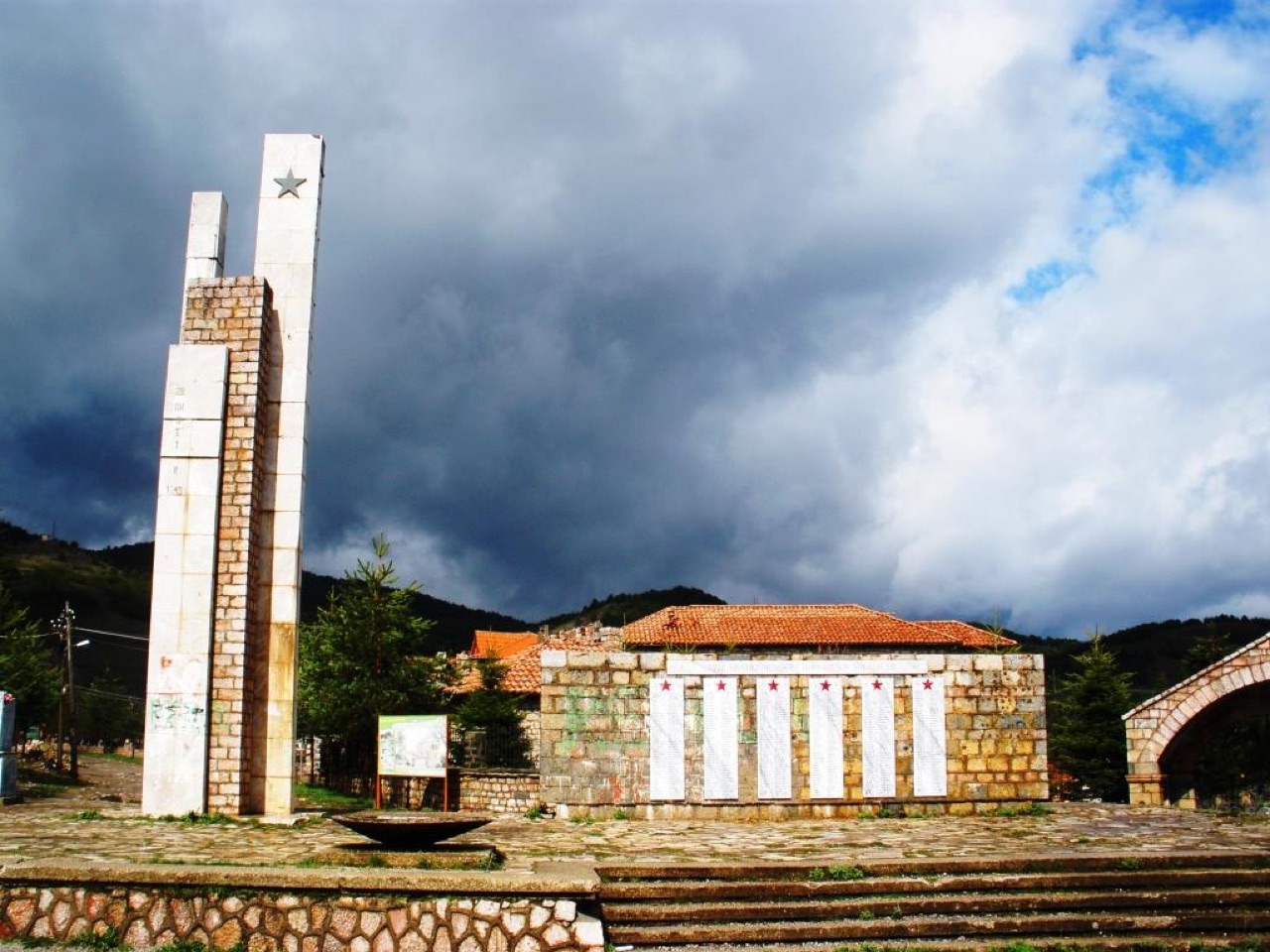
During the Greco-Italian War, Greek forces captured the town on 30 November 1940. In April 1941, following Greece's capitulation, Moscopole returned to Axis control. The remaining buildings were razed three times during the partisan warfare of World War II: once by Italian troops and twice by the Albanian nationalist organisation Balli Kombëtar. Fifteen partisans from Moscopole died during the war; a lapidar was subsequently erected in the village with the names of the partisans engraved on it.
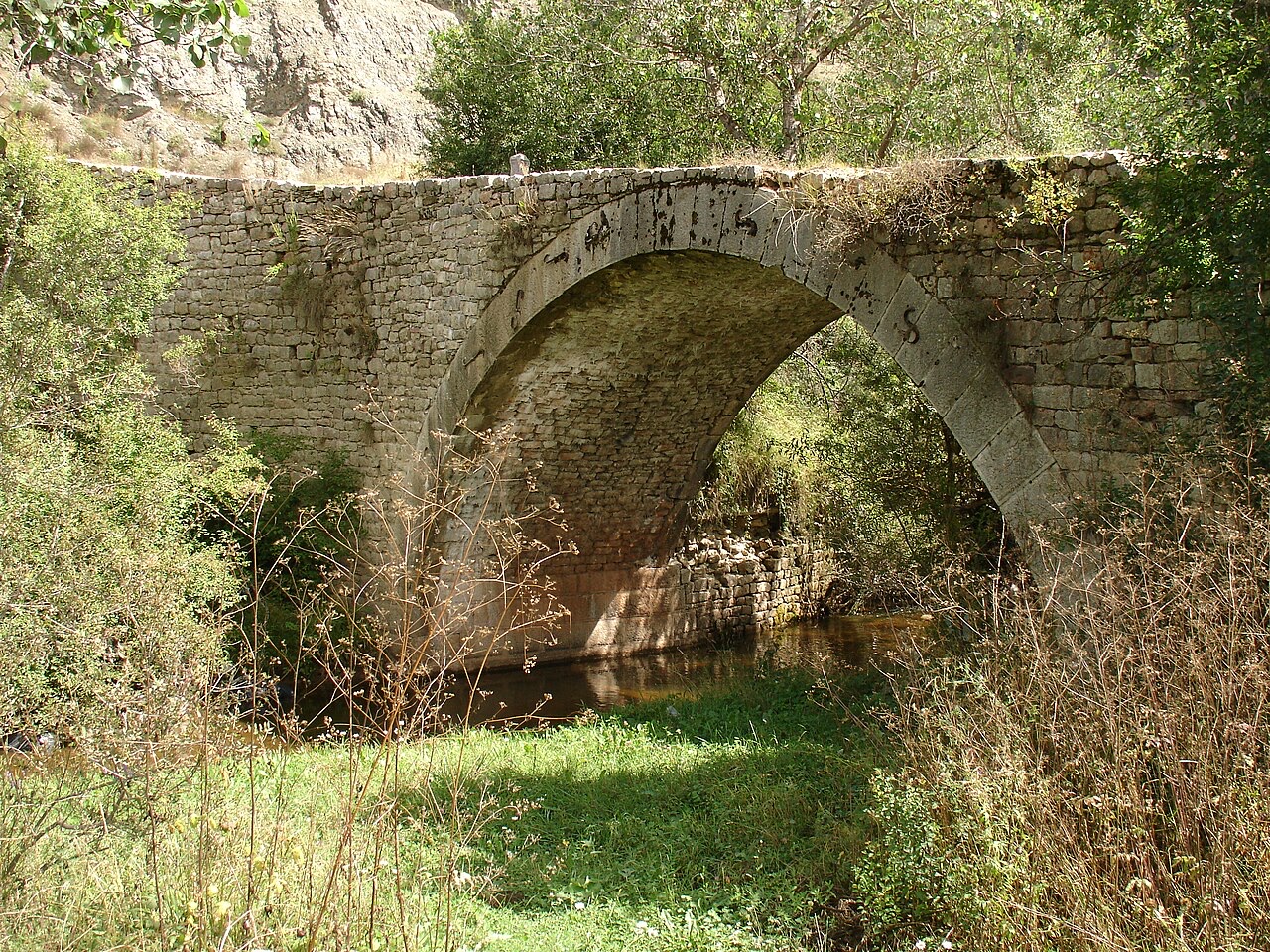
Of the original 24 to 30 churches of Moscopole, five have survived into modern times, along with the St. John the Baptist Monastery (Albanian: Manastiri i Shën Prodhromit or Manastiri i Shën Gjon Pagëzorit; Greek: Μονή Αγίου Ιωάννου του Προδρόμου), located in the vicinity of the town. The five surviving churches are: Saint Athanasius, Saint Elijah, Saint Mary, Saint Michael (also known as Archangels Michael and Gabriel), and Saint Nicholas. A bridge also survives from the old city.
The surviving churches are considered among the most representative examples of 18th-century ecclesiastical art in the Balkans. Their murals are described as comparable to those found in the major monastic centres at Mount Athos and Meteora in Greece. Architecturally, the churches follow a consistent design: large three-aisled basilicas with gable roofs, single-apsed, with a wide altar apse and internal niches serving as prothesis and diaconicon. Most churches have one niche each on the northern and southern walls beside the prothesis and diaconicon, and an arched porch runs along the southern side.
Among the churches that no longer stand is Saint Paraskevi, described as the patron saint of the town and probably the first church built in Moscopole, dating to the 15th century. The church of Saint Charalampus has partially surviving outer walls. Saint Euthymius has been completely destroyed. In 1996, the church of Saint Michael was vandalised by Albanian adolescents reported to be under the influence of a foreign Muslim fundamentalist, an incident described as having shocked and dismayed the Albanian public. In 2002, the five standing churches were placed on the World Monuments Fund's 2002 World Monuments Watch.
In 1894, Gustav Weigand visited Moscopole and described it as a village of only 220 families, half Albanian and half Aromanian. A report by Greek consul Betsos in 1900 recorded 200 families in total: 120 Albanian and 80 Aromanian. The report noted that the 18th-century destruction had dispersed the Aromanian population and that socio-political instability in the nearby Opar region had caused Albanian Christians to leave their homes and settle in Moscopole. Most of the older Aromanian families were recorded as having a Greek national consciousness, while three families and some newer residents were pro-Romanian, led by an unfrocked priest named Kosmas.
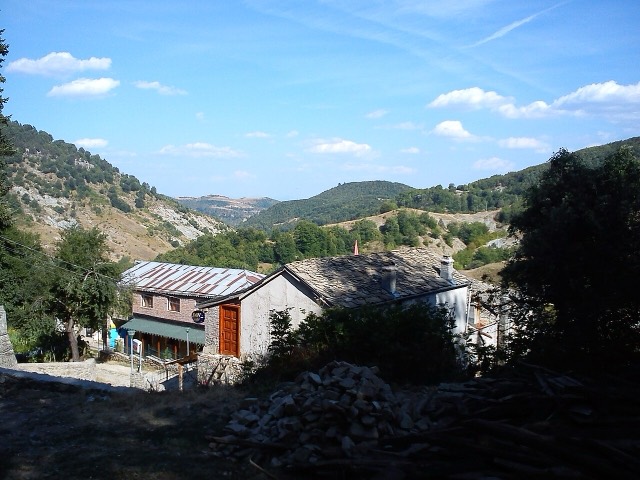
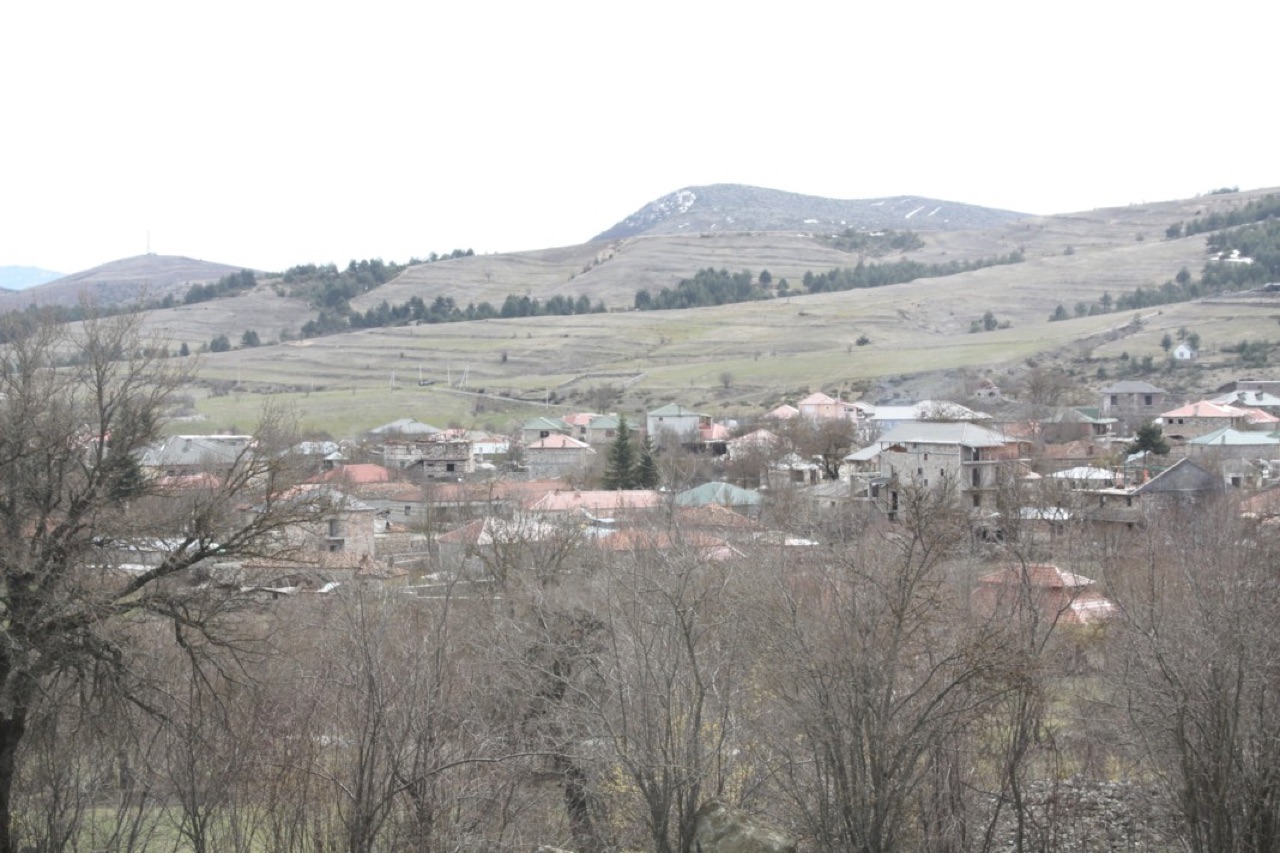
In 2011, the population of Moscopole was recorded as 1,058. The municipality of Moscopole encompasses the villages of Moscopole, Shipskë, Krushovë, Gjonomadh and Lavdar; in 2005 the municipality as a whole had a population of 2,218, while the settlement itself had approximately 500 residents. Aromanians no longer form a majority of the population. The communist period brought some Muslims from surrounding villages into Moscopole, and migration has depressed the populations of surrounding villages. Modern Moscopole is situated 21 kilometres from Korçë at an altitude of 1,160 metres and functions administratively as a subdivision of Korçë municipality.
The destruction of Moscopole and the expulsion of Aromanians from the city gave rise to a distinctive literary and cultural mythology. Comparisons were drawn between Moscopole and Jerusalem, and the city was portrayed as a 'New Jerusalem', 'New Athens' and 'Arcadia of the Balkans'. Romanian historian Sorin Antohi characterised this discourse as expressing an 'exalted feeling of finding of a magnetic beauty and without any imperfection of a brilliant city' that 'evokes a dreamlike image'.
The founder of this Aromanian literary trend is identified as Leon Boga. Other writers associated with it include Nicolae Constantin Batzaria, Nicolae Caratană, Ion Foti, Kira Mantsu and Nicolae Velo. These writers, predominantly young Aromanians educated in Romanian schools, wrote about Moscopole with feelings of nostalgia, love and depression at its loss. Many members of the Aromanian diaspora in Budapest and Vienna also began developing a distinct Aromanian identity during this period, making them among the first Aromanian populations to do so. Moscopole has continued to hold a central symbolic position within Aromanian nationalism, often described in mythical and utopian terms.
最も暖かい月は August (日中の平均最高気温 25°C), 最も寒い月は January (夜間の平均最低気温 -4°C), 最も雨が多い月は December (110 mm). 年間総降水量の平均は 1,002 mm.
| 月 | 最高気温 | 最低気温 | 降水量 | 降水日数 | 日照時間/日 |
|---|---|---|---|---|---|
| January | 3°C | -4°C | 103 mm | 11 | 6.4 h |
| February | 4°C | -4°C | 91 mm | 10 | 7.5 h |
| March | 8°C | -1°C | 98 mm | 13 | 8.8 h |
| April | 12°C | 2°C | 97 mm | 14 | 10.2 h |
| May | 17°C | 7°C | 87 mm | 14 | 11.5 h |
| June | 22°C | 11°C | 60 mm | 10 | 13.4 h |
| July | 25°C | 14°C | 42 mm | 8 | 13.6 h |
| August | 25°C | 14°C | 38 mm | 6 | 12.6 h |
| September | 20°C | 10°C | 75 mm | 9 | 10.4 h |
| October | 15°C | 6°C | 90 mm | 9 | 8.7 h |
| November | 10°C | 2°C | 110 mm | 11 | 6.6 h |
| December | 4°C | -2°C | 110 mm | 12 | 5.9 h |
出典: ERA5 reanalysis via Open-Meteo, 1994–2023 · 「最高気温」および「最低気温」は日平均最高・最低気温です。「降水日数」は降水量が1mm以上の日数を計上しています。
都市 · Korçë
The highland city of serenades, the first Albanian-language school, and the country's oldest brewery.
村 · Korçë
In the 18th century one of the largest towns in the Balkans; today a village of frescoed churches.
村 · Korçë
A stone village at 1,340 m in the Morava mountains, one of Albania's small ski destinations.
件名
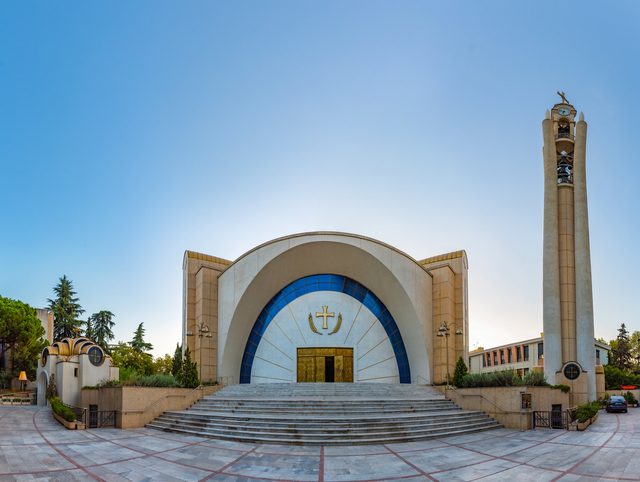
An autocephalous church since 1937, rebuilt almost from nothing after 1991.
このページに誤りがありますか? 修正は歓迎しており、原典記録と照合して確認します。何が誤っているか、また可能であれば正しい数値の出典をお知らせください。