都市 · Tiranë
Tirana
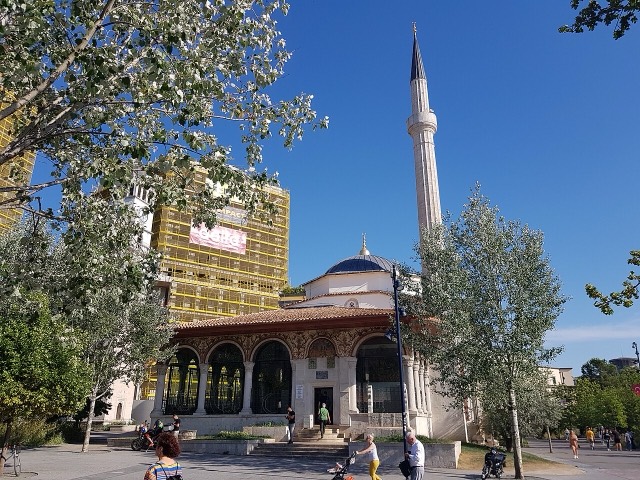
The capital: a fast-changing city of painted blocks, Ottoman survivals and new towers, under Mount Dajti.
すべての県、すべての海岸、すべての世紀
ガイドビュー
アルバニアを初めて知る方へ。各ページは、詳細に入る前に、10歳の子どもにも読み聞かせられる平易な説明から始まります。
エキスパートビュー
基本知識はすでにお持ちの方向け。平易な説明を非表示にし、内容を直接表示します。これがデフォルトです。
史跡 · Tiranë County
The small mosque on Skanderbeg Square whose frescoes of trees and waterfalls are unusual in Islamic art.
保存
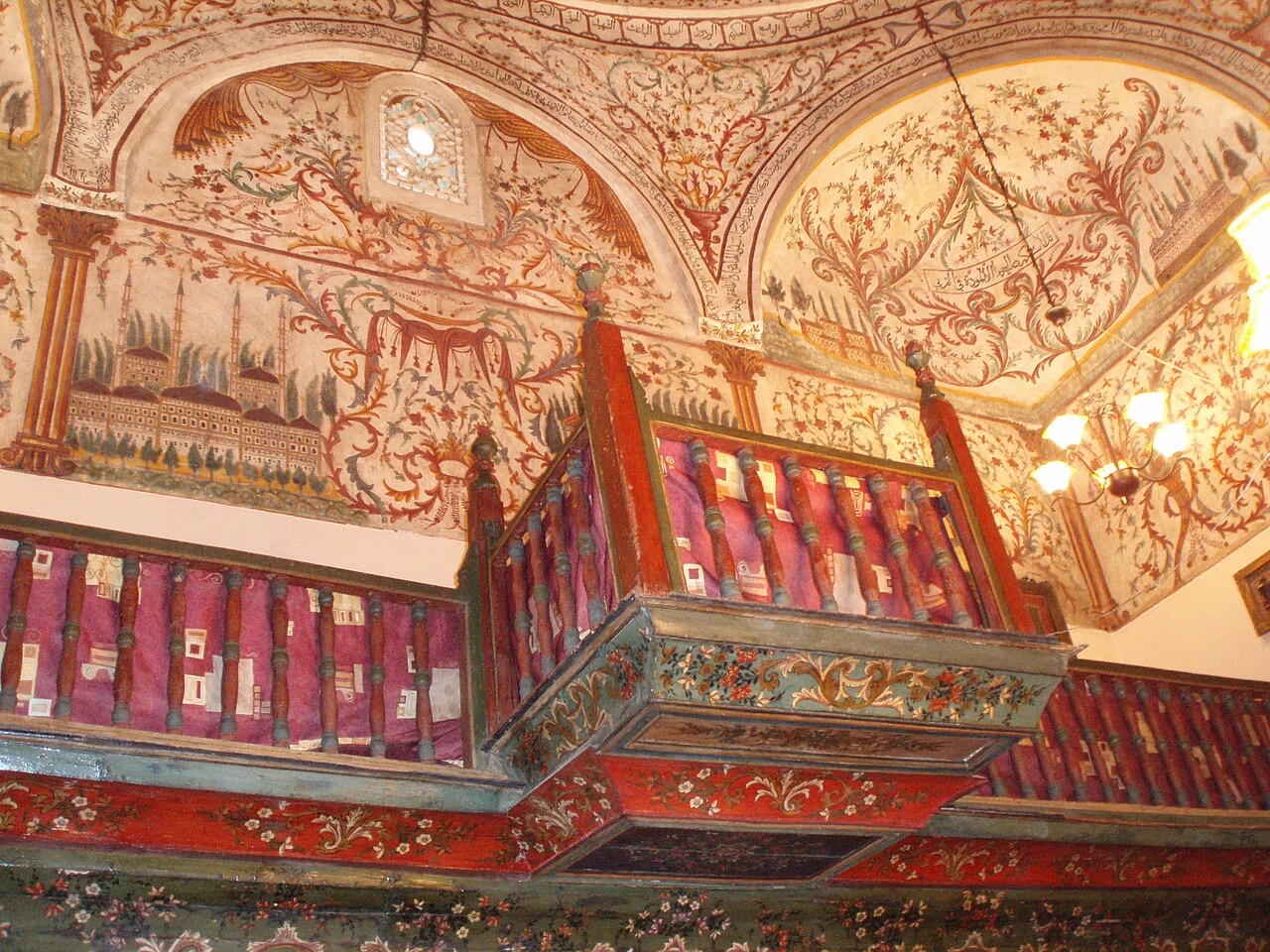
This is the oldest building on Tirana's main square. Its walls are painted with trees, waterfalls and bridges, which is rare in a mosque. It was closed under communism and reopened in 1991 when thousands of people walked in without permission.
This is the oldest building on Tirana's main square. Its walls are painted with trees, waterfalls and bridges, which is rare in a mosque. It was closed under communism and reopened in 1991 when thousands of people walked in without permission.
Construction of the Et'hem Bey Mosque began in 1791 or 1794 — sources differ on the precise date — under Molla Bey. The building was completed in 1819 or 1821 by Molla Bey's son, Haxhi Ethem Bey, who was a great-grandson of Sulejman Pasha. The mosque takes its official name from this son: it is formally designated the Haji Et'hem Bey Mosque, rendered in Albanian as Xhamia e Haxhi Et'hem Beut and in Turkish as Hacı Edhem Bey Camii.
The mosque is a Sunni place of worship situated in Tirana, Albania's capital. It stands as one of the few surviving Ottoman-era religious structures in the city centre, a significance that reflects both the duration of its construction — spanning roughly a quarter of a century across two generations — and the prominent lineage of the family responsible for it.
At the time of its construction, the Et'hem Bey Mosque formed part of a complex of buildings that constituted the historical centre of Tirana. The old Bazaar stood directly in front of the mosque. To the east was the Sulejman Pasha Mosque, built in 1614 and subsequently destroyed during World War II. To the north-west stood the Karapici mosque.
The mosque today forms an architectural complex together with the Clock Tower of Tirana, making the immediate area around Skanderbeg Square a concentration of Ottoman-period civic and religious structures. The loss of the Sulejman Pasha Mosque during the war reduced this ensemble substantially, leaving the Et'hem Bey Mosque as the principal surviving Ottoman religious monument on the square.
Under the totalitarian government of the Socialist People's Republic of Albania, led by Enver Hoxha, the Et'hem Bey Mosque was closed as a house of worship along with other religious buildings across the country. Rather than demolishing it, the state declared the mosque a historical monument. Restorations were carried out in the late 1960s and early 1970s under this protected status, preserving the structure while denying its religious function.
Albania's policy of enforced state atheism, of which Hoxha was the architect, effectively suspended religious practice for decades. The mosque's designation as a historical monument during this period placed its physical fabric under a form of institutional protection, even as its congregation was dispersed and its religious life extinguished.
On 18 January 1991, at the onset of the fall of communism in Albania, approximately 10,000 people entered the mosque without authorisation from the authorities. They carried flags. Despite opposition from communist authorities, the police did not interfere. The event is recorded as a milestone in the rebirth of religious freedom in Albania.
The reopening was not an officially sanctioned act but a spontaneous assertion of religious identity at a moment when the communist system was collapsing. The scale of participation — 10,000 people in a single gathering — and the absence of police intervention marked a decisive public break with four decades of enforced atheism.
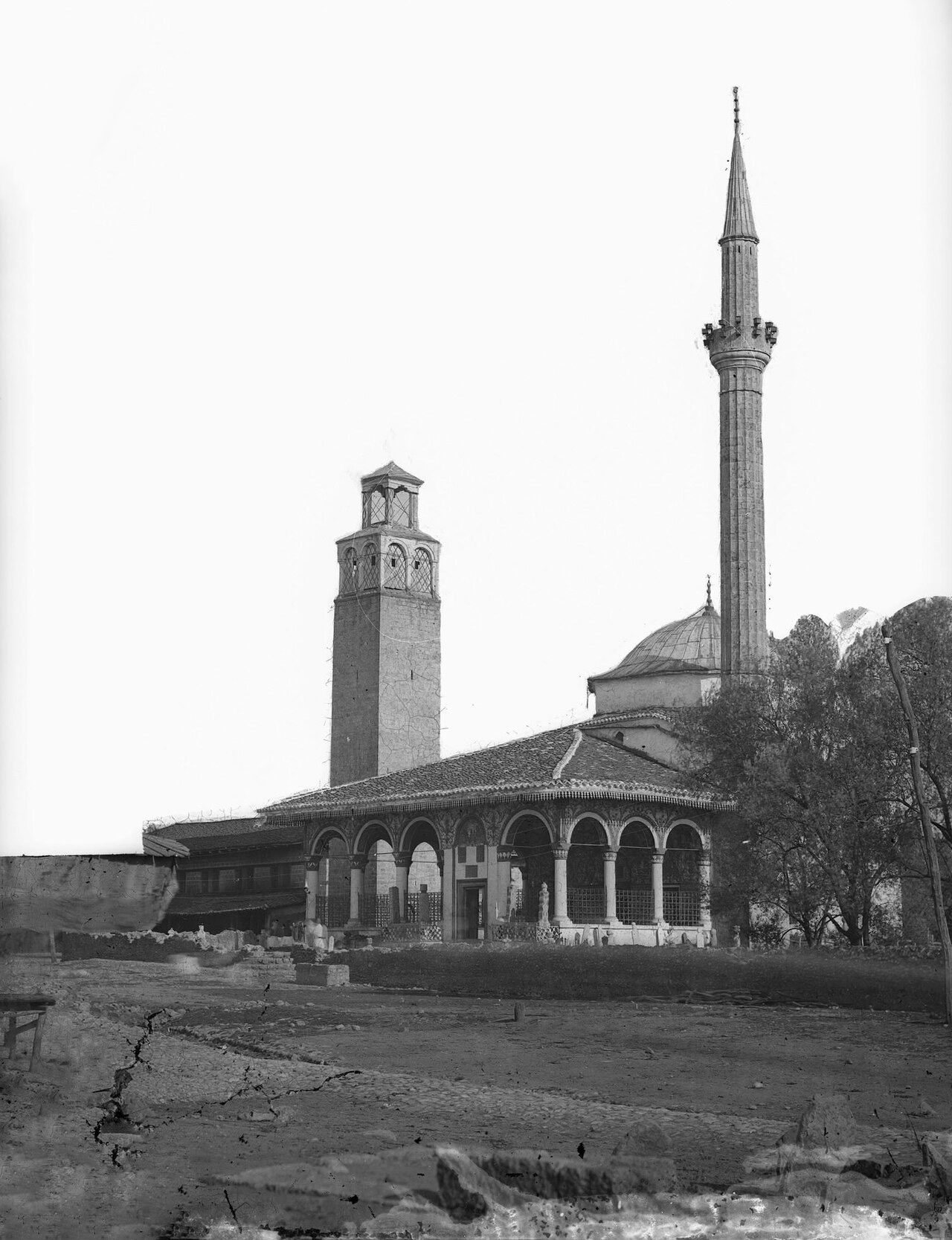
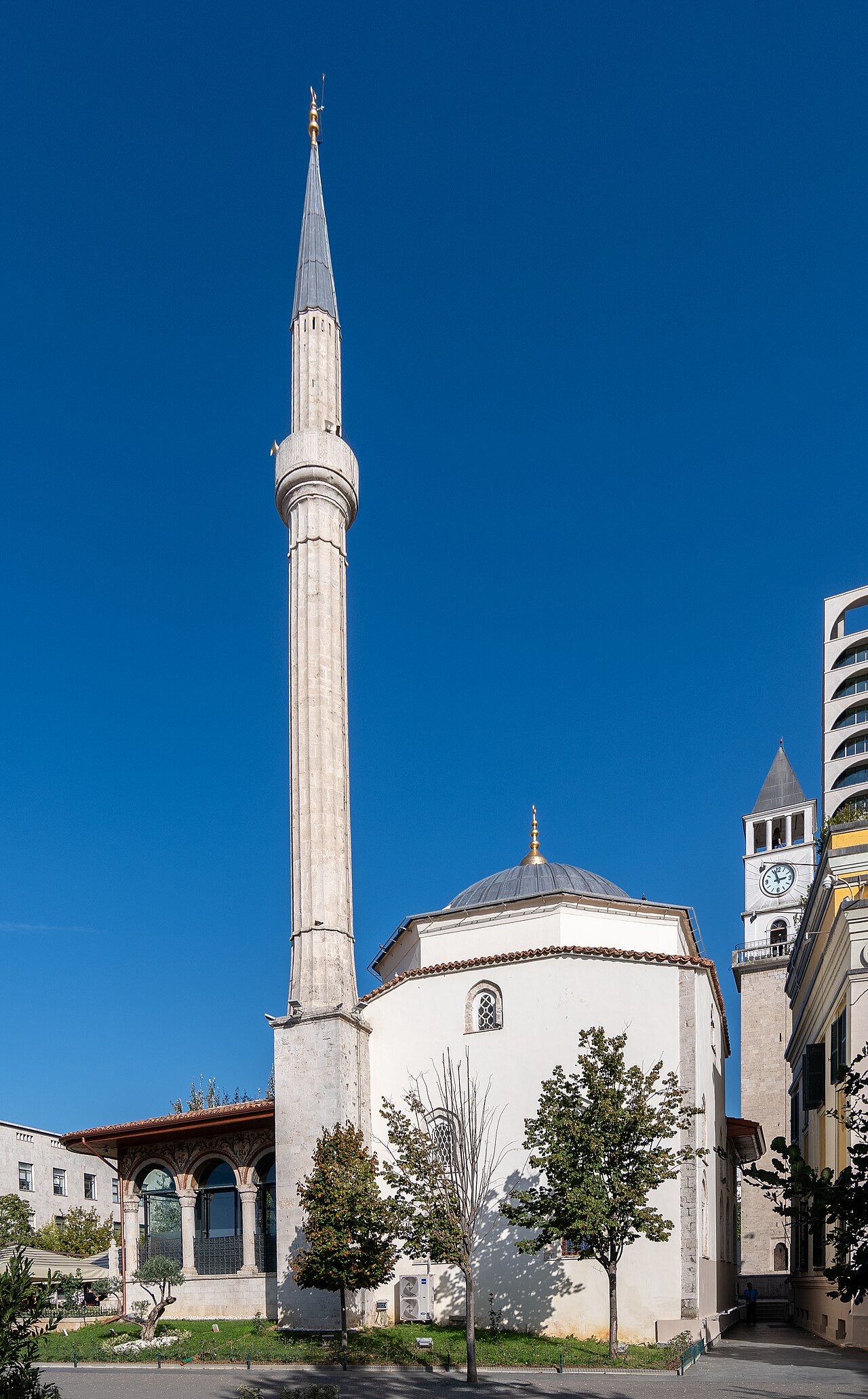
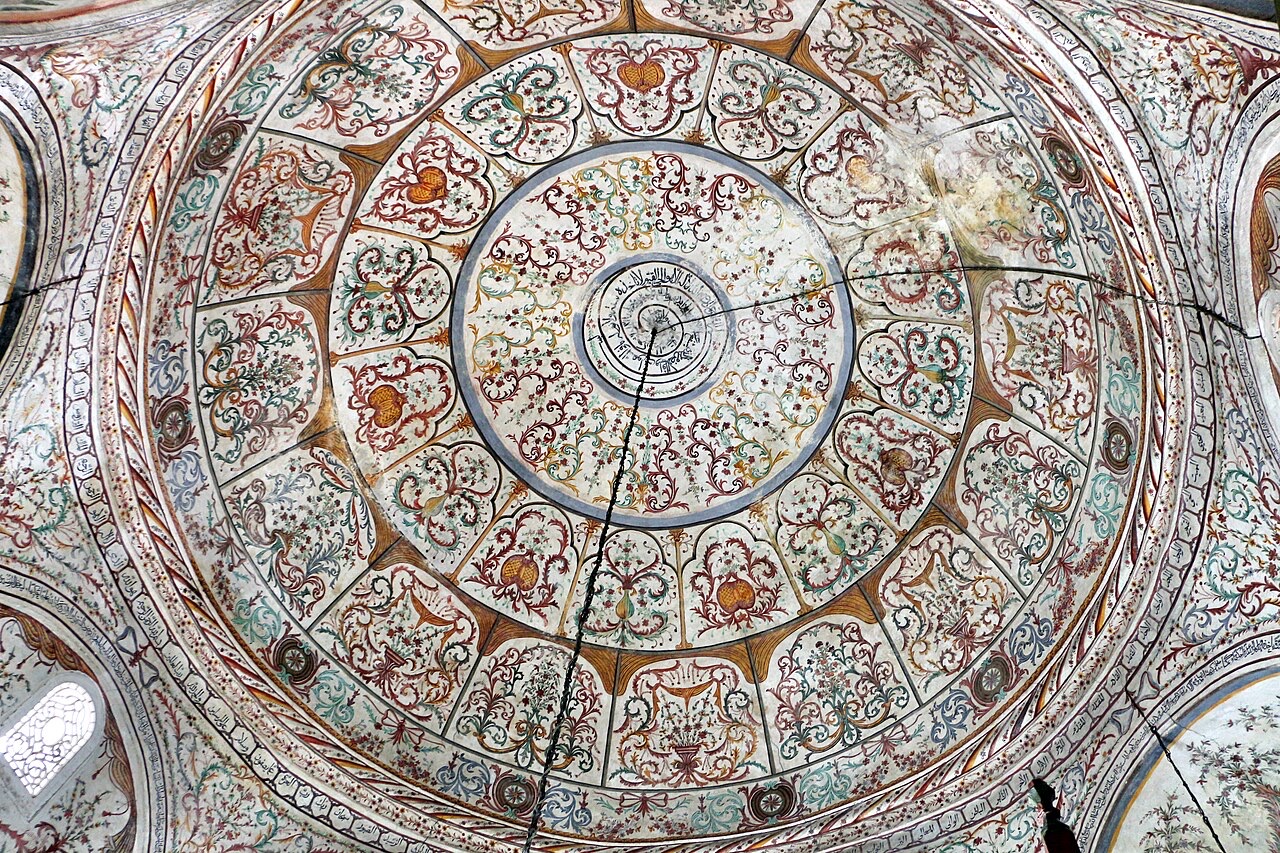
The mosque consists of three principal elements: a prayer hall, a portico that runs along its northern side, and a minaret. The prayer hall is entered from the north and is built on a square plan, constructed as a single unified volume. It is covered by a semi-spherical dome that contains no windows.
The portico, which surrounds the prayer hall on the north, is decorated with numerous landscape paintings. The minaret completes the composition. Tours of the mosque are given daily, though not during prayer service. Visitors are required to remove their shoes before entering the inner room.
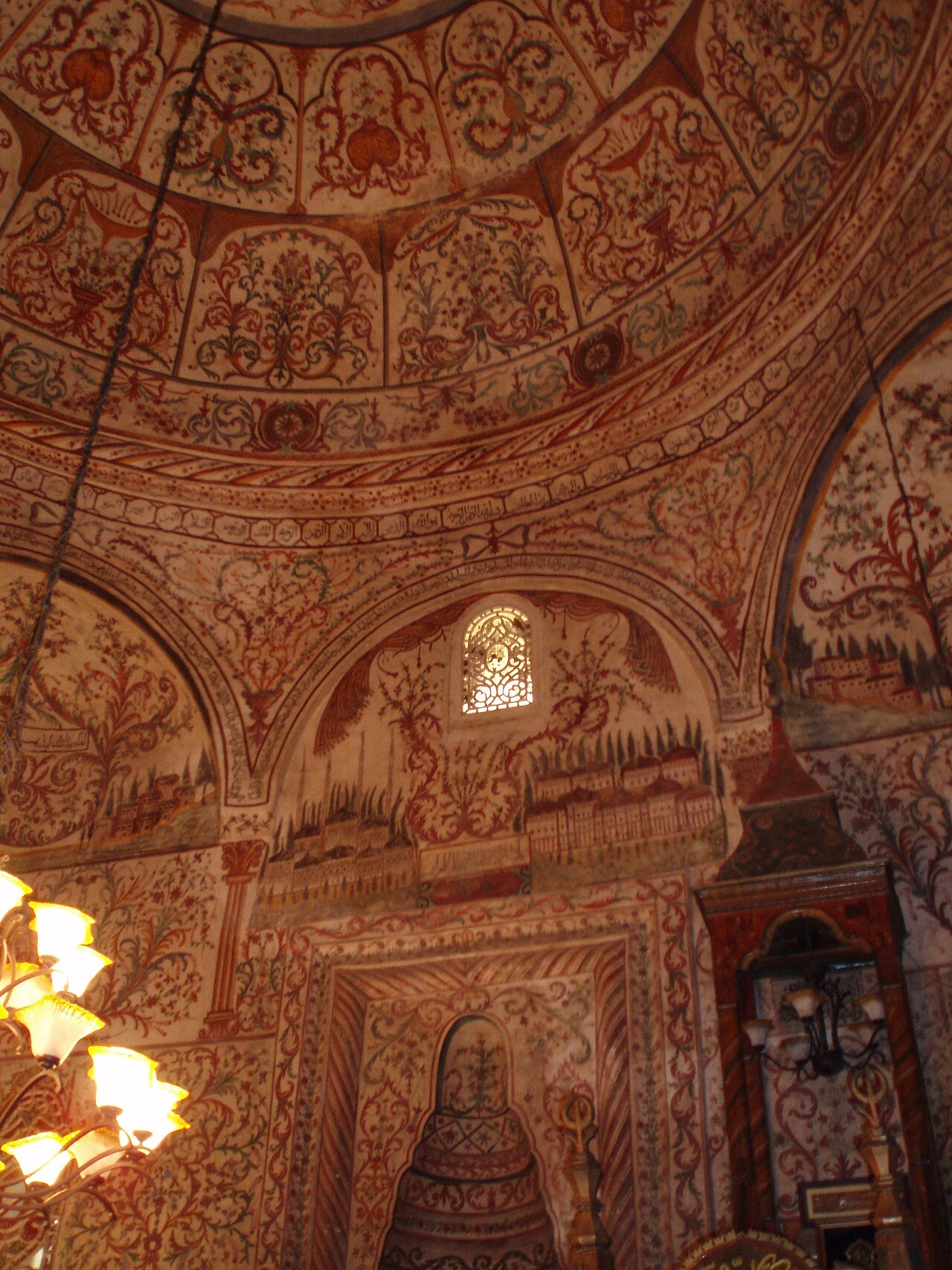
The Et'hem Bey Mosque is particularly noted for its frescoes, which appear both outside and inside the portico. These depict trees, waterfalls, and bridges. According to the scholar Kristo Frashëri, one painting in the portico portrays an island with a river flowing through it on which boats sail.
The landscapes depicted in the mural paintings are, by and large, not representations of real places but imaginary scenes. This quality distinguishes them from strictly documentary or topographical painting traditions, and gives the decorative programme an idealised character that is consistent with a broader Ottoman aesthetic of painted architectural ornament.
Inside the prayer hall, on the eastern side and in the prayer area reserved for women, a painting of the Süleymaniye Mosque in Istanbul is visible among other landscape scenes. The Süleymaniye is shown with its four minarets, rendered in the same manner as it appears in the Bachelors' Mosque in Berat, indicating a shared pictorial convention between these two Albanian Ottoman mosques.
One of the chronograms inscribed in the mosque carries the statement that 'the mosque has given eternal beauty to the city, as Hagia Sophia has given to Istanbul.' The author of these verses invokes the idea of Hagia Sophia without depicting it directly on the walls. The identification of the Süleymaniye with the legacy of Hagia Sophia reflects a broader Ottoman understanding: the Süleymaniye, positioned on Istanbul's third hill and dominating the city's skyline, was conceived as a progeny of the former Byzantine basilica.
The chronogram's comparison of the Et'hem Bey Mosque to Hagia Sophia is not a claim of architectural equivalence but a rhetorical gesture placing the Tirana mosque within a lineage of sacred significance. Hagia Sophia does not appear in the mural paintings themselves; its presence is textual rather than visual.
The association between the Süleymaniye and Hagia Sophia was, as the article notes, 'almost understandable': the Süleymaniye mosque, built under Suleiman the Magnificent and set prominently on the Istanbul skyline, carried a symbolic weight that connected it in Ottoman cultural memory to the great Byzantine church that preceded the conquest of Constantinople. By invoking this chain of association, the mosque's inscription situates a provincial Albanian building within a grand imperial and religious narrative.
The Et'hem Bey Mosque does not stand in isolation. It forms an architectural complex together with the Clock Tower of Tirana, both structures occupying the area around the central square. This pairing of mosque and clock tower is characteristic of Ottoman civic design, in which religious and temporal infrastructure were built as complementary components of a public space.
The survival of both structures into the present day means that the complex retains its Ottoman-era spatial logic to a degree that has been lost elsewhere in Tirana's city centre, where redevelopment and wartime destruction removed many contemporaneous buildings, including the Sulejman Pasha Mosque to the east.
Since its reopening in 1991, the mosque has functioned as an active Sunni place of worship. Tours are conducted daily, with the exception of prayer times, allowing the building's frescoes and architecture to be seen by the general public. Visitors are required to remove their shoes before entering the inner room, in accordance with standard Islamic practice.
The mosque's dual role — as a functioning religious site and as a publicly visited historical monument — reflects its status under communist rule, when the monument designation preserved the structure. That preservation, intended to detach the building from its religious function, ultimately kept the fabric intact for its return to use as a mosque after 1991.
最も暖かい月は August (日中の平均最高気温 30°C), 最も寒い月は January (夜間の平均最低気温 2°C), 最も雨が多い月は November (146 mm). 年間総降水量の平均は 1,187 mm.
| 月 | 最高気温 | 最低気温 | 降水量 | 降水日数 | 日照時間/日 |
|---|---|---|---|---|---|
| January | 11°C | 2°C | 127 mm | 11 | 7.2 h |
| February | 12°C | 3°C | 110 mm | 11 | 8.1 h |
| March | 15°C | 5°C | 120 mm | 11 | 9.6 h |
| April | 18°C | 8°C | 108 mm | 13 | 10.7 h |
| May | 23°C | 13°C | 90 mm | 11 | 12.1 h |
| June | 27°C | 17°C | 52 mm | 7 | 13.6 h |
| July | 30°C | 19°C | 32 mm | 5 | 13.8 h |
| August | 30°C | 20°C | 35 mm | 6 | 12.9 h |
| September | 26°C | 16°C | 104 mm | 9 | 10.7 h |
| October | 21°C | 12°C | 118 mm | 9 | 9.2 h |
| November | 17°C | 8°C | 146 mm | 11 | 7.4 h |
| December | 12°C | 4°C | 146 mm | 12 | 6.7 h |
出典: ERA5 reanalysis via Open-Meteo, 1994–2023 · 「最高気温」および「最低気温」は日平均最高・最低気温です。「降水日数」は降水量が1mm以上の日数を計上しています。
都市 · Tiranë
The capital: a fast-changing city of painted blocks, Ottoman survivals and new towers, under Mount Dajti.
史跡 · Tiranë
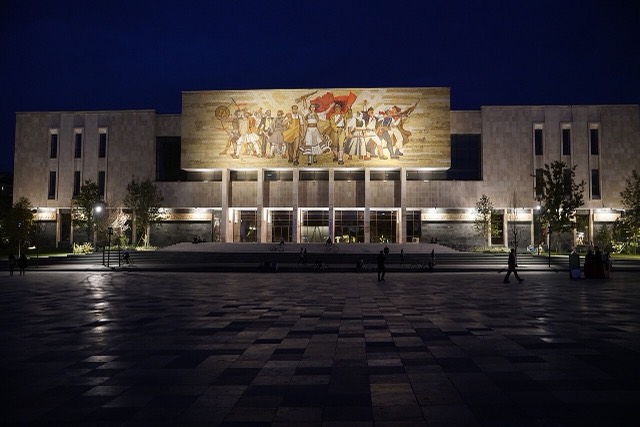
Albania's principal museum, under the Skanderbeg Square mosaic mural known as 'The Albanians'.
件名
Four historic communities — Sunni, Bektashi, Orthodox and Catholic — and a state that banned all of them from 1967 to 1990.
このページに誤りがありますか? 修正は歓迎しており、原典記録と照合して確認します。何が誤っているか、また可能であれば正しい数値の出典をお知らせください。