城市 · Durrës
Durrës
Albania's principal port and its oldest continuously inhabited city, founded as Epidamnos in 627 BC.
每个县、每段海岸、每个世纪
引导视图
初次了解阿尔巴尼亚?每个页面均以通俗易懂的说明开篇——即便是十岁的孩子也能读懂——随后再展开详细内容。
专业视图
您已掌握基础知识。直接进入正题,简明解释默认隐藏。此为默认模式。
公路 · Durrës County
A narrow, largely dormant network built after 1947; a rebuilt Durrës–Tirana line is the main active project.
保存
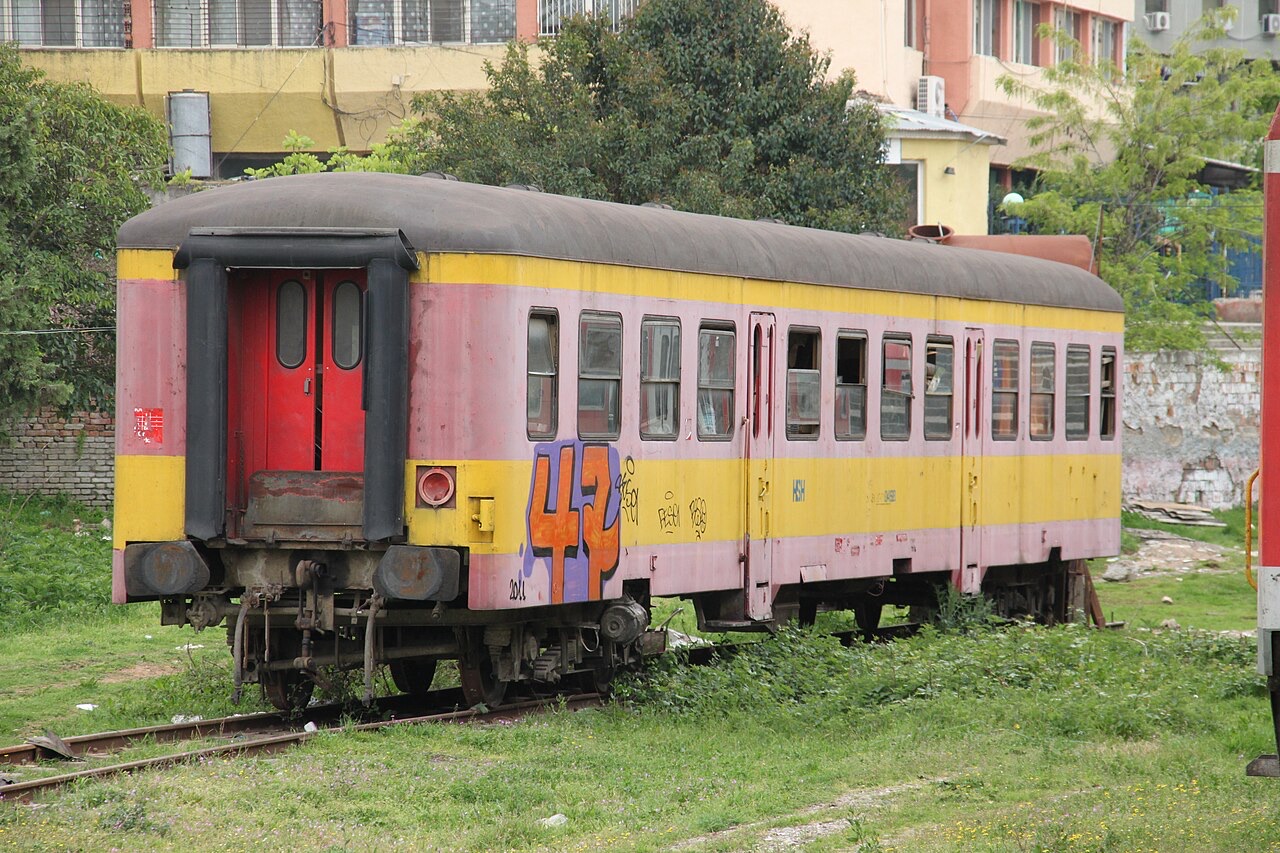
Albania's railways were built after 1947, partly by volunteer work brigades. Most lines have closed or fallen into disrepair. A rebuilt line between Durrës and Tirana, with a branch to the airport, is the main current project.
Albania's railways were built after 1947, partly by volunteer work brigades. Most lines have closed or fallen into disrepair. A rebuilt line between Durrës and Tirana, with a branch to the airport, is the main current project.
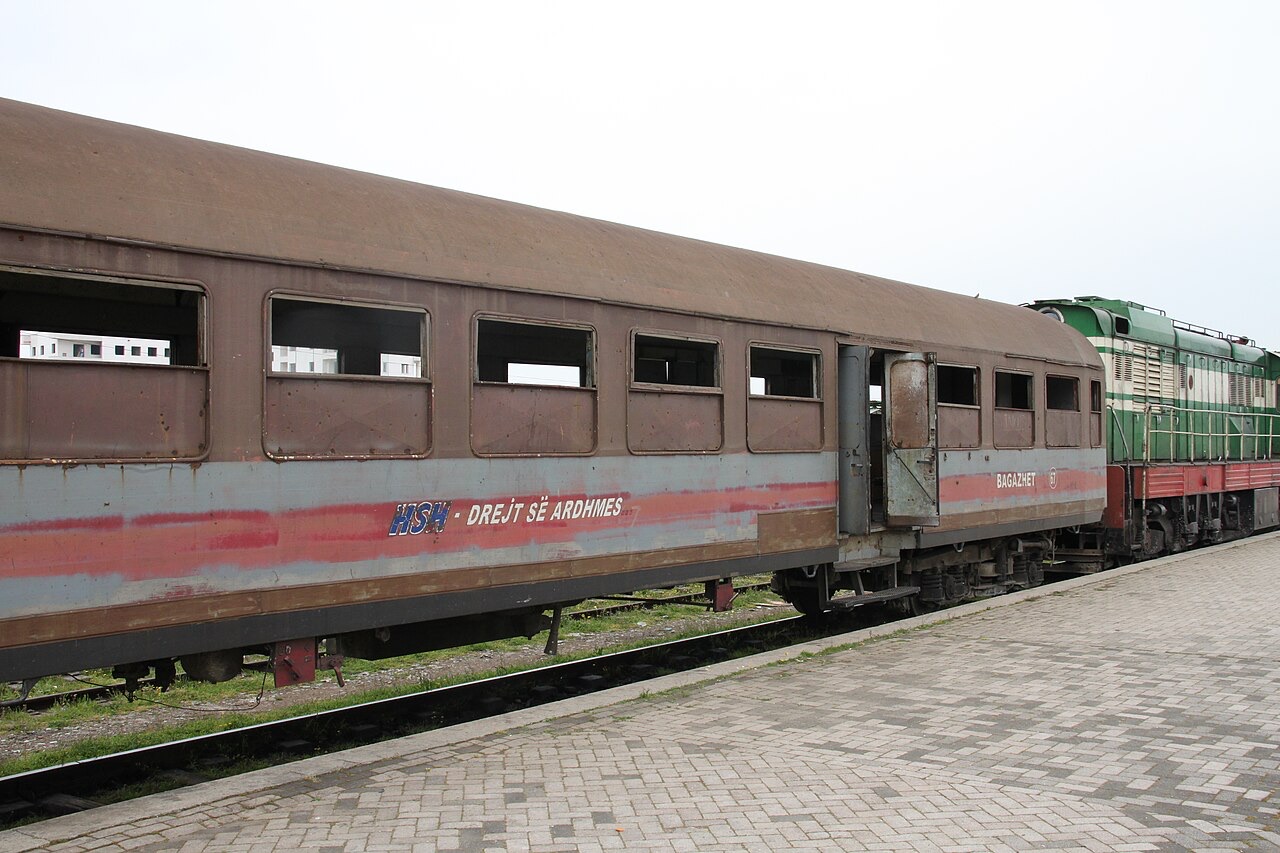
Hekurudha Shqiptare, abbreviated HSH and translated as Albanian Railways, is the state-owned operator of Albania's national railway system. Although state-owned, HSH became a private company in 2005. The main passenger terminal for the network was Durrës station, situated in the port city of Durrës on the Adriatic coast.
At its fullest extent, the HSH network ran east toward Pogradec (reduced to Librazhd by 2012), south to Vlorë, and north to Shkodër. A branch line connected the capital Tirana to the main network, though by 2015 this had been cut back to Kashar, approximately 10 kilometres (6.2 miles) from Tirana. There is no physical rail connection between Albania and its neighbours Kosovo, North Macedonia, or Greece.
The entire HSH network was unelectrified at the time of operation, with traction provided by Czechoslovak T-669 diesel-electric locomotives. The system was single-track throughout, with passing loops installed at various points along the routes to allow trains travelling in opposite directions to pass one another.
Passenger rolling stock was sourced second-hand from several European operators: Germany's DB and the former DR, Italy's FS, Austria's ÖBB, and Poland's PKP. This reliance on used equipment from multiple countries reflected the network's constrained resources rather than any coordinated procurement strategy.
Operational difficulties were significant and varied. Vandalism caused internal and external damage to locomotives and carriages, including the stoning of rolling stock. Sections of track were damaged by landslides, and lengths of rail were stolen for iron scrap, further disrupting services.
In the 1980s, the HSH network was extended north beyond Shkodër into what is now Montenegro, crossing the Albanian border at Hani i Hotit. This cross-border section is restricted to freight traffic only; no passenger services operate over it.
Additional freight-only branch lines exist within Albania. Occasional freight trains run between Podgorica and Shkodër and between Durrës and the oil refinery at Ballsh. The extension of the network into Montenegro represents Albania's only international rail connection, a status that the ongoing Vorë–Hani i Hotit rehabilitation project is intended to modernise.
Passenger services on the HSH network contracted substantially in the years following the system's peak. The Librazhd–Pogradec line closed to passenger traffic in 2012. Stored locomotives and carriages from Prrenjas were subsequently moved to Elbasan, and the section was considered a candidate for dismantling on the grounds that it does not connect any major cities.
By 2015, some rail stations and rolling stock along the Durrës–Tirana line were renovated and repainted in a red and white livery. The Tirana–Shkodër line is closed, with the exception of the Durrës–Elbasan service and a section between Shkodër and Laç. The system in its reduced state is described as barely surviving on these two remaining services.
Construction work to upgrade the Durrës–Tirana line and connect it with Rinas Airport using electric-powered trains began in 2021, financed by a loan from the European Bank for Reconstruction and Development (EBRD). Completion is expected in 2027.
Once operational, the upgraded line is estimated to reduce travel time between Tirana station and Tirana International Airport to 12 minutes, with three intermediate stops. The Tirana–Durrës journey is estimated at 22 minutes, served by eight stops along the route.
The Vorë–Hani i Hotit rehabilitation project covers 120 kilometres of track between Vorë and the Montenegrin border. Its scope includes track upgrades, full electrification, renovation of 12 stations, construction of a new freight station at Lezhë 2, and safety improvements such as secured level crossings and service roads. On completion, the line is intended to accommodate passenger trains at speeds of up to 100 km/h. The estimated investment is €356 million. The project is co-financed by EU grants through the Western Balkans Investment Framework alongside loans from the European Investment Bank and the EBRD, and forms part of the Western Balkans Economic and Investment Plan as an indicative extension of the Mediterranean TEN-T Core Network.
A separate agreement covering the reconstruction of the Durrës–Rrogozhina railway was signed on 8 April 2025 between the Government of Albania and the European Investment Bank, providing an EU financial package of €90.5 million. The agreement was concluded during the official visit to Albania of Kaja Kallas, High Representative for Foreign Affairs and Security Policy and European Commission Vice-President. The Durrës–Rrogozhina line forms part of the VIII Corridor project.
A further route under consideration is a Pristina–Durrës connection linking Albania with Kosovo. The Albanian and Kosovo governments approved a feasibility study for this route in 2021, with the study itself to be undertaken in 2023. Initial findings are reported to be under development into a full plan, though no construction has been announced.
城市 · Durrës
Albania's principal port and its oldest continuously inhabited city, founded as Epidamnos in 627 BC.
城市 · Elbasan
A central industrial city inside an Ottoman fortress wall, on the old Via Egnatia.
城市 · Tiranë
The capital: a fast-changing city of painted blocks, Ottoman survivals and new towers, under Mount Dajti.
指南
Furgons, intercity buses, a near-dormant railway, and why most visitors end up hiring a car.
本页内容有误? 欢迎提交更正意见,所有意见均会与原始记录核对。请告知错误所在,如能提供正确数据的出处,请一并注明。