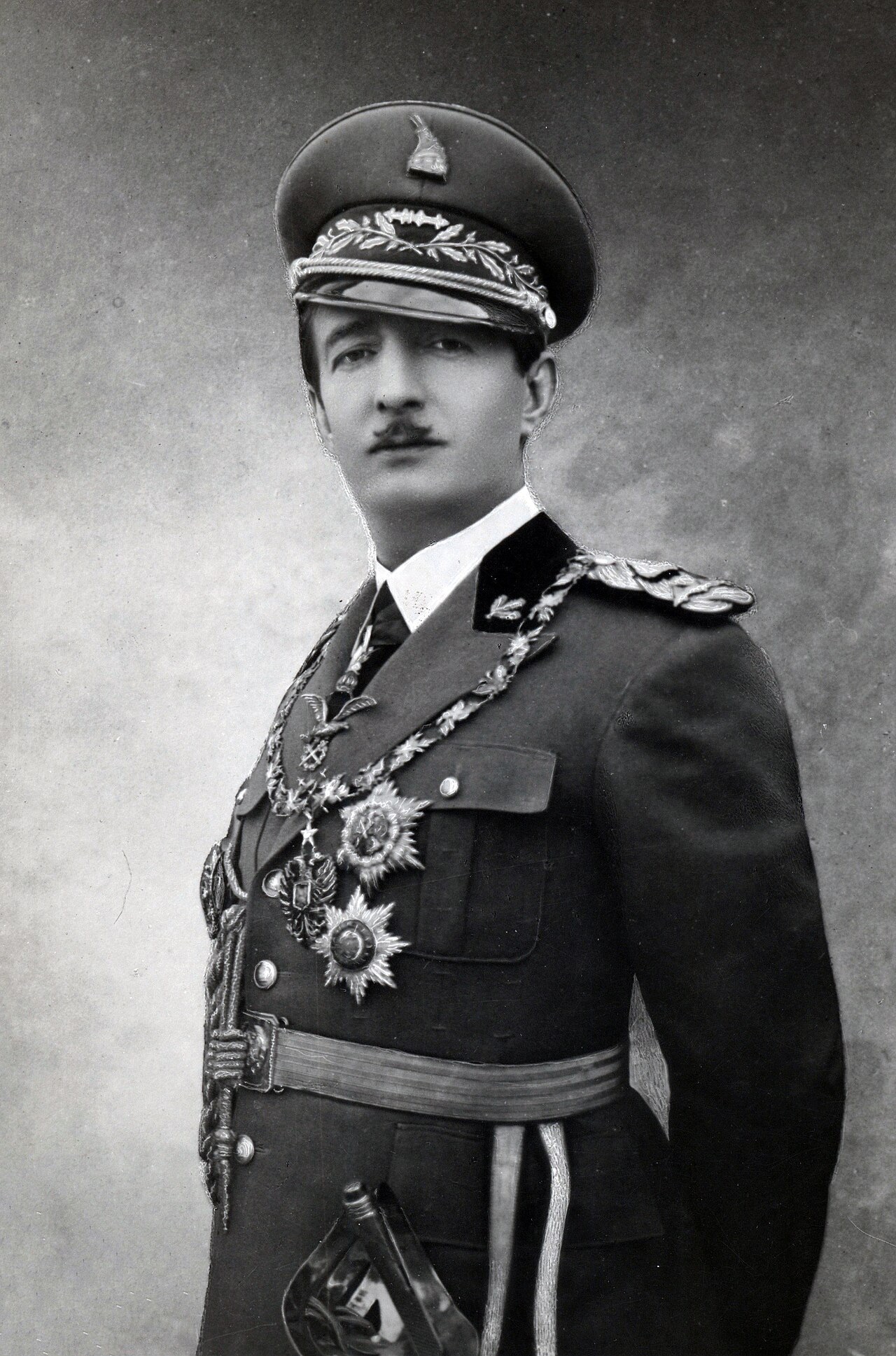
- Lived
- 8 October 1895 – 9 April 1961
- Known for
- President then King of the Albanians, 1925–1939
- Prime minister
- 1922
- President
- 1925
わかりやすく説明すると
Ahmet Zogu came from a landowning family in the north. He became prime minister, then president, then declared himself King Zog I in 1928. He borrowed heavily from Italy, which eventually invaded in 1939. He spent the rest of his life abroad and never returned.
簡易説明
Ahmet Zogu came from a landowning family in the north. He became prime minister, then president, then declared himself King Zog I in 1928. He borrowed heavily from Italy, which eventually invaded in 1939. He spent the rest of his life abroad and never returned.
このページの内容
-
Ottoman era
Origins and early life in Ottoman Albania
Zog was born Ahmed Muhtar Bey Zogolli on 8 October 1895 in Burgajet Castle, near Burrel in northern Albania. He was the third son of Xhemal Pasha Zogolli and the first son by Xhemal Pasha's second wife, Sadije Toptani. The family was of beylical rank and held feudal authority over the region of Mati. His paternal grandfather was Xhelal Pasha Zogolli. On his mother's side, the Toptani family claimed descent from the sister of the 15th-century Albanian commander Skanderbeg, though this lineage was a family claim rather than an established historical fact.
Zog was educated at Galatasaray High School in Beyoğlu, Istanbul, then the capital of the Ottoman Empire. When his father died in 1911, Zog became governor of Mat, appointed ahead of his elder half-brother Xhelal Bey Zogolli. In 1912 he participated in the Albanian Declaration of Independence as representative of the Mat District. During the First World War he volunteered on the side of Austria-Hungary, and was detained in Vienna in 1917 and 1918 and in Rome in 1918 and 1919 before returning to Albania. His time in Vienna gave him an affinity for Western European customs and political models.
In 1922, Zog formally changed his surname from Zogolli to Zogu, which he considered to sound more Albanian. His political support base in the early 1920s included southern feudal landowners — beys — as well as merchants, industrialists, and intellectuals from northern noble families.
-
1920–1924
Rise through the Albanian government, 1920–1924
After returning to Albania in 1919, Zogolli entered government rapidly. He served as Governor of Shkodër from 1920 to 1921, as Minister of the Interior in March to November 1920 and again from 1921 to 1924, and as chief of the Albanian military from 1921 to 1922. His principal rivals during this period were Luigj Gurakuqi and Fan S. Noli. In 1922, at the age of 27, he became Albania's youngest ever prime minister.
In February 1924, Zogolli was shot twice inside the corridors of the Albanian Parliament by Beqir Valteri, who came from the same region. Valteri fled but surrendered after intervention by Qazim Koculi and Ali Klissura. He was subsequently freed by the Court of Tirana. Zogolli stepped back briefly from political life but promised to forgive Valteri. Shortly afterward, Zogolli's industrialist opponent Avni Rustemi was assassinated, an event that triggered a broader political crisis.
The assassination of Rustemi provoked a leftist revolt in 1924, forcing Zogolli and approximately 600 of his allies into exile in June of that year. He returned to Albania later in 1924 with the military backing of Yugoslav forces and Yugoslavia-based General Pyotr Wrangel's White Russian troops, led by General Sergei Ulagay, and was re-established as prime minister.
-
1925–1928
The presidency, 1925–1928
Zogu was elected the first President of Albania by the Constituent Assembly on 21 January 1925 and took office on 1 February for a seven-year term. A new constitution vested him with sweeping executive and legislative powers, including the right to appoint all major government personnel and one-third of the lower house. In practice, the arrangement made him effectively a dictator.
Economically, Zogu's principal ally was the Kingdom of Italy, which provided loans in exchange for a greater role in Albania's fiscal policy. On 28 June 1925, Zogu ceded the territory of Sveti Naum to Yugoslavia in exchange for the village of Peshkëpi and other concessions. His administration was also marked by disputes with Kosovo Albanian leaders, principally Hasan Prishtina and Bajram Curri.
Zogu's Albania during the presidential period was a police state: civil liberties were largely absent, the press was closely censored, and political opponents were imprisoned and frequently killed. Most of the country's villages remained serf plantations run by the Beys, reflecting an Ottoman-era social structure that coexisted with Zogu's European-style governmental framework.
-
1928–1939
Proclamation of the kingdom and Zog's reign, 1928–1939
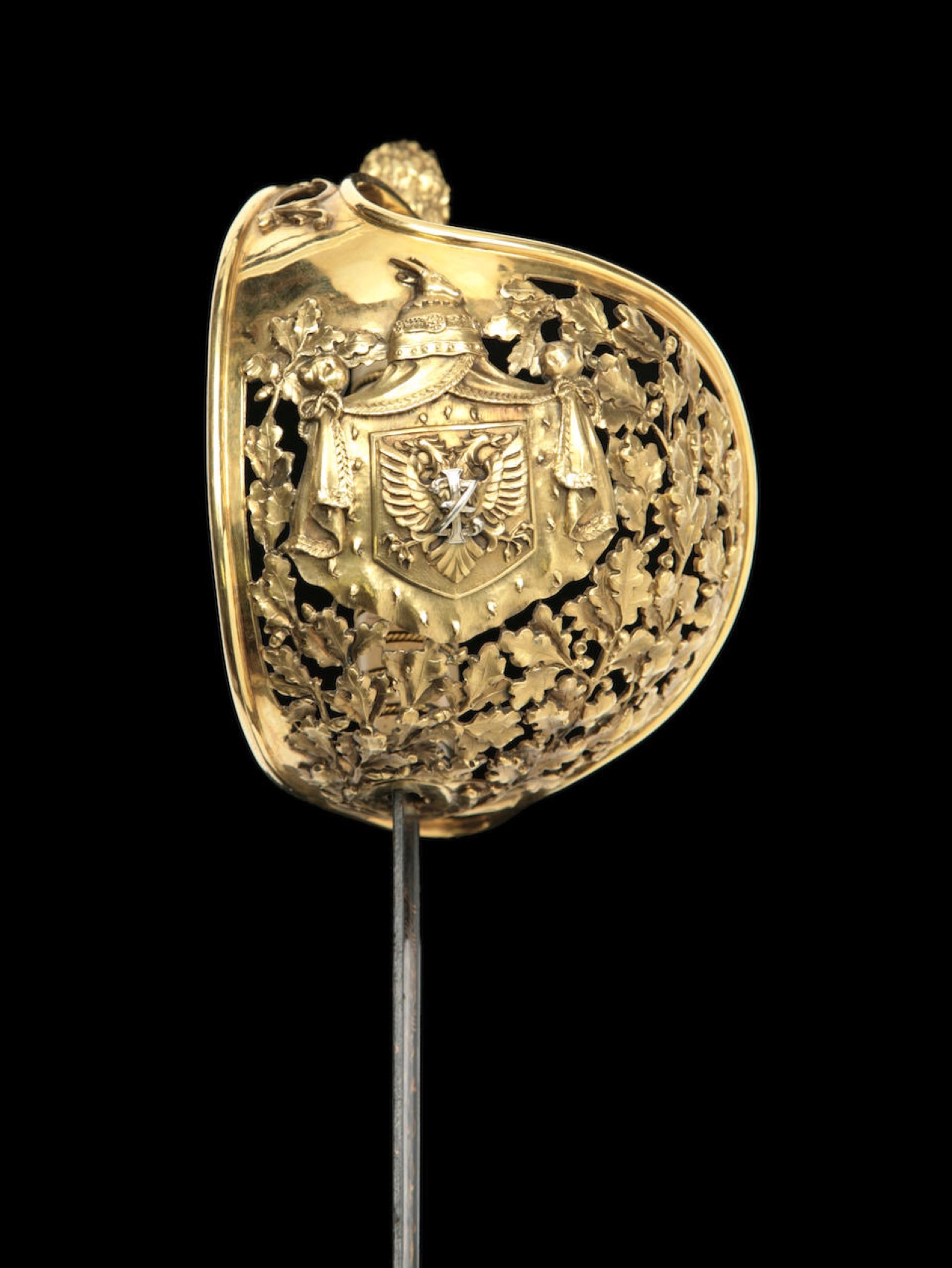
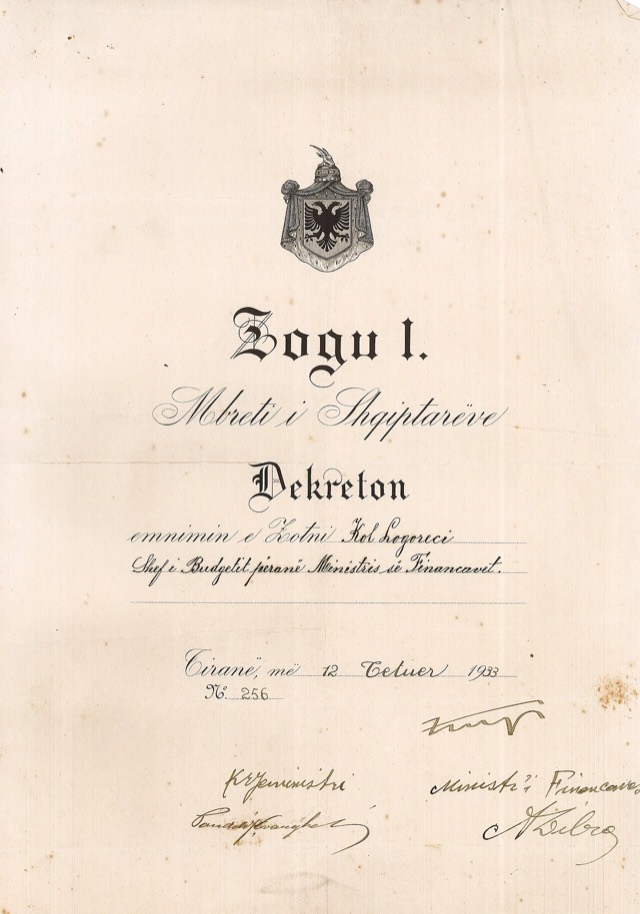
On 1 September 1928, Albania was declared a kingdom and Zogu proclaimed himself Zog I, King of the Albanians. On the same day he also declared himself Field Marshal of the Royal Albanian Army; he was never technically crowned. He chose to reign under his surname rather than his Islamic forename Ahmet, considering the latter likely to isolate him diplomatically in Europe. He also initially adopted the parallel title 'Skanderbeg III', treating Prince Wied as 'Skanderbeg II', though this usage subsequently fell out of use.
Zog's constitution established a nominally constitutional monarchy. It forbade any Prince of the Royal House from serving as Prime Minister or Cabinet member, and prohibited the union of the Albanian throne with that of any other country — a provision that would be breached with the Italian invasion of 1939. Like the King of the Belgians under the Belgian constitutional model, the King of the Albanians was required to swear an oath before Parliament before exercising royal powers. Zog swore on both the Bible and the Quran in an attempt to unite the country's religious communities, he himself being Muslim. He also instituted a distinctive Zogist salute: a flat hand placed over the heart with the palm facing downwards.
In 1929, Zog abolished Islamic law in Albania and replaced it with a civil code modelled on the Swiss civil code, following a parallel reform that Mustafa Kemal Atatürk had carried out in Turkey in the same decade. In 1938, responding to a request from his advisor Constantino Spanchis, Zog opened Albania's borders to Jewish refugees fleeing persecution in Nazi Germany. His mother Sadije was declared Queen Mother, and his siblings were given royal status as Prince and Princesses Zogu. One sister, Senije (c. 1897–1969), married Shehzade Mehmed Abid Efendi, a son of Sultan Abdul Hamid II.
Although the constitution framed a constitutional monarchy, Zog retained in practice the dictatorial powers he had exercised as president, leaving Albania effectively a military dictatorship throughout his reign.
Assassination attempts against Zog
Approximately 600 blood feuds reportedly existed against Zog, and he is said to have survived more than 55 assassination attempts during his reign. The most significant of these was an attack on 20 February 1931 at the Vienna State Opera, where Zog was attending a performance of Pagliacci. Two attackers, Aziz Çami and Ndok Gjeloshi, struck while Zog was entering his car. The attempt had been organised by the 'National Union' (Bashkimi Kombëtar), a coalition of exiled opponents formed in Vienna in 1925 on the initiative of Ali Këlcyra, Sejfi Vllamasi, Xhemal Bushati, and others.
During the Vienna attack, Zog's guard Llesh Topallaj was mistaken for the king by Gjeloshi and shot three times in the back of the head. Çami's gun jammed and did not fire. Zog escaped unhurt, assisted by Albanian Consul Zef Serreqi and local police. Austrian authorities subsequently arrested Çami, Gjeloshi, and several others including Qazim Mulleti, Rexhep Mitrovica, and Sejfi Vllamasi. Most were released and expelled from Austria. Gjeloshi received a sentence of three years and six months, and Çami two years and six months.
Zog's fear of assassination shaped daily life at court. He frequently surrounded himself with a personal guard, limited public appearances, and had his mother supervise the royal kitchen to guard against poisoning.
Italian influence and the 1939 invasion
Italian interest in Albania predated Zog's kingship; Mussolini's government had supported him from early in his presidency, and that backing came at the cost of increasing Italian influence in Albanian affairs. During the worldwide depression of the early 1930s, Albania became almost entirely economically dependent on Italy. By 1932 and 1933, Albania could not meet the interest payments on its loans from the Society for the Economic Development of Albania, which Italy used as leverage to press for further concessions: Italian control of the Gendarmerie, a customs union, and Italian management of Albania's sugar, telegraph, and electrical monopolies.
Zog resisted the most intrusive demands. He refused an Italian requirement that Albanian schools teach Italian, slashed the national budget by 30 percent, dismissed all Italian military advisers, and nationalised Italian-run Roman Catholic schools in northern Albania. In 1934 he attempted, without success, to cultivate closer ties with France, Germany, and the Balkan states, after which Albania drifted back into Italy's political orbit. The Italians also compelled Zog not to renew the First Treaty of Tirana of 1926, though he retained British officers in the Gendarmerie as a partial counterweight against Italian pressure.
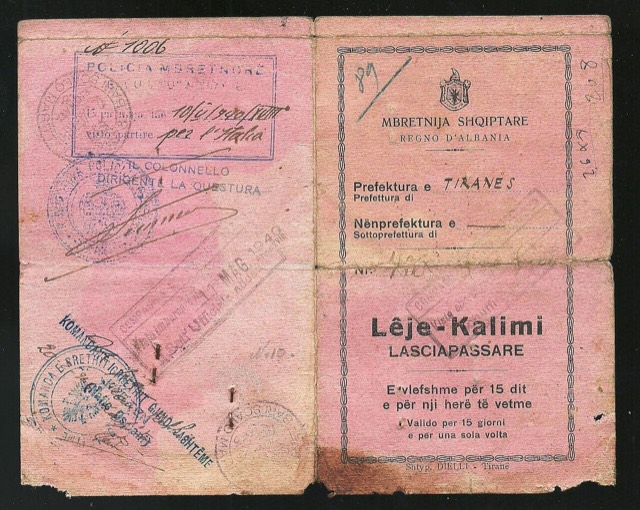
Two days after Crown Prince Leka's birth, on 7 April 1939 — Good Friday — Italy invaded Albania. The Albanian army was ill-equipped to resist, having been extensively staffed by Italian advisers and officers; formal resistance was minimal, though elements of the gendarmerie and parts of the general population did oppose the invasion. The royal family, having anticipated an invasion, had already begun gathering gold from the National Bank of Tirana and Durrës. They fled into exile with that gold. Mussolini subsequently declared Albania a protectorate under Italy's King Victor Emmanuel III. According to one contemporary account, a large part of the Albanian population welcomed the Italians.
Marriage, family, and court life
Zog had been engaged to the daughter of Shefqet Bey Verlaci before becoming king, but broke off that engagement shortly after his accession. Under the Albanian customs of blood vengeance prevalent at the time, Verlaci acquired the right and obligation to kill Zog, adding to the security pressures the king already faced.
In April 1938, Zog married Countess Geraldine Apponyi de Nagy-Appony, a Roman Catholic aristocrat of half-Hungarian and half-American descent. The wedding ceremony was broadcast across Tirana by Radio Tirana, which Zog officially launched five months after the marriage. Their only child, Crown Prince Leka, was born in Albania on 5 April 1939.
Prior to Leka's birth, the heir presumptive was Tati Esad Murad Kryziu, born in Tirana on 24 December 1923, son of Zog's sister Princess Nafije. At the age of five in 1928 he was made an honorary General of the Royal Albanian Army. In 1931 he was formally designated Heir Presumptive with the style of His Highness and the title Prince of Kosova. After the royal family's exile he settled in France, where he died in August 1993 at the age of 69.
Zog had limited recognition among European royal houses because he was a self-proclaimed monarch with no dynastic links to established European royal families. He did maintain strong ties with Muslim royal dynasties in the Arab world, particularly Egypt, whose ruling dynasty was of Albanian origin. Governments that honoured him formally included Italy, Luxembourg, Egypt, Yugoslavia, France, Romania, Greece, Belgium, Bulgaria, Hungary, Poland, Czechoslovakia, and Austria.
Exile during and after World War II
Following the Italian invasion, the royal family fled first to Greece, then to Istanbul, and subsequently travelled through Romania, Poland, Latvia, Sweden, Norway, and Belgium before reaching Paris. When Germany invaded France, their escape was assisted by Prince Mehmed Orhan Osmanoğlu, aide-de-camp to Zog and a member of the Ottoman imperial dynasty. The family then settled in England, residing initially at The Ritz hotel in London.
In 1941 the family moved briefly to Forest Ridge, a house in South Ascot in Berkshire, before settling at Parmoor House near Frieth in Buckinghamshire, with some court staff living in locations around Lane End. In 1946 Zog and most of his family left England to live in Egypt at the invitation of King Farouk. In 1951, Zog purchased the sixty-room Knollwood estate in Muttontown, New York, on Long Island, but the property was never occupied, fell into ruin, and was sold in 1955. Following Farouk's overthrow in 1952, the family left Egypt for France in 1955.
Communist partisans had seized full control of Albania in November 1944. One of their first acts was to ban Zog from ever returning to the country. He was formally deposed in 1946. Zog made several attempts to reclaim his throne. Forces loyal to him, sponsored by MI6 and the CIA, attempted infiltrations into Albania, but most were ambushed because intelligence had been passed to the Soviet Union by the British spy Kim Philby.
Zog died on 9 April 1961 at the Foch Hospital in Suresnes, Hauts-de-Seine, France, aged 65, from an undisclosed condition. He had reportedly smoked around 225 cigarettes a day and had been seriously ill for some time. He was initially buried at the Thiais Cemetery near Paris. His widow Geraldine died in 2002, aged 87, in a military hospital in Tirana.
Repatriation and posthumous recognition
In October 2012, the Albanian government decided to repatriate Zog's remains from France. His body was exhumed from the Thiais Cemetery in Paris on 15 November 2012, with a guard of honour provided by French Legionnaires in ceremonial dress on behalf of the French President.
The remains were returned to Albania in a state ceremony on 17 November 2012, timed to coincide with celebrations marking Albania's independence centennial. Zog and family members were interred in a reconstructed royal mausoleum in Tirana. The ceremony was attended by the Albanian President and Prime Minister and by representatives of the former royal families of Romania, Montenegro, Russia, and Albania.
A main street in Tirana was subsequently renamed Boulevard Zog I by the Albanian government. A referendum held in 1997 — seven years after the end of Communist rule — proposed restoring the monarchy in the person of Zog's son Leka Zogu, who had been styled 'Leka I, King of the Albanians' since 1961. The official but disputed results indicated that approximately two-thirds of voters favoured continued republican government. Leka disputed the result as fraudulent and attempted an armed uprising, which failed and forced him into exile. He later returned and lived in Tirana until his death on 30 November 2011.
その他の画像
関連項目
関連項目
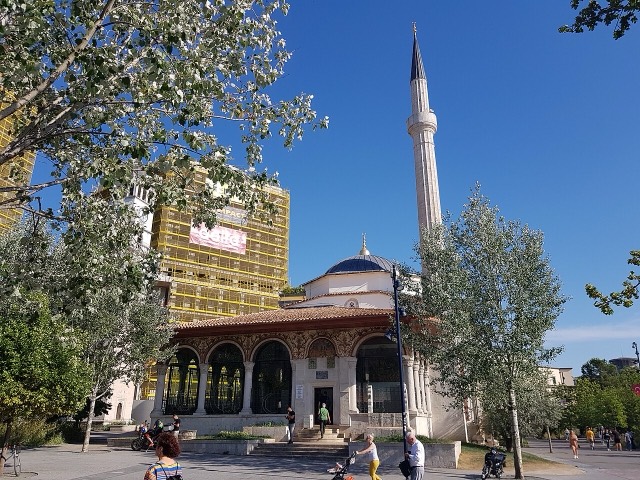
都市 · Tiranë
Tirana
The capital: a fast-changing city of painted blocks, Ottoman survivals and new towers, under Mount Dajti.
歴史的時代
Italian Occupation
Italy invaded on 7 April 1939; Albania was annexed under the Italian crown until Italy's surrender.
出典
- Wikipedia.
Zog I — English Wikipedia
· 取得日 13 Oct 2026
Used to ground the deep-research section and as a discovery aid; not relied on alone for contested claims. - Wikidata.
Wikidata item Q60699
· 取得日 13 Oct 2026
Source of the population, area and elevation figures shown in Quick facts, each with its own observation year. - Wikimedia Commons.
Photographs
· 取得日 13 Oct 2026
Each photograph carries its own creator, licence and file link beneath it. Only public-domain, CC0, CC BY and CC BY-SA files are published.
このページに誤りがありますか? 修正は歓迎しており、原典記録と照合して確認します。何が誤っているか、また可能であれば正しい数値の出典をお知らせください。