مدينة · Gjirokastër
Gjirokastër
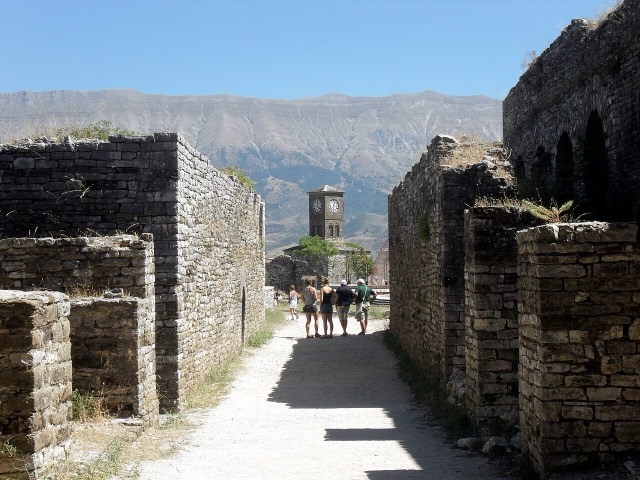
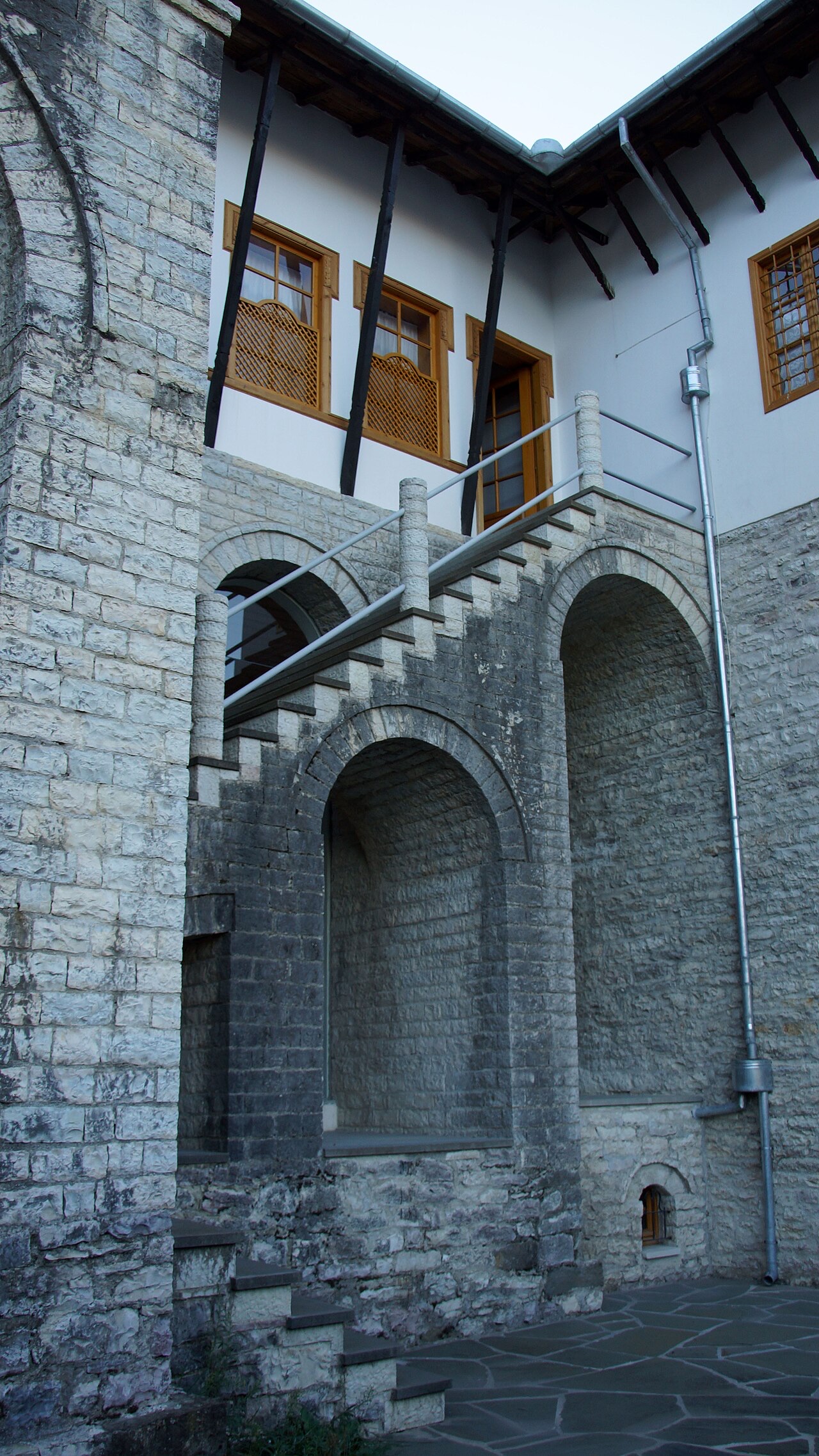
The 'stone city': slate-roofed tower houses on a steep slope beneath one of the Balkans' largest castles.
كل مقاطعة، كل ساحل، كل قرن
عرض إرشادي
هل أنت جديد على ألبانيا؟ تفتتح كل صفحة بشرح مبسّط يمكن قراءته لطفل في العاشرة من عمره، قبل أن تبدأ التفاصيل.
عرض للمتخصصين
أنت تعرف الأساسيات بالفعل. مباشرةً إلى الجوهر، مع إخفاء الشروح المبسّطة. هذا هو الوضع الافتراضي.
شخصية
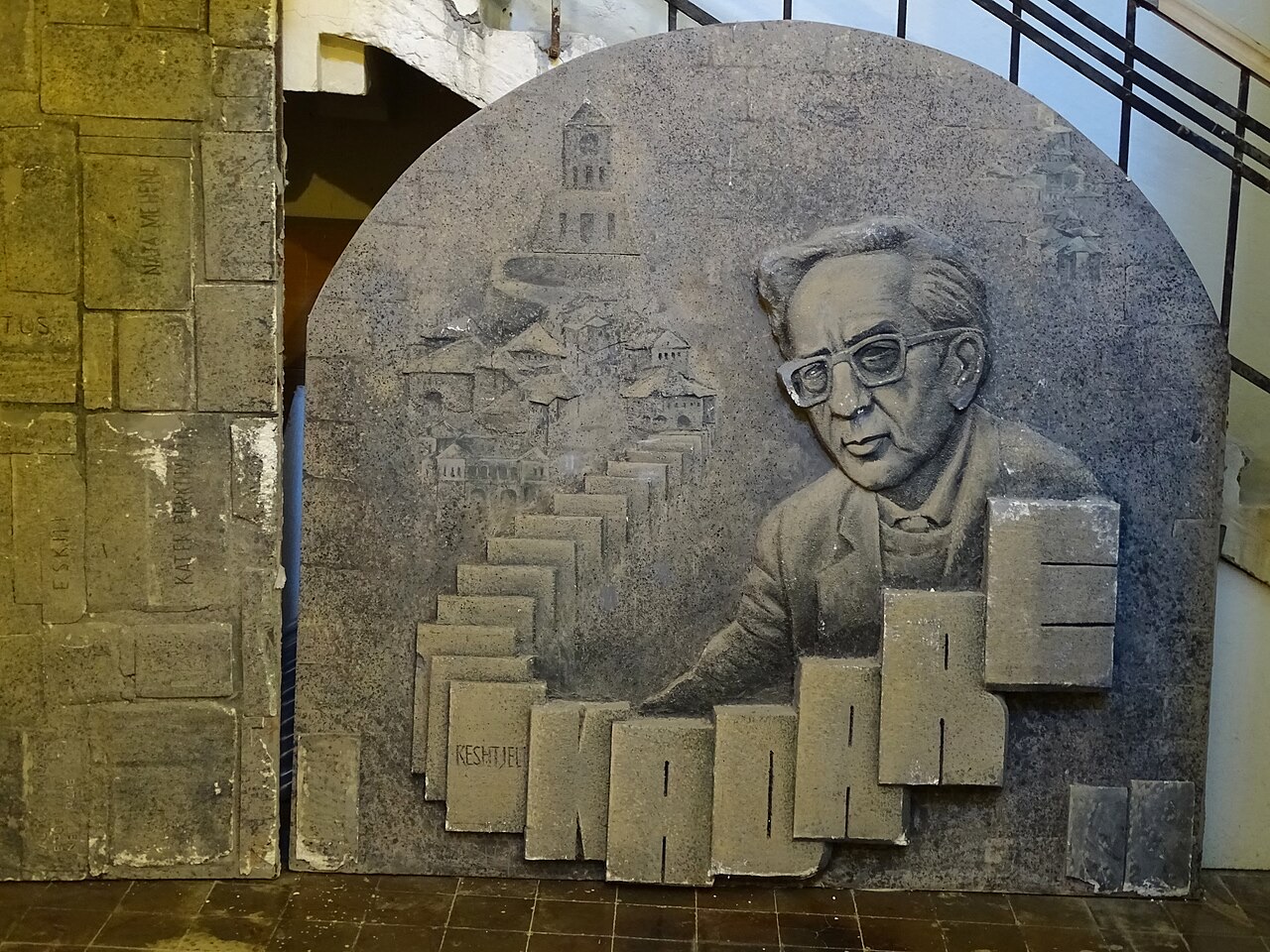
The writer who found ways to describe a totalitarian state from inside it, in novels read worldwide.
حفظ
Ismail Kadare was Albania's most famous writer. He was born in Gjirokastër and published novels throughout the communist period, using myth and history to write about power in ways the censors would allow. In 2005 he won the first International Booker Prize.
Ismail Kadare was Albania's most famous writer. He was born in Gjirokastër and published novels throughout the communist period, using myth and history to write about power in ways the censors would allow. In 2005 he won the first International Booker Prize.
Ismail Kadare was born on 28 January 1936 in Gjirokastër, a historic Ottoman fortress-city in the mountains of what is today southern Albania, roughly a dozen miles from the Greek border. The city is characterized by tall stone houses. Kadare grew up on a street locally known as Lunatics' Lane. His birth fell during the reign of King Zog I in the Kingdom of Albania.
His father, Halit Kadare, worked as a post office employee; his mother, Hatixhe Dobi, was a homemaker who had married in 1933 at the age of 17. On his mother's side, his great-grandfather was a Bejtexhi of the Bektashi Order, known as Hoxhë Dobi. Though born into a Muslim family, Kadare was an atheist.
When Kadare was three years old, Italian Prime Minister Benito Mussolini's forces invaded Albania and removed King Zog. By the time Kadare was nine, Italian troops had withdrawn and the communist-led People's Socialist Republic of Albania had been established, creating the political environment that would shape his entire literary career.
After completing primary and secondary schooling in Gjirokastër, Kadare studied Languages and Literature at the Faculty of History and Philology of the University of Tirana, receiving a teacher's diploma in 1956. He then studied at the Gorky Institute of World Literature in Moscow, where he did postgraduate work from 1958 to 1960 during the Khrushchev era.
His training in Moscow was designed to produce a communist writer and 'engineer of human souls', oriented toward Socialist Realism—a style defined by the idealized depiction of revolutionary communist values. In Moscow he encountered writers working under that banner, but also gained access to contemporary Western literature, including works by Jean-Paul Sartre, Albert Camus, and Ernest Hemingway. He rejected Socialist Realism internally while also writing his first novel, Qyteti pa reklama (The City Without Signs), a critique of socialist careerism in Albania, in 1959.
He also published a collection of poetry in Russian during his time in the Soviet Union. Kadare returned to Tirana in October 1960 on Albanian orders, before Albania formally broke its political and economic ties with the USSR. He would remain based in Tirana for the next thirty years.
Kadare began writing very early. At age 12 he wrote his first short stories, published in the Pionieri (Pioneer) journal in Tirana, a communist magazine for children. In 1954 he published his first poetry collection, Frymëzime djaloshare (Boyish inspirations), followed by Ëndërrimet (Dreams) in 1957. He won a poetry contest in Tirana at age 17, which enabled his travel to Moscow. By 1961 he had published another volume of poetry, Shekulli im (My Century), which was particularly popular with Albanian youth.
His early work quickly attracted official suspicion. A poem entitled 'The Princess Argjiro', which retold the legend of a 15th-century princess said to have jumped from Gjirokastër Castle to avoid Ottoman capture, was denounced. An official reader's report concluded that Kadare had committed historical and ideological errors and had disregarded socialist literary principles. In 1962, an excerpt from his first novel published as the short story Coffeehouse Days in a communist youth magazine was banned immediately after publication, contributing to an early official reputation for 'decadence'.
Following his return from Moscow, Kadare worked as a journalist, became editor-in-chief of the literary periodical Les Lettres Albanaises (published simultaneously in Albanian and French), and contributed to the literary review Drita for five years. The apartment in Tirana where he lived for those thirty years now houses the Ismail Kadare House museum and archives.
In 1963, at the age of 26, Kadare published The General of the Dead Army. The novel follows an Italian army general and a priest who, twenty years after World War II, travel to Albania to locate the remains of Italian soldiers killed there and return them to Italy for burial. Albanian literary critics attacked the novel for flouting socialist ideals and for its dark tone, placing it in stark contrast to Albanian works that glorified the communist revolution. Kadare himself regarded it as 'good literature' but not his best work.
The French translation by Isuf Vrioni, published in Paris by Albin Michel in 1970, produced Kadare's international breakthrough. The French house published the novel without Kadare's knowledge or permission, as Albania at the time was not a signatory to the Universal Copyright Convention and there was no copyright protection on the text. Once published in France, the novel was translated into most European languages; by 1977 it had appeared in more than twenty languages. The Albanian communist press simultaneously hailed it as 'one of the most successful translations of the world of the 70s' while elements of the secret police and the Politburo's old guard called Kadare 'an agent of the West'.
The novel inspired three films: Luciano Tovoli's 1983 Italian production starring Marcello Mastroianni and Michel Piccoli; Bertrand Tavernier's 1989 French film Life and Nothing But starring Philippe Noiret; and Dhimitër Anagnosti's 1989 Albanian film The Return of the Dead Army starring Bujar Lako.
Living under Enver Hoxha's Stalinist regime, which persisted from the end of World War II until 1985 and under which at least 100,000 people were imprisoned for political reasons and approximately 5,000 were executed, Kadare developed systematic techniques to evade censors. He used parable, myth, fable, folk-tale, allegory, and legend, combining them with double-entendre, allusion, insinuation, satire, and coded messages. Albanian historian Anton Logoreci described him during this period as 'a rare sturdy flower growing, inexplicably, in a largely barren patch'.
Three of his books were formally banned. His 1965 novella The Monster, published in the literary magazine Nëntori, was labelled 'decadent' and banned on publication—his second ban. A political poem entitled 'The Red Pasha' (1975), which mocked the Albanian communist bureaucracy, led to his denunciation, reportedly a narrow escape from being shot, and a period of manual labour in a remote village in central Albania. In 1981, The Palace of Dreams was banned after 20,000 copies had been sold, following condemnation at a meeting of the Albanian Writers Union attended by members of the Politburo.
In January 1985, his novel A Moonlit Night was published and then banned by the authorities. On 9 April 1985, Hoxha fell into a coma and died the following night at age 76. That same evening, members of the Union of Writers, the Albanian Politburo, and the Central Committee of the Communist Party hastily convened a meeting to condemn Moonlit Night. His 1985 novella Agamemnon's Daughter—a direct critique of the regime set in the 1970s—was smuggled out of the country with the help of his French editor Claude Durand, but was not published until 2003. Hoxha initiated a process of eliminating Kadare but, according to the article, backed off due to Western reaction; there was a nightly presence of authorities outside Kadare's apartment.
Kadare published The Palace of Dreams in 1981. The novel is set in the imaginary United Ottoman States (U.O.S.), an authoritarian dystopia whose enormous bureaucratic entity—the Palace of Dreams—collects every dream in the empire, sorts, files, and analyses them, and reports the most dangerous to the Sultan. The first excerpt had appeared in Kadare's 1980 collection of four novellas, Gjakftohtësia (Cold-bloodedness); the completed novel appeared the following year in the second edition of Emblema e dikurshme (Signs of the Past).
Readers quickly drew comparisons between the novel's critique of totalitarianism and the contemporary Albanian government. At a meeting of the Albanian Writers Union, Kadare was accused by the Union's president of deliberately avoiding direct politics by cloaking his fiction in history and folklore. The novel was condemned in the presence of several Politburo members, viewed as an anticommunist work and a mockery of the political system. It was subsequently banned, but only after 20,000 copies had sold. Western press reaction and protests mounted in Kadare's defence, and the authorities were initially reluctant to imprison him given his international standing and Albania's rapid economic decline. Of all his works, Kadare stated he was most proud of having written this one.
In 1990, Kadare requested a meeting with Albanian president Ramiz Alia, at which he urged him to end human rights abuses, implement democratic and economic reforms, and end Albania's isolation. Disappointed with Alia's slow response, and facing threats from the Sigurimi secret police, Kadare sought and received political asylum in France in October 1990. At the time Albania had a population of approximately 3.3 million and was described as Europe's last Communist-ruled country. He decided to defect, he later said, because he was convinced that his defection would do more to advance democratisation in Albania than any action he could take from within. The official Albanian press agency called the act 'ugly' and declared that Kadare had placed himself 'in the services of the enemies of Albania'. Despite this, his books were not fully banned by the Communist authorities.
His Parisian exile was productive. His 1992 novel The Pyramid, a political allegory set in ancient Egypt focused on intrigues surrounding the construction of the Great Pyramid of Cheops, was awarded the Prix Méditerranée Étranger in France in 1993. His 1996 novel Spiritus, in which two ghosts return to a post-communist world to investigate rumours about a spirit that proves to be a Sigurimi listening device, was described by Kadare as a narrative and compositional turning point, its influence felt in all subsequent novels. His 2008 novel The Fall of the Stone City was shortlisted for the Independent Foreign Fiction Prize in 2013 and won the Rexhai Surroi Prize in Kosovo.
Beginning in the 1990s, both major Albanian political parties repeatedly asked Kadare to serve as a consensual President of the country. He declined on every occasion. In 2023 he was granted citizenship of Kosovo by President Vjosa Osmani.
Kadare accumulated a substantial number of international literary prizes. In 1992 he received the Prix mondial Cino Del Duca. In 1996 France made him a foreign associate—and effectively a lifetime member—of the Académie des Sciences Morales et Politiques, filling the chair vacated by the recently deceased philosopher Karl Popper. In 1998 he received the Herder Prize in Austria. In 2005 he was awarded the inaugural Man Booker International Prize in the United Kingdom for the full body of his work. In 2009 he received the Prince of Asturias Award for Literature in Spain. In 2015 he received the Jerusalem Prize in Israel.
He won the Park Kyong-ni Prize in South Korea in 2019, and the Neustadt International Prize for Literature in the United States in 2020, nominated by Bulgarian writer Kapka Kassabova. The nominating juror wrote: 'Kadare is the successor of Franz Kafka. No one since Kafka has delved into the infernal mechanism of totalitarian power and its impact on the human soul in as much hypnotic depth as Kadare.' He was nominated for the Nobel Prize in Literature 15 times but never received it; Kadare noted that the press spoke about it so frequently that 'many people think that I've already won it.'
In 2016, French president François Hollande awarded Kadare the Légion d'Honneur at the rank of Commandeur, making him the first Albanian to receive that distinction. In 2023, French president Emmanuel Macron elevated him to Grand Officer of the Legion of Honour by special decree, placing him among 250 world-renowned personalities so honoured. That same year he won the America Award in Literature for lifetime contribution to international writing. He also held honorary doctorates from the University of Grenoble III (1992), the University of Pristina (2003), and the University of Palermo (2009), and was a member of the Academy of Albania, the Berlin Academy of Arts, and the Mallarmé Academy.
After several years of declining health, Kadare died from a heart attack at a hospital in Tirana on 1 July 2024, at the age of 88. A state funeral was held on 3 July at the National Theatre of Opera and Ballet in Tirana, followed by a private burial ceremony. Albania declared two days of national mourning; neighbouring Kosovo declared one day.
His works have been published in 45 languages, and by 2020 approximately 80 novels, plays, screenplays, poetry collections, essays, and story collections had been translated. His complete works were published simultaneously in French and Albanian by Fayard between 1993 and 2004; his Albanian-language works have been published exclusively by Onufri Publishing House since 1996. A 20-volume set of complete works appeared in 2009.
His legacy was defined primarily by his sustained literary resistance to totalitarianism from within one of Europe's most repressive states. Critic Richard Eder called him 'a supreme fictional interpreter of the psychology and physiognomy of oppression'. His writing has been compared to that of Nikolai Gogol, Franz Kafka, George Orwell, Gabriel García Márquez, Milan Kundera, Dostoevsky, Isak Dinesen, and Balzac, though commentators also described his voice as distinctly original. French academician Henri Amouroux noted that Soviet dissidents including Solzhenitsyn published their work during the era of de-Stalinization, whereas Kadare published in a country that remained Stalinist until 1990. He is survived by his wife, Albanian author Helena Kadare (née Gushi), and their two daughters, including Besiana Kadare, Albanian ambassador to the United Nations and vice president of the UN General Assembly for its 75th session.
مدينة · Gjirokastër
The 'stone city': slate-roofed tower houses on a steep slope beneath one of the Balkans' largest castles.
حقبة تاريخية
Forty-six years under Enver Hoxha and his successor: total collectivisation, the banning of religion, successive breaks with…
الموضوع
A culture shaped by mountain isolation, five centuries of Ottoman rule, and fifty years of enforced separation.
ثمة خطأ في هذه الصفحة؟ نرحب بالتصويبات وتُراجَع في مواجهة سجل المصدر. أخبرنا بما هو خاطئ، وإن أمكن، بالمكان الذي يأتي منه الرقم الصحيح.