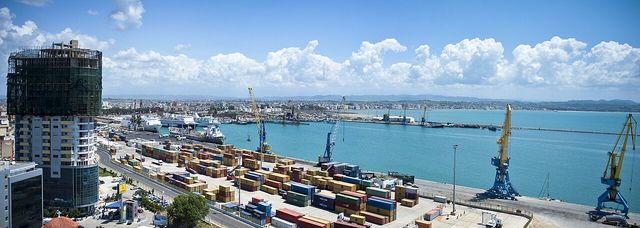
Industrie
Tourism in Albania
The fastest-growing part of the economy, concentrated on the southern coast and in a short summer season.
Elke provincie, elke kust, elke eeuw
Begeleidende weergave
Nieuw in Albanië? Elke pagina begint met een uitleg in eenvoudige taal die u aan een tienjarige zou kunnen voorlezen, voordat de details beginnen.
Expertweergave
U kent de basis al. Meteen naar de kern, met de eenvoudige uitleg verborgen. Dit is de standaardinstelling.
Historische periode
NATO membership in 2009, EU candidate status in 2014, and tourism growing into a central industry.
Opslaan
Since 2000 Albania has joined NATO, become a candidate to join the European Union, and seen a large rise in visitors. Roads, airports and hotels have been built quickly. Emigration and a shrinking population remain the country's biggest long-term problems.
Since 2000 Albania has joined NATO, become a candidate to join the European Union, and seen a large rise in visitors. Roads, airports and hotels have been built quickly. Emigration and a shrinking population remain the country's biggest long-term problems.
Albania declared independence from the Ottoman Empire on 28 November 1912, but the 20th century brought successive and often violent changes of political order: a monarchy under King Zog I from 1928, Italian occupation in 1939, German occupation from 1943, and then four decades of Marxist-Leninist rule under Enver Hoxha following liberation in 1944. In 1998, the country formally became a sovereign parliamentary constitutional republic, its governance structured by a constitution grounded in the separation of powers.
The constitutional framework divides authority among three branches: a legislature (the Parliament), an executive headed by a ceremonial president and a functional prime minister, and a judiciary consisting of constitutional and supreme courts together with appeal and administrative courts. Political rights are formally guaranteed regardless of ethnic, linguistic, racial or religious affiliation, though international assessments have consistently identified concerns about judicial independence, corruption, and media freedom.
The People's Republic of Albania under Enver Hoxha embraced Marxist-Leninist ideology and implemented authoritarian policies that included the abolition of private property, severe restrictions on travel, and prohibition of religious practices. The regime was characterised by recurring purges, extensive repression and hostility to external influences; opposition was met with internal exile, extended imprisonment or execution.
Albania's diplomatic trajectory under Hoxha moved from alignment with Yugoslavia, to partnership with the Soviet Union, to close ties with China during the Sino-Soviet split. The country withdrew from the Warsaw Pact in 1968 following the Soviet invasion of Czechoslovakia. Relations with China stagnated after 1970 and Albania progressively reduced its dependence on Beijing. In 1976, Albania became the world's first constitutionally atheist state. Religious estates had been nationalised in 1946, and religious institutions were closed or converted to other uses.
In the domestic sphere, the regime prioritised Soviet-style industrialisation, expansion of education and healthcare, the introduction of a national railway system, and the elimination of adult illiteracy. It also pursued targeted advances in women's rights, while simultaneously suppressing civil and religious freedoms. The regime persecuted Muslim, Roman Catholic and Eastern Orthodox clergy, with public executions of religious figures recorded during this period.
After the first multi-party elections of 1991, the communist party held a parliamentary majority until its defeat in 1992 by the Democratic Party. During the mid-1990s, considerable economic resources flowed into pyramid schemes that were actively supported by the government. The schemes involved somewhere between one sixth and one third of the country's population. Despite warnings from the International Monetary Fund, Prime Minister Sali Berisha defended the schemes as legitimate investment firms, encouraging further public participation including the sale of homes and livestock to raise deposits.
The schemes began to collapse in late 1996. Initially peaceful protests demanding the return of funds turned violent in February 1997 when government forces fired on demonstrators. In March 1997, the Police and Republican Guard deserted, leaving their armouries open to militias and criminal gangs. The resulting civil disorder prompted large-scale evacuation of foreign nationals and a refugee crisis. Both Prime Minister Aleksandër Meksi and President Sali Berisha resigned in the wake of the subsequent general election.
In April 1997, Operation Alba, a United Nations peacekeeping force led by Italy, entered Albania with two stated goals: assisting the evacuation of expatriates and securing conditions for international organisations. The Western European Union's multinational Albanian Police element worked alongside the government to restructure the judicial system and reorganise the Albanian police.
Albania formally applied for European Union membership on 28 April 2009 and joined NATO the same year, having been invited to join the alliance on 3 April 2008. EU candidate status was granted in June 2014, with accession negotiations beginning at the first intergovernmental conference in July 2022. Albania opened negotiations on the fundamentals cluster in October 2024 and, according to the article, had opened all negotiating clusters by late 2025, a development the European Commission described as a significant milestone.
Foreign policy since the end of communism has been oriented toward Euro-Atlantic integration, regional stability, advocacy for Kosovo's international recognition, and the protection of Albanian communities in Kosovo, Greece, Italy, Montenegro, North Macedonia and Serbia. Albania recognised Kosovo's sovereignty in 2008 and has held annual joint governmental meetings with Kosovo since an inaugural session in 2014. Albania became a member of the United Nations in 1955.
The 2013 parliamentary election ended eight years of Democratic Party government under Sali Berisha. The Socialist Party led by Edi Rama won, heading the Alliance for a European Albania coalition. The Socialist Party subsequently won the 2017, 2021 and 2025 elections, making Rama the first Albanian prime minister to secure four consecutive mandates. Rama's governments have prioritised judicial reform, public administration changes, urban redevelopment, digitalisation of public services, tourism development and EU accession.
A significant institutional development was the 2016 justice reform package, which created the Special Structure against Corruption and Organized Crime (SPAK). SPAK subsequently prosecuted high-level figures from both the governing majority and the opposition: former prime minister Sali Berisha was indicted on corruption charges in 2024; former president Ilir Meta was arrested and charged with corruption and money laundering; Tirana mayor Erion Veliaj was detained in 2025 on corruption and money-laundering allegations he denied; and Deputy Prime Minister Belinda Balluku was investigated over public-tender allegations and dismissed by Rama in February 2026.
Freedom House classifies Albania as 'Partly Free' and as a 'Transitional or Hybrid Regime', noting that elections are competitive but that politics is highly polarised, dominated by powerful party leaders, and affected by corruption and bribery. Its Nations in Transit report describes national governance as dominated by clientelist party politics and states that elections have been affected by vote-buying, manipulation, fraud and gerrymandering. In 2021, Transparency International and the Institute for Democracy and Mediation published a report arguing that state-capture mechanisms in Albania involved clientelist networks, corruption in the judiciary and laws designed to benefit particular private interests. The Bertelsmann Transformation Index reported in 2026 that political and patronage networks continued to undermine meritocracy, and that high-level corruption investigations had revealed networks diverting state contracts and resources toward political associates and criminal networks.
On 26 November 2019, a 6.4-magnitude earthquake struck Albania with its epicentre approximately 16 kilometres southwest of Mamurras. The most affected areas were Durrës and Kodër-Thumanë. The tremor was felt as far away as Taranto in Italy and Belgrade in Serbia. The response included humanitarian aid from the Albanian diaspora and several foreign governments.
In 2026, large anti-government demonstrations known as the Flamingo Revolution emerged following proposed luxury coastal developments on Sazan Island and the Zvërnec peninsula, including projects linked to Jared Kushner. Demonstrators accused the government of lacking transparency, endangering protected ecosystems, and failing to tackle corruption or improve public services. The protests expanded from environmental concerns into broader demands for government accountability, early elections and Rama's resignation. European Parliament figures warned that the coastal development plans could affect Albania's EU accession process if they conflicted with environmental obligations and democratic standards. Police used tear gas, pepper spray and water cannon during demonstrations in Tirana; authorities stated the response followed attacks on officers and property damage.
Albania is classified as a developing open-market economy with upper-middle income status. As of 2025, nominal GDP stood at $26.911 billion, with a GDP per capita of $9,474 and a projected annual growth rate of 3.8% for that year. The service sector is the largest component of the economy, comprising 48.6% of GDP, followed by industry at 20.2%, agriculture, forestry and fisheries at 18.5%, and manufacturing at 6.3%. Economic activity is heavily concentrated in the Tirana–Durrës–Laç triangle, referred to as Durana; in 2021, Tirana County alone accounted for 44% of national GDP.
Tourism has expanded dramatically: from roughly 500,000 visitors in 2005 to an estimated 11.7 million in 2024 according to UN Tourism figures. The sector directly accounted for 8.4% of GDP in 2016, rising to 26% when indirect contributions are included. Albania has also signed the Stabilisation and Association Agreement with the EU (2006), a free trade agreement with the European Free Trade Association (2009), and is party to CEFTA and the Black Sea Economic Cooperation organisation.
The economy faces structural vulnerabilities including widespread corruption, distorted competition, a large informal sector, persistent labour shortages, and frequent modifications to fiscal legislation. The United States Department of State has identified Albania as vulnerable to money laundering through real estate, construction, virtual assets and business development. The Global Initiative Against Transnational Organized Crime's 2025 Global Organized Crime Index described Albania as a prominent money-laundering destination, stating that the construction sector is heavily infiltrated by illicit funds. The illegal drug trade is reported to contribute approximately $100 million to the economy annually.
Albania covers an area of 28,748 square kilometres on the Balkan Peninsula, bordering Montenegro to the northwest, Kosovo to the northeast, North Macedonia to the east and Greece to the south, with the Adriatic Sea to the west and the Ionian Sea to the southwest. The country extends approximately 340 kilometres from north to south and 148 kilometres from east to west. Mount Korab, at 2,764 metres above Adriatic sea level, is the highest point. Lake Shkodër in the northwest is Southern Europe's largest lake, and Lake Ohrid to the southeast is one of the world's oldest continuously existing lakes.
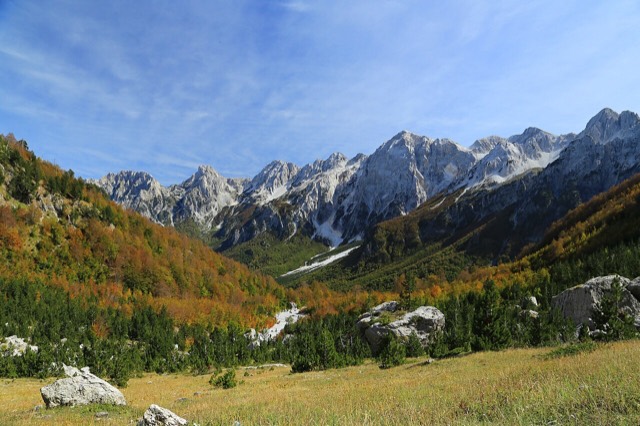
The climate ranges from Mediterranean and subtropical in the western half to oceanic, continental and subarctic in the eastern half, spanning five primary Köppen climatic types. Average monthly temperatures range from -1 °C in winter to 21.8 °C in summer. The highest recorded temperature was 43.9 °C at Kuçovë on 18 July 1973; the lowest was -29 °C at Shtyllë, Librazhd on 9 January 2017. Mean annual precipitation is approximately 1,485 millimetres, ranging between 600 and 3,000 millimetres depending on location. The Albanian Alps receive at least 3,100 millimetres annually and are considered among Europe's most humid regions; four glaciers have been found there at an altitude of approximately 2,000 metres, which is described as extremely rare for such a southerly latitude.
The 2023 census recorded a population of 2,402,113, a significant decline from 2,821,977 in the 2011 census. The decrease began after the collapse of the communist regime and is attributed to falling fertility rates and large-scale emigration. Projections indicate the population will continue to shrink for at least the following decade. In 2022, the birth rate was 20% lower than in 2021, largely because people of childbearing age had emigrated. Population density stands at 83.6 inhabitants per square kilometre.
The counties of Tirana and Durrës together account for approximately 41% of the total population, with 32% in Tirana County and 9% in Durrës County. Peripheral counties such as Gjirokastër and Kukës each contribute only 3% of the national total, and areas including Dibër and Kukës have experienced severe depopulation. The proportion of the population living in urban areas rose from 47% in 2001 to 65% in 2023. The number of ethnic Albanians living abroad is estimated to exceed the population residing within Albania's borders, making it one of the countries with the highest rates of outmigration relative to population in the world.
Freedom of the press and free expression are guaranteed by the constitution, but in practice media freedom has been weakened by political pressure, concentrated ownership, opaque financing and the overlap between media, business and political interests. In the 2026 World Press Freedom Index, Albania ranked 83rd of 180 countries. The top four owners in the Albanian television market reach between 48.93% and 58.60% of audiences. The public broadcaster is Radio Televizioni Shqiptar (RTSH); major private broadcasters include Top Channel, TV Klan, Vizion Plus and Ora News. In March 2023, the headquarters of Top Channel was attacked with automatic weapons, killing a security guard.
Violence against women and girls is described as widespread: nearly 60% of women in rural areas suffer physical or psychological violence and nearly 8% are victims of sexual violence. Protection orders are frequently violated. The Council of Europe's GREVIO body reported in 2024 that serious gaps remained, including persistent gender stereotypes, extremely low reporting of sexual violence and limited specialist services. In 2026, the United Nations in Albania welcomed the adoption of a new law on prevention and protection from violence against women and domestic violence.
Roma, Balkan Egyptian and other minority communities face documented barriers in education, housing, employment and access to public services. Designated national and cultural minorities in Albania include Aromanian, Greek, Macedonian, Montenegrin, Serb, Roma, Egyptian, Bosnian and Bulgarian peoples, as well as Gorani and Jews. The 2023 census recorded 91.07% of respondents reporting Albanian as the language spoken at home. Greek is the second most widely spoken language, used as a first language by an estimated 0.5 to 3% of the population, concentrated in the south. Macedonian holds official status in Pustec Municipality in eastern Albania.
De warmste maand is August (gemiddeld dagelijks maximum 31°C), de koudste is January (gemiddeld dagelijks minimum 1°C), en de natste is December (124 mm). De gemiddelde jaarlijkse neerslag bedraagt 1,013 mm.
| Maand | Maximum | Minimum | Neerslag | Natte dagen | Zon/dag |
|---|---|---|---|---|---|
| January | 11°C | 1°C | 104 mm | 11 | 7.1 h |
| February | 12°C | 2°C | 90 mm | 10 | 8.1 h |
| March | 15°C | 4°C | 104 mm | 11 | 9.5 h |
| April | 19°C | 7°C | 100 mm | 13 | 10.6 h |
| May | 24°C | 12°C | 83 mm | 12 | 11.9 h |
| June | 28°C | 16°C | 51 mm | 9 | 13.5 h |
| July | 31°C | 18°C | 33 mm | 6 | 13.7 h |
| August | 31°C | 19°C | 32 mm | 6 | 12.8 h |
| September | 26°C | 15°C | 82 mm | 9 | 10.7 h |
| October | 22°C | 11°C | 92 mm | 9 | 9.2 h |
| November | 17°C | 7°C | 119 mm | 10 | 7.2 h |
| December | 12°C | 3°C | 124 mm | 12 | 6.6 h |
Bron: ERA5 reanalysis via Open-Meteo, 1994–2023 · "Maximum" en "Minimum" zijn het gemiddelde dagelijkse maximum en minimum van de luchttemperatuur. "Natte dagen" telt dagen met ten minste 1 mm neerslag.
Industrie
The fastest-growing part of the economy, concentrated on the southern coast and in a short summer season.
Onderwerp
An upper-middle-income economy of roughly $30 billion, led by services and tourism, with remittances and construction close…
Historische periode
The fall of the regime, mass emigration, and the 1997 collapse of the pyramid schemes.
Toelichting
Candidate since 2014, negotiating since July 2022 — where the process actually stands and what the remaining steps are.
Toelichting
The 2023 census recorded a resident population far below the 2011 count — the clearest measure of three decades of emigration.
Iets onjuist op deze pagina? Correcties zijn welkom en worden gecontroleerd aan de hand van de bronregistratie. Laat ons weten wat onjuist is en, indien mogelijk, waar het juiste cijfer vandaan komt.