Исторический объект · Durrës
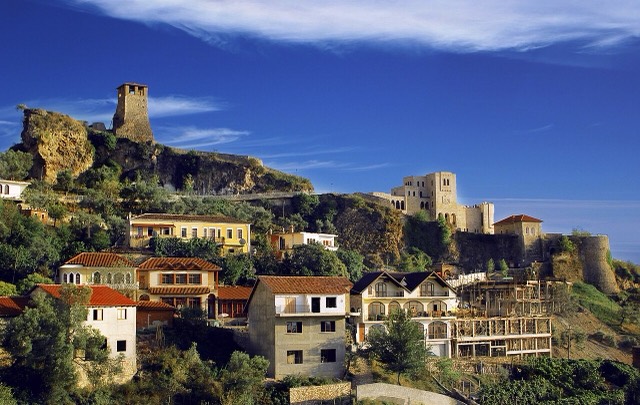
Krujë Castle
Skanderbeg's base, which held out against three Ottoman sieges and now houses the national museum of the resistance.
Каждый округ, каждый берег, каждый век
Режим с пояснениями
Впервые об Албании? Каждая страница начинается с доступного объяснения, понятного даже десятилетнему ребёнку, и лишь затем переходит к подробностям.
Режим эксперта
Основы вам уже известны. Сразу к существу вопроса, без простых пояснений. Это режим по умолчанию.
Исторический период
Arbanon, then the Angevin Kingdom of Albania, then the great noble houses — Thopia, Balsha, Kastrioti, Arianiti.
Сохранить
In the Middle Ages Albania was ruled by local princes and noble families rather than one king. The first Albanian state, Arbanon, appeared around 1190. Later, families like the Kastrioti and the Thopia held their own territories.
In the Middle Ages Albania was ruled by local princes and noble families rather than one king. The first Albanian state, Arbanon, appeared around 1190. Later, families like the Kastrioti and the Thopia held their own territories.
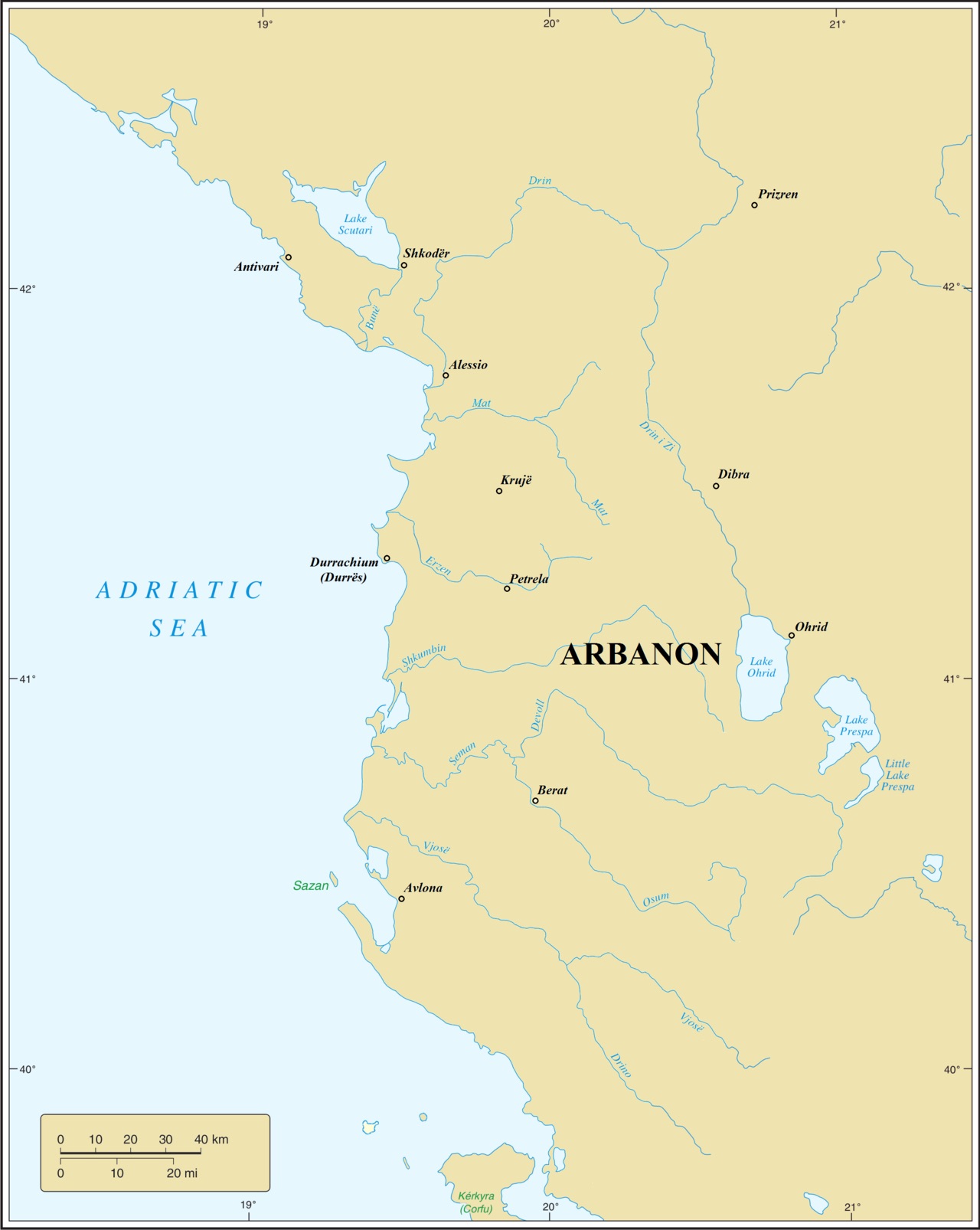
Arbanon (Latin: Arbanum; Greek: Árvanon) was a medieval principality occupying territory in present-day central Albania. Scholars widely regard it as the first Albanian state to emerge in recorded history. It was established in 1190 by an Albanian archon named Progon in the region surrounding Kruja, to the east and northeast of Venetian territories.
The principality was ruled by the native Progoni family across three successive lords: Progon himself, then his son Gjin, and finally Gjin's brother Demetrius. In 1204, Arbanon attained full, though temporary, political independence by exploiting the weakening of Constantinople that followed its sack during the Fourth Crusade. That independence effectively ended around 1216 with the death of Demetrius and the northward advance of Michael I Komnenos Doukas of the Despotate of Epirus. The principality was ultimately annexed in the winter of 1256–57 by the Byzantine statesman George Akropolites. In 1272, most of its territory, together with Durrës, became part of the Kingdom of Albania.
The principality was called Árvanon (Ἄρβανον) in Greek, Arbanum in Latin, and Raban in the early thirteenth-century Serbian document Life of Stefan Nemanja. The term is linked to the name of a south Illyrian tribe recorded in ancient Greek as Ἀλβανοί (Albanoi). That ethnic label denoted Albanians until it was replaced by Shqiptar in the eighteenth century. One scholarly attribution, by Orel, connects the form directly to a Latin rendering of the tribal name Albanoi.
Versions of the root 'Arbën' appear as early as the second century BC. The historian Polybius mentions a location called Arbona (Greek: Ἄρβωνα; Latin: Arbo) to which Illyrian troops under Queen Teuta fled to escape Roman forces. The location of Arbona is uncertain: it may have been an island in Liburnia or another site within Illyria. In the sixth century AD, Stephanus of Byzantium, in his geographical dictionary Ethnica, records a city in Illyria called Arbon (Ἀρβών) and provides two singular ethnic forms for its inhabitants: Arbonios (Ἀρβώνιος) and Arbonites (Ἀρβωνίτης).
By the eleventh century, the name Arbanon (also Albanon) was applied to a mountainous region west of Lake Ohrid and in the upper valley of the river Shkumbin. The fortress of Kruja served as the military and administrative centre throughout the principality's existence. According to historian Alain Ducellier, Arbanon in its earlier phase did not have direct access to the sea, and was a small territory stretching between the rivers Devoll and Shkumbin.
At its greatest extent under Demetrius Progoni, the principality's claimed territory ran from the Shkumbin river valley in the south to the Drin river valley in the north, and from the Adriatic coast in the west to the Black Drin in the east. In his correspondence with Pope Innocent III, Demetrius described his domain as the mountainous region among Shkodra, Durrës, Ohrid, and Prizren (regionis montosae inter Scodram, Dyrrachium, Achridam et Prizrenam sitae). In its final phase, as recorded by George Akropolites, the territory lay between Durrës and Lake Ohrid on a west–east axis, and between the Shkumbin and Mat river valleys on a south–north axis.
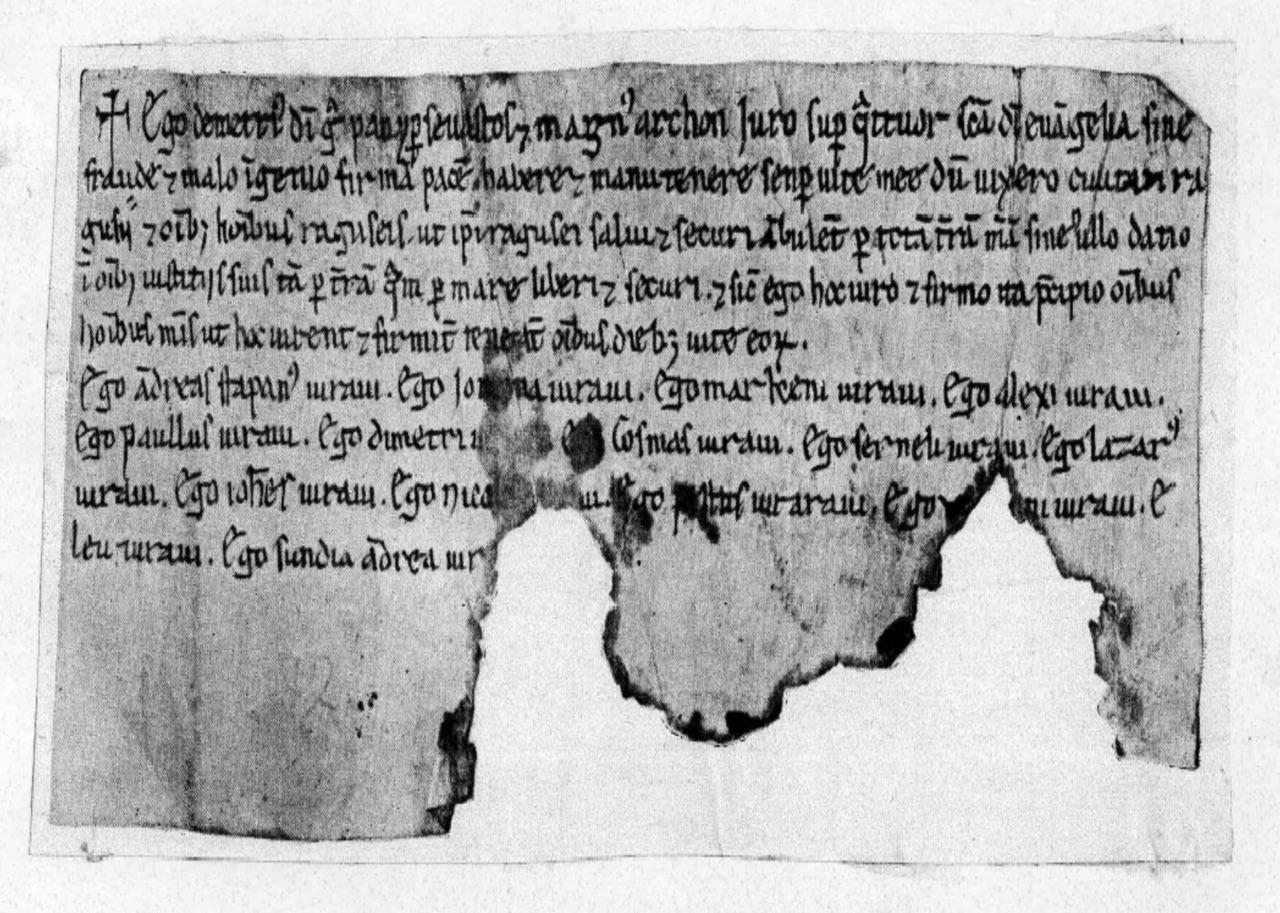
Primary sources for early Arbanon are scarce, with the chronicles of the Byzantine historian George Akropolites representing the most detailed account of the period. Documentary evidence predating the principality's formal establishment records that in 1166, a prior Arbanensis named Andrea and a bishop of Arbanon named Lazarus participated in a ceremony held in Kotor, then under the Serbian Grand Principality. The following year, Pope Alexander III wrote to Lazarus congratulating him for returning his bishopric to the Catholic faith and urging him to acknowledge the Archbishop of Ragusa as his superior. After some local resistance, a Papal letter dated 1188 placed the Bishopric of Arbanon under direct papal dependence.
Little is recorded of Progon himself beyond the fact that between 1190 and 1198 he was the first ruler of Kruja and its surroundings. The Kruja fortress passed hereditarily within the family. Progon was succeeded by his son Gjin, who died in 1208 (some sources give 1207), and then by his other son Demetrius. A note from 1198 records that Stefan Nemanjić briefly controlled a part of the area north of the Drin, stating that in that year he captured Pult from Arbanon.
Demetrius was the third and last lord of the Progoni family, ruling between 1208 (or 1207) and 1216 (or 1215). He pursued an active foreign policy intended to preserve Arbanon's sovereignty against the Republic of Venice and the Despotate of Epirus. In 1208–09 he considered converting from Eastern Orthodoxy to Catholicism in order to neutralise Venetian claims — Venice held nominal rights over Albania — since conversion would place Arbanon under another Catholic state and thereby undercut Venetian justification for intervention. He corresponded with Pope Innocent III and requested missionaries; the Pope instructed Nicolaus, the Catholic archdeacon of Durrës, to make preparations. Demetrius halted the process shortly afterwards, judging it unnecessary after defeating Đorđe Nemanjić, a Venetian vassal to his north.
In 1208 Demetrius also secured a marriage with Komnena Nemanjić, daughter of Stefan Nemanjić and granddaughter of the last Byzantine Emperor Alexios III Angelos. Through this connection to the Byzantine imperial family he received recognition under the title panhypersebastos. He used the title princeps Arbanorum ('prince of the Albanians') in dealings with foreign powers, and in Latin documents is also referred to as iudex and megas archon. In 1209 he signed a treaty with the Republic of Ragusa granting free passage to Ragusan merchants across Albanian territory. He was subsequently excommunicated for seizing church property following the death of the Catholic Archbishop of Durrës.
In 1210, Venice and Michael I Komnenos Doukas of Epirus concluded an agreement under which Doukas would become a Venetian vassal in exchange for recognition of his claims up to the Shkumbin river valley, a core area of Arbanon. In 1212, Venice further allowed the coastal duchy of Durrës to pass to Michael. These arrangements surrounded Arbanon with hostile forces and appear to have reduced the principality, by the end of Demetrius's life, to territory north of the Shkumbin and south of the Drin. A Latin foundational inscription at the Catholic church of Gëziq, in the Ndërfandë near modern Rreshen in Mirdita, records that Progoni funded the church's construction and designated as his successor Progon, son of Gjin Progoni, with the title protosebastos. The inscription also identifies Progoni and the iudices of Arbanon as dependent on the princes of Zeta, Vladin and Đorđe Nemanjić.
The foundational inscription of the church of Gëziq is one of the most significant documents from the principality's later period. Written in Latin and produced after Demetrius's death, it records that Progoni, having been readmitted to the Catholic Church, provided funds for the construction of the church. It also serves as Progoni's last will.
The inscription indicates that the new church was built on the site of an older church dedicated to St. Mary (Shën Mëri), but Progoni rededicated the new building to Shën Premte, the patron saint of Arbanum. This choice suggests the church may have been intended as the seat of the Diocese of Arbanum or of a new diocese at the centre of Progoni's remaining domain. The church is described in the inscription as being offered to his people (nationi obtulit).
Demetrius died in 1215 or 1216 without a male heir. Power passed initially to his wife Komnena Nemanjić. She was subsequently married to a Greco-Albanian lord named Gregorios Kamonas. Kamonas had previously been married to Gjin Progoni's daughter, and the new marriage to Komnena was necessary to legitimise his succession to power. After taking control of Kruja, Kamonas worked to strengthen relations with the Grand Principality of Serbia, which had been weakened by a Slavic assault on Scutari.
Kamonas and Komnena had a daughter together, who married a local magnate named Golem (also recorded as Gulam). Golem continued to rule as a semi-independent lord in Arbanon, operating successively under Theodore Komnenos Doukas of Epirus until 1230, and then under Ivan Asen II of Bulgaria until Ivan Asen's death in 1241. During the conflicts between Michael II Komnenos Doukas of Epirus and the Nicaean Emperor John III Doukas Vatatzes, Golem and Theodore Petraliphas, who had initially been Michael's allies, defected to John III in 1252. Golem is last mentioned in historical records at a meeting with George Akropolites in Durrës in the winter of 1256–57.
Following Golem's submission to the Empire of Nicaea in 1252, the Emperor Theodore II Laskaris appointed Constantine Chabaron as ruler of the principality. This initial Nicaean conquest proved short-lived: the imposition of direct rule prompted the Rebellion of Arbanon in 1257. George Akropolites subsequently annexed the statelet and installed a Byzantine civil, military, and fiscal administration. Akropolites' own historical writings constitute the main primary source for late Arbanon.
In 1256, Manfred of Sicily invaded Durrës and the surrounding area as far south as Berat and Vlorë. After his death, those territories passed to Charles I of Anjou. In late February 1272 the Kingdom of Albania was declared, with Durrës as its main seat, incorporating most of the territory that had formed Arbanon.
Between 1190 and 1204, Arbanon functioned as a principality within the Byzantine Empire, possessing considerable autonomy while remaining formally dependent, as indicated by the titles its rulers held: 'archon' under Progon and 'panhypersebastos' under Demetrius. In 1204, following the sack of Constantinople during the Fourth Crusade, Arbanon achieved full autonomy. That autonomy lasted approximately twelve years, ending with the death of Demetrius in 1215 or 1216.
After 1216, the principality fell successively under the Despotate of Epirus, then the Bulgarian Empire, and from 1235 under the Empire of Nicaea. The Gëziq inscription records the Progoni family's dependence on the princes of Zeta, Vladin and Đorđe Nemanjić (r. 1208–1216). In its last phase, Arbanon maintained allied relations with the Kingdom of Serbia while being primarily connected to the Despotate of Epirus. Arbanon also benefited economically from its position along the Via Egnatia trade road, which linked it to the more economically developed Byzantine world.
Robert Elsie notes that the coastal cities of what is now Albania did not contain noticeable Albanian communities throughout the Middle Ages. By contrast, Ducellier records that the coasts of Epirus further south, despite Serbian and Greek political control, were primarily inhabited by Albanians. Arbanon's own territories were inland and mountainous; according to Ducellier, the principality lacked direct access to the sea in its earlier phase.
The Progoni family maintained the fortress of Kruja as the hereditary seat and administrative centre of the principality across all three of its rulers. After the male line ended with Demetrius, legitimacy was transferred through the female line: first through Komnena to Kamonas, and then through Kamonas's daughter to Golem. The Progoni thus shaped Albanian political identity in the early thirteenth century through the use of the title princeps Arbanorum and through correspondence with the papacy and foreign states that established formal international recognition of Arbanon as a distinct polity.
Исторический объект · Durrës
Skanderbeg's base, which held out against three Ottoman sieges and now houses the national museum of the resistance.
Персона
Gjergj Kastrioti: an Ottoman commander who changed sides and held Albania against the empire for twenty-five years.
Исторический период
Twenty-five years in which a coalition of Albanian nobles held off the Ottoman Empire at its height.
Нашли ошибку на этой странице? Исправления приветствуются и проверяются по исходной записи. Сообщите нам, что именно неверно, и по возможности укажите, откуда взята правильная цифра.