Sitio histórico · Tiranë
Albania's Bunkers
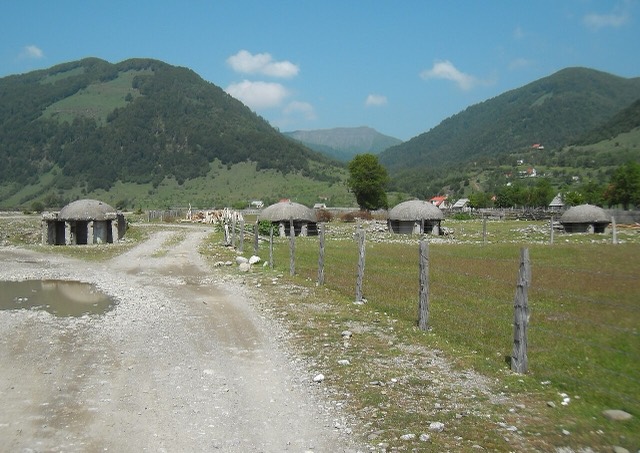
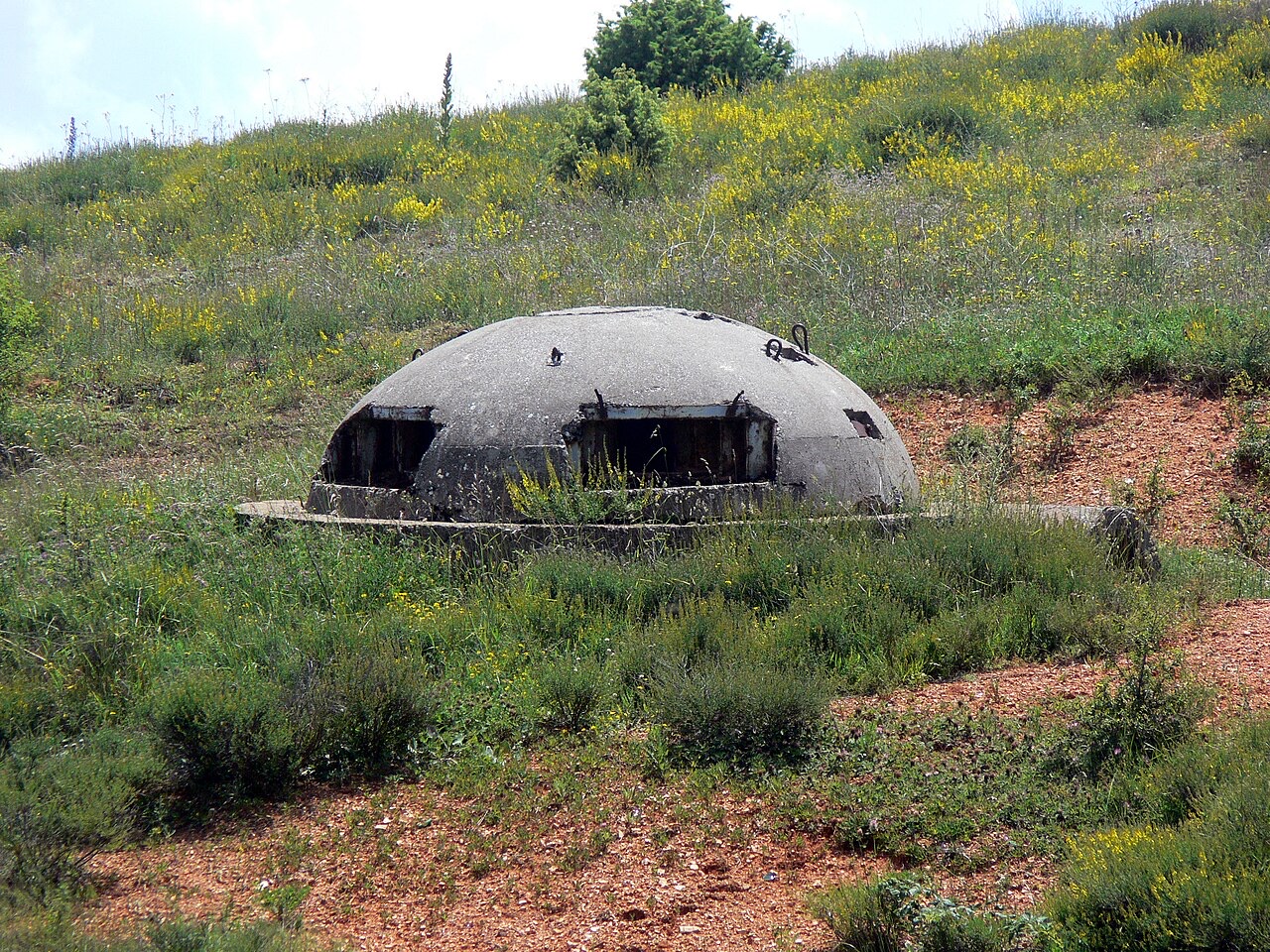
Roughly 170,000 concrete pillboxes built under Enver Hoxha — the most visible physical legacy of the communist state.
Cada condado, cada costa, cada siglo
Vista guiada
¿Nuevo en Albania? Cada página comienza con una explicación en lenguaje sencillo que cualquiera podría entender, antes de entrar en los detalles.
Vista experta
Ya conoces los fundamentos. Directo al contenido, con las explicaciones básicas ocultas. Esta es la vista predeterminada.
Período histórico
Forty-six years under Enver Hoxha and his successor: total collectivisation, the banning of religion, successive breaks with Yugoslavia, the USSR and China, and near-total isolation.
Guardar
From 1944 to 1991 Albania was a communist state led by Enver Hoxha. Private property, religion and foreign travel were all banned. Albania fell out with Yugoslavia, then the Soviet Union, then China, until it was almost completely alone. Around 170,000 concrete bunkers were built against an invasion that never came.
From 1944 to 1991 Albania was a communist state led by Enver Hoxha. Private property, religion and foreign travel were all banned. Albania fell out with Yugoslavia, then the Soviet Union, then China, until it was almost completely alone. Around 170,000 concrete bunkers were built against an invasion that never came.
On 29 November 1944, the National Liberation Movement (LANÇ) liberated Albania from German occupation, having already formed a provisional government, the Anti-Fascist National Liberation Council, in May of that year. Unlike most countries that became part of the Eastern Bloc, where communist parties nominally shared coalition governments for several years before seizing full control, Albania's provisional government was an undisguised communist regime from the outset, dominated by the two-year-old Communist Party of Albania and its first secretary, Enver Hoxha.
In December 1944, the provisional government nationalized foreign and domestic trade, commercial enterprises, and existing industries, and authorised the confiscation of property belonging to political exiles and 'enemies of the people'. In August 1945, it adopted Albania's first sweeping agricultural reform, targeting the country's 100 largest landowners, who controlled close to a third of Albania's arable land. Under the Agrarian Reform Law, roughly half of all arable land was redistributed: peasants with agricultural machinery could retain up to 40 hectares, religious and other institutions were limited to 20 hectares, and landless peasants received up to 5 hectares with nominal compensation required.
In December 1945, Albanians elected a new People's Assembly, but the ballot presented only a single list from the Communist-dominated Democratic Front. Official tallies recorded 92% voter turnout and 93% support for the Front's ticket. The assembly convened in January 1946, formally dethroned King Zog I, abolished the monarchy, and declared Albania a people's republic. It then adopted a constitution modelled on the Yugoslav and Soviet constitutions. Hoxha became simultaneously prime minister, foreign minister, defence minister, and commander-in-chief of the army. On 11 January 1946, the People's Republic of Albania was formally established.
Until Yugoslavia's expulsion from the Cominform in June 1948, Albania functioned effectively as a Yugoslav satellite state. Yugoslavia was the first country to recognise Albania's provisional government, and in January 1945 the two governments signed a treaty establishing Kosovo as a Yugoslav autonomous province, with Albania renouncing its wartime claim to the territory. A July 1946 treaty of friendship and cooperation was followed by agreements coordinating economic plans, standardising monetary systems, and establishing a customs union. Serbo-Croatian was made a required subject in Albanian high schools. About 20,000 tons of Yugoslav grain helped avert famine, and Albania also received US$26.3 million from the United Nations Relief and Rehabilitation Administration.
Yugoslav investment financed a sugar refinery in Korçë, a food-processing plant in Elbasan, a hemp factory at Rrogozhinë, a fish cannery in Vlorë, and a printing press, telephone exchange, and textile mill in Tirana. Joint Albanian-Yugoslav companies operated in mining, railroad construction, petroleum, electricity production, and international trade. However, the relationship soured as Albania complained that Yugoslavia paid too little for its raw materials and used joint companies to exert economic control. Yugoslavia pressed Albania to concentrate on agriculture and raw-material extraction, while Albanian planners wanted light industry and an oil refinery.
Internal affairs minister Koçi Xoxe, a committed pro-Yugoslav, manoeuvred to subordinate Albania to Belgrade. Nako Spiru, head of Albania's Economic Planning Commission and Hoxha's principal ally, was the leading internal critic of Yugoslav economic dominance; following intense criticism at a November 1947 party meeting spearheaded by Xoxe, Spiru died the following day in circumstances his death was framed as a suicide. When the Cominform expelled Yugoslavia on 28 June 1948, Albania reversed course within days: Yugoslav advisers were given 48 hours to leave, all bilateral economic agreements were rescinded, and a propaganda campaign began that transformed Tito into an 'imperialist monster'. Xoxe was dismissed, replaced as internal affairs minister by Mehmet Shehu, and after a secret trial was executed in May 1949. Subsequent purges removed 14 of the 31 members of the party's Central Committee and 32 of 109 People's Assembly deputies, and roughly 25% of party members were expelled.
Albania's relations with Western governments deteriorated rapidly after the communist government refused to permit free elections in December 1945. Tirana restricted the movement of American and British personnel, accusing them of instigating anti-communist uprisings in the northern mountains. Britain announced in April 1946 that it would not send a diplomatic mission to Tirana; the United States withdrew its mission in November of that year. Both powers opposed Albania's admission to the United Nations.
A major incident arose in 1946 after Tirana claimed jurisdiction over the channel between the Albanian mainland and the Greek island of Corfu. Britain responded by sailing four destroyers through the channel. Two ships struck mines on 22 October 1946, killing 44 crew members. The case was brought before the International Court of Justice, which in its first ever ruling decided against Albania.
From 1946 onwards, the United States and Britain implemented a covert plan to overthrow the communist government by backing royalist and anti-communist forces inside Albania. Working with King Zog and his personal guard, the two intelligence services recruited Albanian refugees and émigrés from Egypt, Italy, and Greece; trained them in Cyprus, Malta, and West Germany; and infiltrated them into Albania in guerrilla units in 1950 and 1952. Albanian security forces killed or captured all of them. Kim Philby, a Soviet double agent serving as liaison between British intelligence and the CIA, had leaked details of the plan to Moscow; the security breach is estimated to have cost approximately 300 infiltrators their lives. Following a wave of subversive activity that included the March 1951 bombing of the Soviet embassy in Tirana, a penal code enacted in September 1952 mandated the death penalty for anyone over eleven years of age convicted of conspiring against the state, damaging state property, or committing economic sabotage. Between 5,000 and 25,000 people were killed in total during the communist era, though this figure is an estimate recorded in the source.
After the split with Yugoslavia, Albania became dependent on Soviet assistance. In February 1949, it joined Comecon, the communist bloc's economic coordination organisation, and entered trade agreements with Poland, Czechoslovakia, Hungary, Romania, and the Soviet Union. The Soviet Union sent military advisers and built a submarine installation on Sazan Island. In 1951, Albania launched its first five-year plan, which prioritised exploitation of oil, chromite, copper, nickel, asphalt, and coal resources, alongside expansion of electricity production and improvement of transportation. By 1955, private farms still produced approximately 87% of Albania's agricultural output, but by 1960 the same proportion came from collective or state farms.
Social conditions improved measurably in the early 1950s for a population then numbering approximately 1.2 million. The number of Albanian doctors rose by about a third to roughly 150, and hospital beds increased from 1,765 in 1945 to approximately 5,500 in 1953. The infant mortality rate fell from 112.2 deaths per 1,000 live births in 1945 to 99.5 per 1,000 by 1953. The number of schools, teachers, and students doubled between 1945 and 1950, and illiteracy fell from an estimated 85% in 1946 to 31% in 1950. The State University of Tirana was founded in 1957, and the Albanian Academy of Sciences opened fifteen years later.
Stalin's death in March 1953 created new pressures. Neither Hoxha nor Shehu attended his funeral, apparently fearing that the change in Soviet leadership might encourage rivals within the Albanian party. Khrushchev's subsequent moves towards 'peaceful coexistence' and de-Stalinisation alarmed both men. Albania became a founding member of the Warsaw Pact in 1955, though the alliance did nothing to resolve Albanian mistrust of Yugoslavia. During Khrushchev's 'secret speech' at the Twentieth Party Congress in 1956, Hoxha defended Stalin and refused to follow the new Soviet line. A subsequent visit to Moscow in April 1957 was productive: Hoxha secured cancellation of approximately US$105 million in outstanding loans and about US$7.8 million in additional food assistance. However, by 1958 tensions had re-emerged over Kosovo, and Khrushchev reportedly told Hoxha during a 1959 visit that Albania should aspire to become 'socialism's orchard' — meaning it should accept a role as agricultural producer rather than industrial state, a proposal the Albanian leadership flatly rejected.
Albania's alignment with China against the Soviet Union became explicit in June 1960 at a Romanian Workers' Party congress, where Khrushchev attempted to secure condemnation of Beijing. Albania's delegation, alone among European delegations, supported China. The Soviet Union immediately organised a campaign to remove Hoxha and Shehu, cutting promised grain deliveries to Albania during a drought and encouraging a pro-Soviet faction within the Party of Labour of Albania. A plot apparently involving force to unseat the two Albanian leaders was also attributed to Moscow. Four pro-Soviet Albanian leaders, including Teme Sejko and Tahir Demi, were tried and executed. China began compensating for cancelled Soviet wheat shipments despite its own economic difficulties.
At the November 1960 Moscow conference of 81 communist parties, Hoxha attacked Khrushchev directly, accusing him of encouraging Greek territorial claims on southern Albania and using economic blackmail. The speech ended any prospect of reconciliation. After additional exchanges at the Soviet Communist Party's Twenty-Second Congress in October 1961, the Soviet Union broke diplomatic relations with Albania in December and withdrew all economic advisers and technicians from the country, including those building the Palace of Culture in Tirana. Moscow also continued dismantling its naval installations on Sazan Island.
China replaced roughly 90% of the parts, foodstuffs, and other goods that the Soviet Union had promised. Chinese loans were offered on more favourable terms than Soviet ones, and, unlike Soviet advisers, Chinese technicians received the same pay as Albanian workers and lived in equivalent housing. China also gave Albania a powerful radio transmission station. Albania, in return, acted as China's chief spokesman at the United Nations. However, Chinese equipment and technicians were considerably less sophisticated than their Soviet equivalents, and a language barrier meant Chinese and Albanian technicians often had to communicate in Russian. Half of Albania's imports and exports had been geared to Soviet suppliers and markets, and the loss of Soviet trade brought Albania's foreign trade close to collapse. An austerity programme was introduced in 1962.
Hoxha's Third Five-Year Plan (1961–65), announced at the APL's Fourth Party Congress in February 1961, allocated 54% of all investment to industry, explicitly rejecting Khrushchev's agricultural prescription. In 1964, Albanian workers completed construction of the Palace of Culture in Tirana without outside help, having seized the vacant Soviet embassy building the same year. Following the Warsaw Pact invasion of Czechoslovakia in August 1968, Albania formally withdrew from the Warsaw Pact within one month, in September 1968, becoming the only Warsaw Pact member to formally leave the alliance before 1990. Soviet leader Leonid Brezhnev made no attempt to prevent the withdrawal.
In the mid-1960s, following Mao Zedong's launch of the Cultural Revolution in China in 1966, Hoxha initiated his own Cultural and Ideological Revolution. The regime abolished military ranks, reintroduced political commissars into the army, and sent administrators and specialists from desk jobs to factories and fields. Six ministries were eliminated, including the Ministry of Justice. Farm collectivisation extended to the remote mountains. Writers and artists who strayed from socialist realism were attacked, the educational system was reformed, and Albania's isolation from European cultural influence was reinforced.
Following Hoxha's speech on 6 February 1967 at the 5th Congress of the Party of Labour of Albania, the authorities launched a campaign to eliminate religious practice. Student agitators were sent into the countryside to compel Albanians to abandon their faiths. By the end of 1967, all churches, mosques, monasteries, and other religious institutions had been closed or converted into warehouses, gymnasiums, and workshops. A special decree abrogated the charters under which the country's main religious communities had operated. Albania declared itself the world's first atheist state, presented as one of Hoxha's principal achievements. The 1976 Constitution, in Article 37, stated that 'The state recognises no religion whatever and supports atheist propaganda for the purpose of inculcating the scientific materialist world outlook in people.' Article 55 explicitly prohibited the formation of any religious organisation and forbade religious activities and propaganda.
The Cultural and Ideological Revolution also had pronounced effects on gender roles and family structures. Before World War II, approximately 90% of Albanian women were illiterate, and in many areas they were regarded as legally subordinate under ancient tribal customs. The party encouraged women to enter paid employment, partly to compensate for labour shortages. Traditional patriarchal kinship structures were further disrupted by collectivisation of agriculture, industrialisation, rural-to-urban migration, and the suppression of religion.
Albanian-Chinese relations began to stagnate by 1970. As China emerged from the Cultural Revolution in the early 1970s and began engaging with the United States, Albania was left increasingly at odds with its principal patron. Albania's press and radio ignored President Nixon's 1972 visit to Beijing. Albania opened trade negotiations with France, Italy, and newly independent Asian and African states, and in 1971 normalised relations with Yugoslavia and Greece. Albania was the only European country that refused to participate in the Helsinki Conference of July 1975.
Following Mao's death in 1976, Hoxha publicly criticised the new Chinese leadership and its pragmatic foreign policy. China responded by inviting Tito to visit Beijing in 1977 and terminating its assistance programmes for Albania in 1978. The Sino-Albanian split left Albania without any foreign benefactor. Albania rejected calls to normalise relations with either the United States or the Soviet Union, instead expanding ties with Western Europe and developing nations and formally enshrining the principle of self-reliance in the 1976 Constitution, which prohibited the government from seeking financial aid or credits from, or forming joint companies with, capitalist or 'revisionist communist' countries.
The practical consequences of isolation were severe. Without Chinese or Soviet aid, Albania experienced widespread shortages of machine parts, wheat, and animal feed. According to the World Bank, Albania's gross national product per capita stood at around US$750 throughout much of the 1980s. Between 1983 and 1988, a prolonged drought reduced water levels in hydropower reservoirs, limiting the electricity supply needed for chromium mining. The economy was further affected by the 1983 OPEC oil price cut. By the late 1980s, aging industrial equipment caused the industrial base to deteriorate significantly. In 1983, Albania imported goods worth US$280 million and exported goods worth US$290 million, recording a trade surplus of US$10 million.
In 1980, Hoxha designated Ramiz Alia as his successor, passing over his long-standing associate Mehmet Shehu. When Shehu declined to step aside voluntarily, Hoxha arranged for Politburo members to rebuke him for allowing his son to become engaged to the daughter of a family with a bourgeois background. Shehu was reported to have committed suicide on 17 December 1981, though suspicions remained that Hoxha had arranged his death. Hoxha subsequently had Shehu's wife and three sons arrested; one of the sons killed himself in prison. In November 1982, Hoxha announced publicly that Shehu had been simultaneously working as a spy for American, British, Soviet, and Yugoslav intelligence services and had planned to assassinate Hoxha.
By 1983, Hoxha's declining health required him to relinquish many duties, and Alia assumed effective administrative responsibility, travelling extensively across Albania and standing in at major state events. Hoxha died on 11 April 1985. Alia was formally elected first secretary of the Party of Labour of Albania two days later. Hoxha had worked to institutionalise his policies through the 1976 Constitution, which enshrined autarky and prohibited external financial assistance, in the hope of constraining any successors from departing from the Stalinist path he had established.
Hoxha purged the defence minister and many senior military officials during the final years of his leadership in response to internal pressures for reform, and later replaced ministers responsible for the economy with younger appointees. These moves reflected a broader pattern of using purges as a control mechanism: the anti-Titoist purges of 1948–49, the removal of moderates in the early 1950s, and the elimination of pro-Soviet and pro-Chinese figures in subsequent years collectively removed large fractions of the party leadership over the course of Hoxha's rule.
After Hoxha's death in 1985, Ramiz Alia maintained firm control over Albania's security apparatus while introducing cautious economic reforms demanded by the country's deteriorating economic situation. Alia reestablished diplomatic relations with West Germany in exchange for development aid and pursued closer ties with Italy and France. The pace of reform intensified as Mikhail Gorbachev's policies of glasnost and perestroika transformed the Soviet Union, and the fall of the Berlin Wall in November 1989 was followed by the collapse of communist governments across Central and Eastern Europe.
The execution of Romanian leader Nicolae Ceaușescu in December 1989 appears to have accelerated Alia's calculations. He signed the Helsinki Agreement — which other European countries had signed in 1975 — recognising certain human rights commitments. On 11 December 1990, under pressure from students and workers, Alia announced that the Party of Labour would relinquish its guaranteed monopoly on power, that other parties could be formed, and that free elections would be held in the spring of 1991. The first multi-party elections in socialist Albania were held on 31 March 1991; the communists won a majority and formed an interim government, but a general strike two months later caused that government to collapse.
The Republic of Albania was proclaimed on 29 April 1991. National elections on 22 March 1992 resulted in victory for the Democratic Party, ending communist rule. All communist symbols were removed on 7 April 1992. The legal foundations of the People's Socialist Republic of Albania were formally repealed on 28 November 1998, upon adoption of the new Constitution of Albania. The transition brought considerable instability: the Democratic Party government's failure to deliver rapid economic improvement led to disillusionment, and in 1996 it was accused of manipulating election results. The government collapsed in 1997 following the failure of pyramid schemes and widespread corruption, requiring external intervention to restore order.
Encyclopædia Britannica, as quoted in the article, notes that Hoxha's modernisation programme transformed Albania from a predominantly agrarian country into a more industrialised society within four decades, with significant progress in industry, agriculture, education, arts, and culture. It cites as particular achievements the drainage of coastal swamps — previously malaria-breeding grounds — for agricultural and industrial use, and the linguistic reform that merged the Gheg and Tosk dialects into a unified literary language.
Political repression was a consistent feature of the entire communist period. The secret police, the Sigurimi (formally the Directorate of State Security, Drejtorija e Sigurimit të Shtetit), enforced political control through dismissal from employment, imprisonment in forced labour camps, and executions. The penal code enacted in September 1952 prescribed the death penalty for anyone over eleven years of age convicted of conspiring against the state. Between 5,000 and 25,000 people were killed during the communist era, though this is an estimated range rather than a confirmed figure. An estimated 100,000 Albanians suffered political persecution under the regime.
A 2016 survey by the Institute for Development Research and Alternatives (IDRA) found that 42% of Albanians believed Hoxha had a positive impact on history, compared with 45% who judged his impact negatively. Citizens in the southern and southwestern regions of Albania reported the highest rates of positive assessment, at 55%. Approximately 35% of respondents said the communist past was not a problem for them, while 62% viewed it as at least somewhat problematic. In academic circles within Albania, assessments tend to be more critical, with emphasis placed on repressive governance, deliberate isolation, and systematic political persecution.
Sitio histórico · Tiranë
Roughly 170,000 concrete pillboxes built under Enver Hoxha — the most visible physical legacy of the communist state.
Sitio histórico · Tiranë
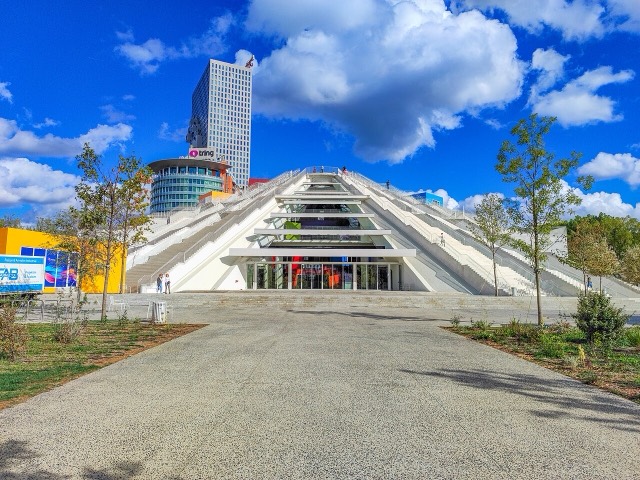
Built as Enver Hoxha's mausoleum-museum, later a nightclub and NATO base, reopened in 2023 as a youth technology centre.
Persona
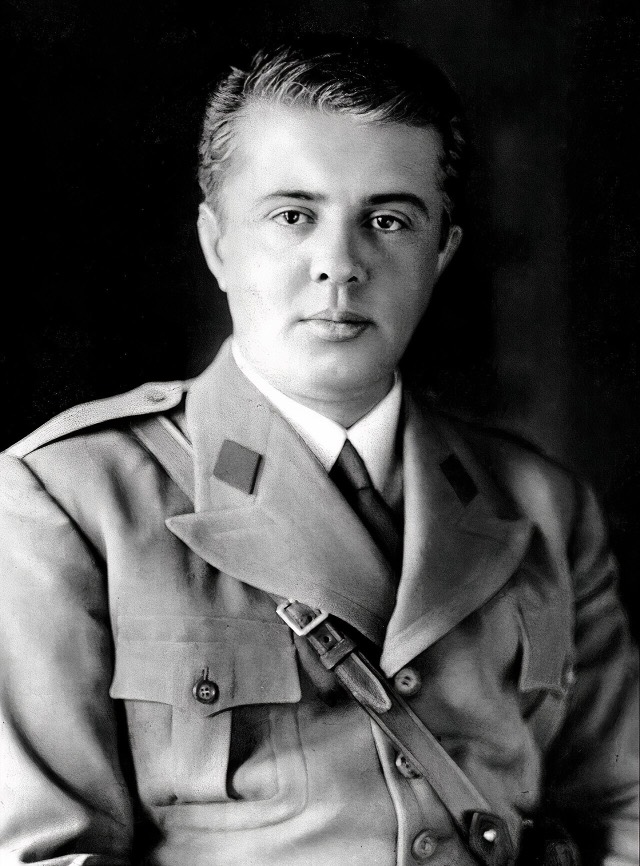
The leader who took Albania out of the Soviet bloc, then out of the Chinese one, and banned religion outright.
Asunto
Four historic communities — Sunni, Bektashi, Orthodox and Catholic — and a state that banned all of them from 1967 to 1990.
Período histórico
Occupation, a three-way resistance, and the sheltering of Jewish refugees under besa.
Asunto
Illyrian kingdoms, Roman roads, five Ottoman centuries, twenty-eight years of independence, forty-six years of the strictest…
Asunto
The Directorate of State Security: the secret police of communist Albania, and the institution the House of Leaves museum was…
Persona
The writer who found ways to describe a totalitarian state from inside it, in novels read worldwide.
¿Algo incorrecto en esta página? Las correcciones son bienvenidas y se contrastan con el registro fuente. Indíquenos qué es incorrecto y, si puede, de dónde procede el dato correcto.