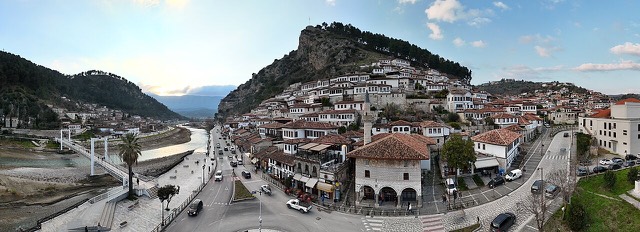
城市 · Berat
Berat
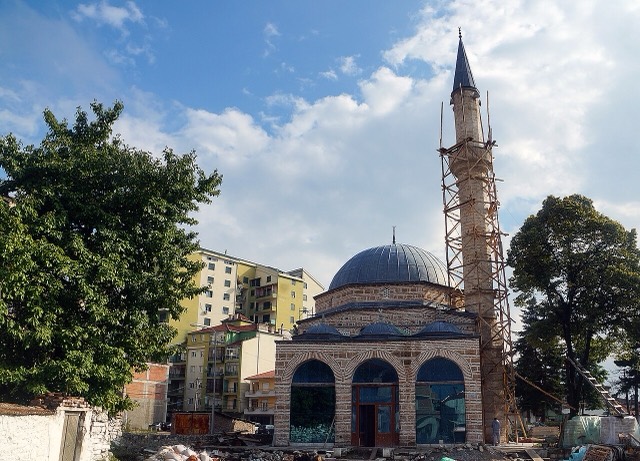
The 'city of a thousand windows': an Ottoman hill town under a still-inhabited castle, UNESCO-listed since 2008.
每个县、每段海岸、每个世纪
引导视图
初次了解阿尔巴尼亚?每个页面均以通俗易懂的说明开篇——即便是十岁的孩子也能读懂——随后再展开详细内容。
专业视图
您已掌握基础知识。直接进入正题,简明解释默认隐藏。此为默认模式。
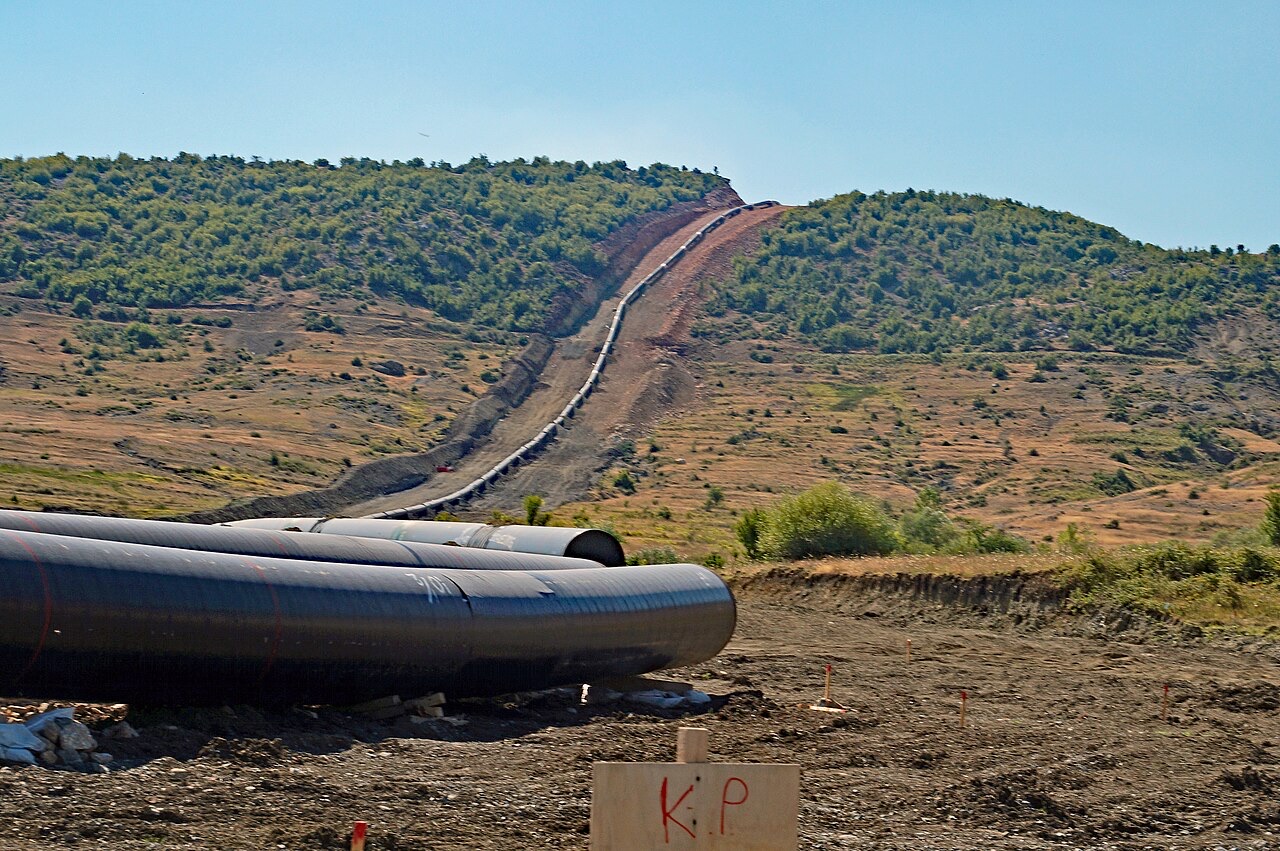
能源设施 · Fier County
The 878 km gas pipeline from the Greek border to Italy, of which 215 km crosses Albania.
保存
A big gas pipeline crosses Albania from Greece to the coast, then runs under the sea to Italy. It carries gas from Azerbaijan to Europe. Albania does not yet use much of the gas itself.
A big gas pipeline crosses Albania from Greece to the coast, then runs under the sea to Italy. It carries gas from Azerbaijan to Europe. Albania does not yet use much of the gas itself.
The Trans Adriatic Pipeline (TAP) is a natural gas pipeline running from the Greece–Turkey border through Greece, Albania and the Adriatic Sea to southern Italy. It has been operational since 2020 and carries natural gas originating from the Shah Deniz field in the Azerbaijani section of the Caspian Sea. TAP forms the final section of the Southern Gas Corridor, a chain of pipelines that begins in Azerbaijan and runs westward through the South Caucasus Pipeline and the Trans-Anatolian Pipeline (TANAP) before connecting to TAP at the Greek-Turkish border.
European institutions have supported the project, classifying it as a 'Project of Common Interest' on the grounds that it enhances energy security and diversifies gas supplies for European markets. As of 2022, the pipeline's capacity stands at 10 billion cubic metres (bcm) per year, with a planned expansion to 20 bcm per year. The initial allocation distributes 8 bcm annually to Italy, 1 bcm to Greece, and 1 bcm to Bulgaria.
The project was announced in 2003 by Swiss energy company EGL Group, subsequently renamed Axpo. A feasibility study was concluded in March 2006, examining two possible routes: a northern corridor through Bulgaria, North Macedonia and Albania, and a southern corridor through Greece and Albania. The southern route was judged more feasible. Greece opposed a routing that would allow Albania to serve as the primary gas transmission hub for the Western Balkans.
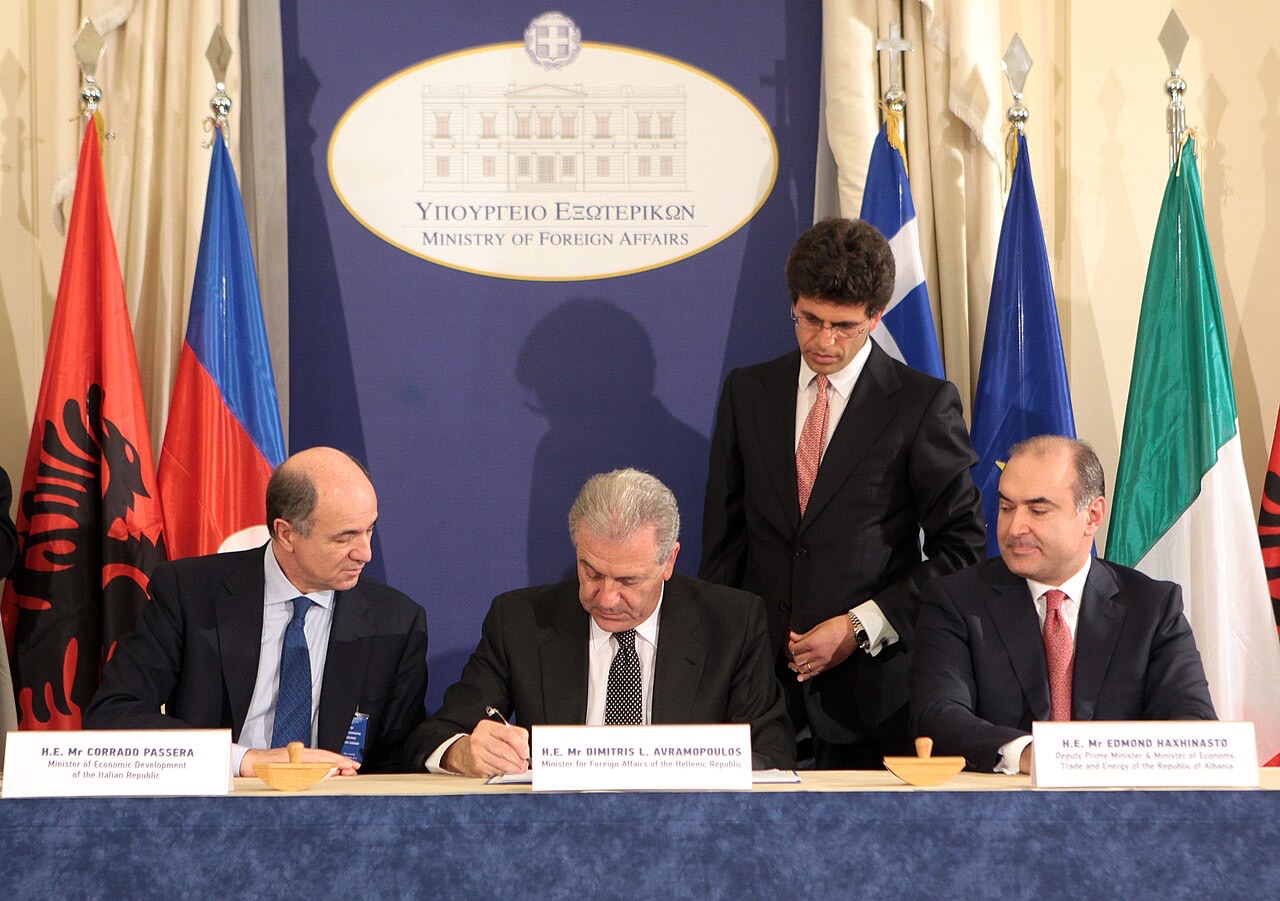
On 13 February 2008, EGL Group and Norwegian energy company Statoil formed Trans Adriatic Pipeline AG, a joint venture to develop, build and operate the pipeline. Early development work included a marine survey of the Adriatic Sea in January 2009 and a route assessment survey in Albania beginning in July 2009. Italy and Albania signed an intergovernmental agreement on energy cooperation in March 2009 that listed TAP as a project of common interest to both countries. Country offices opened in Greece, Albania and Italy in January 2010.
In February 2012, TAP was the first project pre-selected to enter exclusive negotiations with the Shah Deniz Consortium. In June 2013, TAP was chosen over the competing Nabucco West project as the route for Shah Deniz II gas. That same year BP, SOCAR, Total, and Fluxys became shareholders, while in September 2014 E.ON and Total sold their shares to Enagás and Fluxys. In December 2015, Snam acquired Statoil's 20% interest, establishing the ownership structure that broadly persists today.
Construction of the pipeline began on 16 May 2016. The project took approximately four and a half years to complete. Commercial operations commenced on 15 November 2020, and the first Azerbaijani gas was delivered to Italy on 30 December 2020.
Total construction costs were approximately €4.5 billion. Roughly one third of that sum was spent on the section within Albania, reflecting the scale of infrastructure work required in that country. The Albanian section runs for 215 kilometres, the largest single-country onshore segment after Greece's 550-kilometre stretch.
The pipeline begins at Kipoi, in the Evros regional unit at the Greece–Turkey border, where it connects to the Trans-Anatolian Pipeline. It crosses Greece for 550 kilometres (340 miles), then Albania for 215 kilometres (134 miles), then continues 105 kilometres (65 miles) offshore before coming ashore near San Foca in Italy, with a final 8-kilometre (5-mile) onshore section on Italian soil. The total length is 878 kilometres (546 miles). The offshore leg reaches a maximum depth of 810 metres (2,660 feet).
The onshore section uses 48-inch (1,200 mm) pipes operating at a pressure of 95 bars (9,500 kPa; 1,378 psi). The offshore section uses 36-inch (910 mm) pipes at a higher pressure of 145 bars (14,500 kPa; 2,103 psi). The Gas Interconnector Greece-Bulgaria (IGB) has linked TAP to the Bulgarian network since October 2022, enabling the 1 bcm annual allocation to Bulgaria.
A capacity expansion was triggered on 30 January 2023 following the first binding phase of TAP's 2021 market test. This first level of expansion will add 1.2 bcm of capacity per year. The pipeline's design permits expansion up to 20 bcm per year in total.
Trans Adriatic Pipeline AG is registered in Baar, canton Zug, Switzerland. Its stated purpose is the planning, development and construction of the TAP pipeline. The Managing Director is Luca Schieppati.
As of early 2023, the five equal shareholders each hold a 20% stake: BP, SOCAR (the State Oil Company of Azerbaijan), Snam (Italy), Fluxys (Belgium) and Enagás (Spain). This equal distribution followed a transaction announced on 27 January 2023 in which Axpo sold its remaining 5% shareholding to Enagás (4%) and Fluxys (1%), bringing both companies to the 20% level held by the other partners.
The pipeline's Italian landfall generated significant opposition from local communities, elected officials and environmental groups. The gas terminal was constructed in an olive grove near Melendugno, a town in the Apulia region, which contained century-old olive trees. These trees were explanted and relocated to an alternative site, a process that critics noted could not guarantee their survival. Opposition intensified because the region was already affected by Xylella fastidiosa, a deadly parasitic bacterial disease affecting olive trees, and relocation of trees was seen as a potential vector for spreading the disease to previously unaffected areas.
The pipeline's coastal landing point runs under the beach at San Foca. Local residents and environmentalists raised safety concerns about compressed flammable gas being piped 10 metres beneath a beach kept open to the public during summer months. Several local mayors and the governor of Apulia, Michele Emiliano, argued the pipeline risked enabling organised crime and corruption to infiltrate construction procurement on the Italian side.
Governor Emiliano told an Al Jazeera English crew in 2016 that he could not understand why an alternative landing point closer to the industrial port of Brindisi was not selected, given that such a route would have entailed lower costs, less severe environmental impact and proximity to existing gas infrastructure. Critics also questioned the necessity of a taxpayer-funded 60-kilometre interconnector required to link the Melendugno terminal to Italy's national gas network near Brindisi.
城市 · Berat
The 'city of a thousand windows': an Ottoman hill town under a still-inhabited castle, UNESCO-listed since 2008.
城市 · Korçë
The highland city of serenades, the first Albanian-language school, and the country's oldest brewery.
工业
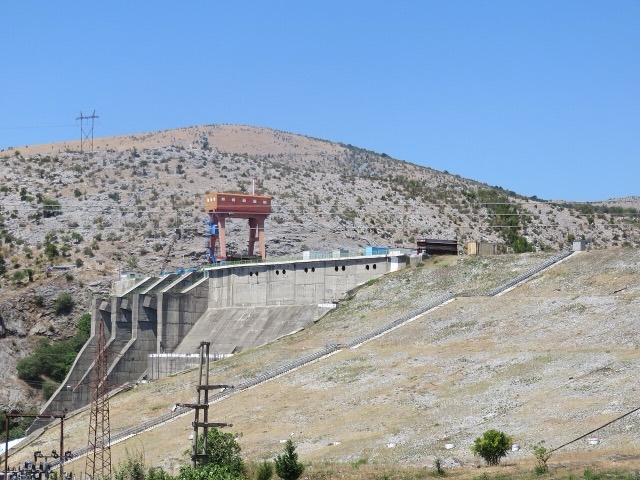
Electricity almost entirely from hydropower — which makes supply depend on rainfall.
主题
An upper-middle-income economy of roughly $30 billion, led by services and tourism, with remittances and construction close…
本页内容有误? 欢迎提交更正意见,所有意见均会与原始记录核对。请告知错误所在,如能提供正确数据的出处,请一并注明。