Industry
Banking and Finance
A euroised, foreign-owned banking sector supervised by the Bank of Albania.
Every county, coast and century
Guided view
New to Albania? Every page opens with a plain-language explanation you could read to a ten-year-old, before the detail begins.
Expert view
You already know the basics. Straight to the substance, with the simple explanations hidden. This is the default.
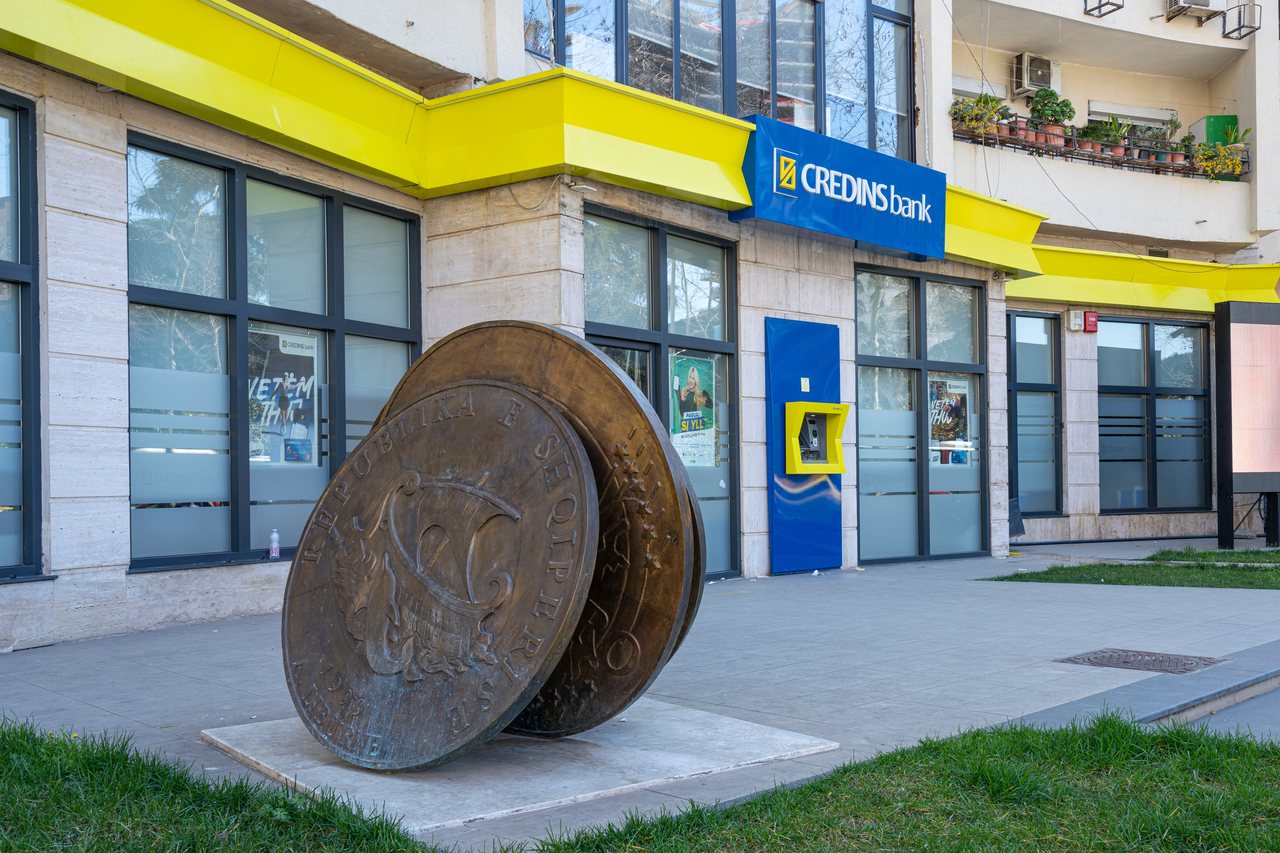
Company · Tiranë County
A large domestically founded commercial bank.
Save
Credins is one of the larger Albanian-founded banks.
Credins is one of the larger Albanian-founded banks.
Credins Bank was established in Albania in March 2003 by a group of Albanian businessmen. It holds the distinction of being the first private bank in Albania founded with Albanian capital. In January 2003, the Bank of Albania announced that an application had been submitted for the licensing of the proposed Banka Credins sh.a., and on 31 March 2003 the bank received Bank of Albania licence number 16, authorising it to conduct banking and financial activity in the country.
The bank's head office is located in Tirana. Public company registration records indicate that an individual named Santo served as general director at the time of the bank's establishment and was reappointed to that position on 20 January 2009.
Santo continued to serve as chief executive officer and director general of Credins Bank until his death. On 26 June 2014, he was shot dead in Tirana. His killing left the bank without its founding chief executive after more than a decade of leadership.
Following Santo's death, the shareholders' assembly convened and appointed Maltin Korkuti as general director on 17 July 2014, approximately three weeks after the killing. The article does not record further details about the circumstances of the shooting or subsequent legal proceedings.
In 2013, the European Bank for Reconstruction and Development provided Credins Bank with €10 million in financing. The funds were designated for two specific purposes: on-lending to small and medium-sized enterprises and supporting trade-finance activities. The arrangement represented an early instance of a major international development institution extending credit facilities to the bank.
In November 2017, British-based Amryta Capital LLP purchased a 14.9% stake in Credins Bank. The Bank of Albania approved the transaction, which was structured as the acquisition of BFSE Holding B.V.'s shares in the bank. The sum paid was not disclosed publicly.
The deal introduced a UK-registered institutional investor as a minority shareholder, marking a notable change in the bank's ownership structure after more than a decade of operation under Albanian private capital.
In 2021, Credins Bank held a market share of 15.88%, making it the second largest bank in Albania at that time. By December 2025, it remained the second largest bank in the country measured by total assets, and had become the largest bank in Albania measured by loan portfolio.
Since 2020, Credins Bank has expanded its operations into Kosovo, extending its presence beyond the Albanian market for the first time. The article does not specify the form or scale of that expansion in further detail.
As of June 2026, Credins Bank operated a network of 51 branches across Albania. In addition to its branch network, the bank maintained 55 ATMs at that date. These figures reflect the bank's growth from a single institution founded in 2003 into one of the country's two largest banks by multiple measures over roughly two decades.
Industry
A euroised, foreign-owned banking sector supervised by the Bank of Albania.
Guide
A foreign-owned banking sector, a partly euroised economy, and a country where cash still matters.
Something wrong on this page? Corrections are welcome and are checked against the source record. Tell us what is wrong and, if you can, where the right figure comes from.