Industry
Banking and Finance
A euroised, foreign-owned banking sector supervised by the Bank of Albania.
Every county, coast and century
Guided view
New to Albania? Every page opens with a plain-language explanation you could read to a ten-year-old, before the detail begins.
Expert view
You already know the basics. Straight to the substance, with the simple explanations hidden. This is the default.
Company · Tiranë County
One of Albania's largest commercial banks, part of Turkey's Çalık Holding.
Save
BKT is one of the biggest banks in Albania. It is owned by a Turkish group.
BKT is one of the biggest banks in Albania. It is owned by a Turkish group.
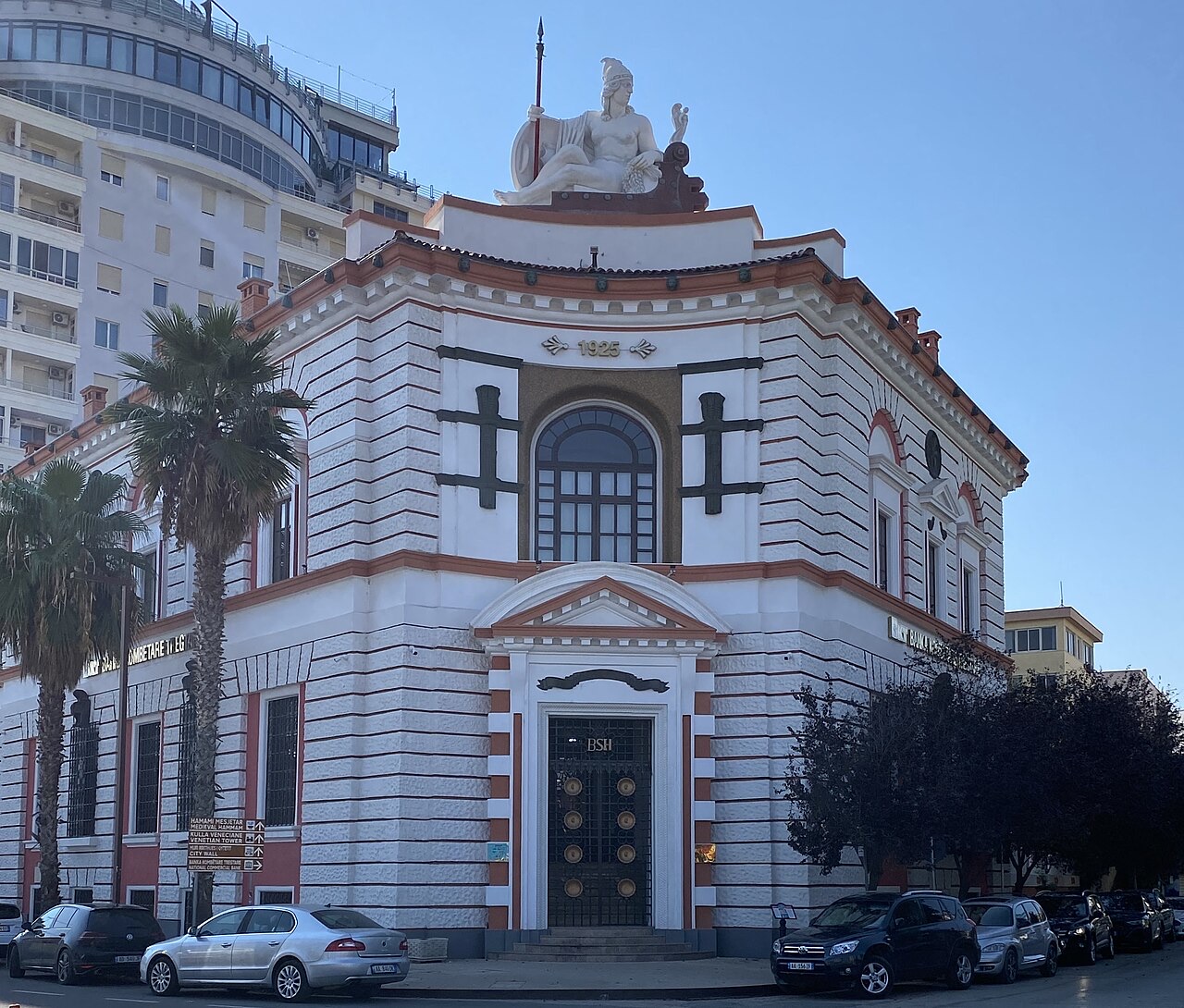
Banka Kombëtare Tregtare traces its institutional origins to the National Bank of Albania, established in 1925. This lineage makes it the oldest operating commercial bank in Albania, though its direct corporate predecessor emerged only during the banking reforms of the early 1990s.
As Albania transitioned away from a centrally planned economy in the early 1990s, the government restructured its banking system into a two-tier model. In 1991, Banka Tregtare Shqiptare (BTSH) was established by subdividing the activities of the Albanian State Bank; its primary function was managing the foreign trade operations of state-owned enterprises with former socialist countries. In 1992, a second subdivision produced Banka Kombëtare e Shqipërisë (BKSH), which was created to manage the domestic trading activity of state-owned entities. The assets and liabilities of both institutions were subsequently transferred to BKT accounts upon the new bank's formation.
Banka Kombëtare Tregtare was formally established in January 1993 through the merger of BTSH and BKSH. The merger consolidated the foreign-trade and domestic-trade banking functions that had previously been divided between the two predecessor institutions.
In July 1997, the bank was restructured as a joint-stock company. At that point, its assets stood at ALL 2.7 billion. This restructuring set the legal and corporate framework that would allow the privatisation process to proceed in the following years.
The privatisation of BKT was completed in 2000. On 6 July 2000, the Albanian Parliament approved a sale contract between the Ministry of Finance and a Consortium of International Investors. Under that agreement, Kentbank acquired 60% of the shares, the International Finance Corporation (IFC) took 20%, and the European Bank for Reconstruction and Development (EBRD) took the remaining 20%. The transfer of ownership entered into force on 17 October 2000.
By November 2000, the new shareholders had invested US$10 million to recapitalise the bank. In 2001, the new ownership undertook a comprehensive restructuring of all aspects of bank operations, covering personnel, procedures, and IT infrastructure.
In 2006, ownership of the majority stake changed hands again. With authorisation from the Bank of Albania and pursuant to a court decision issued on 9 June 2006, the transfer of 60% plus two shares held by Kent Bank was approved in favour of Çalik-Seker Konsorsiyum Yatirim A.S., a Turkish consortium.
In September 2007, BKT decided to expand its operations into Kosovo. By the time that decision was taken, the bank already had 24 branches open, a network that made it the largest Albanian bank in the region.
On 30 June 2009, Çalik Financial Services purchased the shares previously held by the IFC and the EBRD. This acquisition gave Çalik Financial Services 100% ownership of BKT, making it the bank's sole shareholder.
The consolidation of ownership under a single shareholder marked the end of the multi-party consortium structure that had been in place since the 2000 privatisation. After this transaction, the minority stakes held by the two international financial institutions—IFC with 20% and EBRD with 20%—were extinguished.
As of 2021, BKT held a market share of 26.11% in Albania's banking sector, making it the largest commercial bank operating in the country by that measure. The bank's position as the largest is consistent with its scale relative to the Albanian banking market as a whole.
Its status as the oldest operating commercial bank in Albania reflects the unbroken institutional lineage running from the 1925 National Bank of Albania through the State Bank, the two successor entities of 1991–1992, and the merged BKT from 1993 onward. The transfer of assets and liabilities from BTSH and BKSH at foundation gave BKT a balance sheet built on accumulated state-banking activity rather than a clean start.
Industry
A euroised, foreign-owned banking sector supervised by the Bank of Albania.
Guide
A foreign-owned banking sector, a partly euroised economy, and a country where cash still matters.
Something wrong on this page? Corrections are welcome and are checked against the source record. Tell us what is wrong and, if you can, where the right figure comes from.