Strand · Vlorë
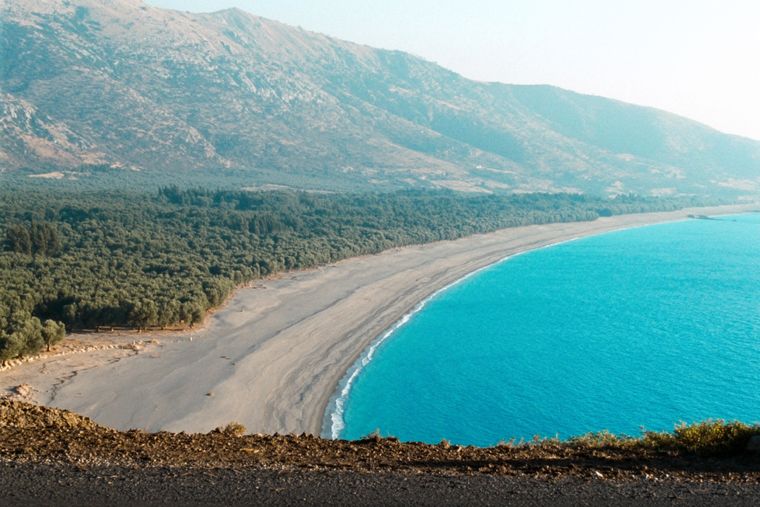
Borsh Beach
At roughly 7 km, the longest single beach on the Riviera, backed by one of Albania's largest olive groves.
Elke provincie, elke kust, elke eeuw
Begeleidende weergave
Nieuw in Albanië? Elke pagina begint met een uitleg in eenvoudige taal die u aan een tienjarige zou kunnen voorlezen, voordat de details beginnen.
Expertweergave
U kent de basis al. Meteen naar de kern, met de eenvoudige uitleg verborgen. Dit is de standaardinstelling.
Strand · Vlorë County
One of the least-developed larger coves on the southern Riviera.
Opslaan
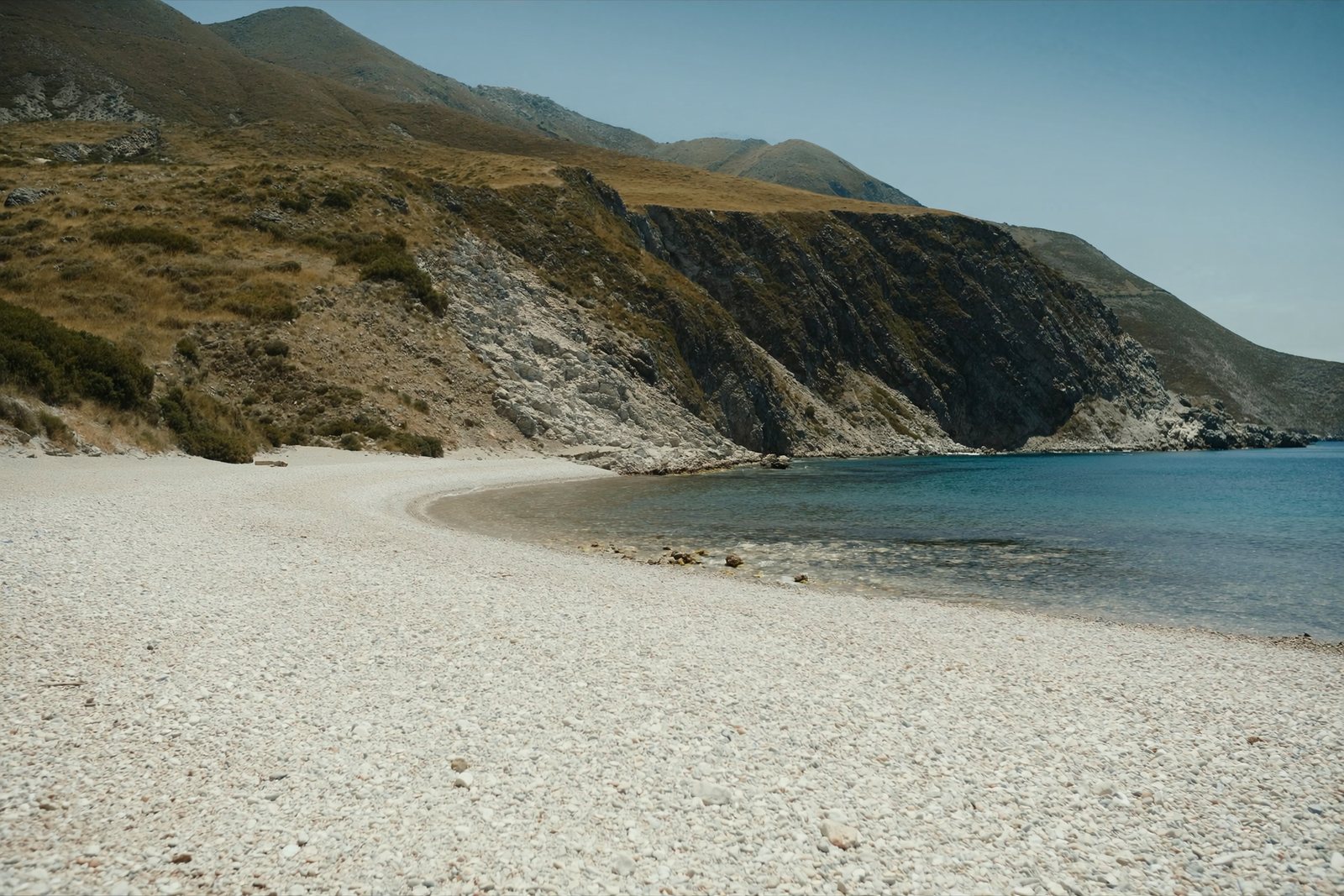
Krorëz is a wide pebble beach south of Borsh that is hard to reach by car, so it stays quiet.
Krorëz is a wide pebble beach south of Borsh that is hard to reach by car, so it stays quiet.
Lukovë is a village in Vlorë County, in southern Albania. It was formerly a municipality in its own right until the 2015 local government reform, at which point it became a subdivision of the municipality of Himarë. The population recorded at the 2011 census was 2,916.
The Albanian toponym Lukovë derives from Slavic roots. Proposed etymologies include the words luk, laka, or luka, meaning water flowing nearby, meadowland, river meadow, or wet meadow along a river, or alternatively from luk or luka meaning a place of onions, combined with the suffix ov/a. The village is known in Greek as Λούκοβο.
During the Ottoman period, Lukovë, together with the nearby settlements of Piqeras and Nivicë, formed part of the Himara area and held special semi-autonomous status within that community. In 1570 and 1571, a short-lived rebellion broke out under Emmanuel Mormoris in the Himara region; after a prolonged siege, the rebels captured the castle of Nivicë.
In 1798, Lukovë and adjacent villages south of Himara were attacked and plundered by Ali Pasha of Ioannina, the local Ottoman lord. Around Easter of 1798, massacres of Orthodox inhabitants were committed in the villages of Nivicë and Shën Vasil. These events were followed by cases of large-scale Islamisation among the local population. The Italian missionary Giuseppe Schirò had written in 1722 that Lukovë was inhabited by ethnic Albanians.
By the end of the 19th century, Greek elementary schools were already operating in the villages of Lukovë, Nivicë, Çorraj, and Shën Vasil. This reflected the presence of Greek-speaking or Greek-educated communities in the area during that period.
According to 1991 estimates, the municipal seat of Lukovë was inhabited by a majority Orthodox Albanian population, recorded at 2,076 persons or 82%, alongside minorities of Muslim Albanians at 250 persons or 12%, and Greeks at 150 persons or 6%. The villages of Borsh, Fterrë, and Sasaj were exclusively populated by Muslim Albanians at that time.
Other villages showed varied compositions. Piqeras had an Orthodox Albanian majority of 991 alongside 100 Muslim Albanians and 50 Greeks. Shën Vasil had an Orthodox Albanian majority of 1,434 with minorities of 220 Muslim Albanians and 210 Greeks. Nivicë had an Orthodox Albanian majority of 899 and a Greek minority of 30. Qazim Pali, a village established during the communist period, was populated by 861 Muslim Albanians alongside 50 Orthodox Albanians and 80 Greeks. A demographic study by Leonidas Kallivretakis in the late 20th century found that across Lukovë commune, 54% of the population were Albanian Christians, 40% were Albanian Muslims, and 6% were Greek Christians.
A 2016 estimate described the municipality as majority Albanian-speaking with a minority of Greek speakers. The Albanians of the Lukovë region speak the Tosk dialect of Albanian, and more specifically the Lab regional dialect. Seaside settlements of the Lukovë area were among Greek minority areas that experienced a substantial population decrease following the fall of communism in Albania in the early 1990s.
Lukovë has a hot-summer Mediterranean climate, classified as Köppen Csa. Precipitation falls mainly in the winter months. Winters are mild and summers are hot and dry. The average annual temperature is 15.1 °C (59.2 °F) and annual precipitation totals 737 mm (29.0 inches).
Several notable individuals are associated with Lukovë and its villages. Vasil Laçi (1922–1941) was an Albanian patriot who in 1941 attempted to kill Victor Emmanuel III, then King of Italy, and Shefqet Bej Vërlaci, then Prime Minister of Albania. Dimitrios Doulis (1865–1928), a Greek politician who served as minister of military affairs of the Autonomous Republic of Northern Epirus, came from Nivicë.
Other figures include Muzafer Korkuti, an Albanian archaeologist and Vice President of the Academy of Sciences of Albania; Nafiz Bezhani, an Albanian jurist, politician, and writer; Jakup Mato, an Albanian publicist and educational administrator who headed the Centre of Art Studies of the Academy of Sciences of Albania; and Niphon of Kafsokalyvia (1316–1411), a Greek monk recognised as a saint of the Eastern Orthodox Church.
De warmste maand is August (gemiddeld dagelijks maximum 28°C), de koudste is January (gemiddeld dagelijks minimum 5°C), en de natste is November (284 mm). De gemiddelde jaarlijkse neerslag bedraagt 1,628 mm. De zeetemperatuur bereikt een piek in augustus van ongeveer 26°C.
| Maand | Maximum | Minimum | Neerslag | Natte dagen | Zon/dag | Zee |
|---|---|---|---|---|---|---|
| January | 11°C | 5°C | 201 mm | 13 | 7.1 h | 16°C |
| February | 12°C | 6°C | 169 mm | 12 | 7.9 h | 15°C |
| March | 14°C | 7°C | 158 mm | 12 | 9.5 h | 15°C |
| April | 16°C | 10°C | 108 mm | 12 | 10.9 h | 16°C |
| May | 21°C | 14°C | 72 mm | 10 | 12.1 h | 19°C |
| June | 25°C | 18°C | 37 mm | 5 | 13.7 h | 24°C |
| July | 28°C | 21°C | 17 mm | 3 | 13.8 h | 26°C |
| August | 28°C | 22°C | 26 mm | 4 | 12.9 h | 26°C |
| September | 24°C | 18°C | 128 mm | 9 | 10.6 h | 26°C |
| October | 20°C | 14°C | 174 mm | 10 | 9.1 h | 25°C |
| November | 16°C | 10°C | 284 mm | 14 | 7.1 h | 21°C |
| December | 12°C | 7°C | 254 mm | 14 | 6.5 h | 18°C |
Bron: ERA5 reanalysis via Open-Meteo, 1994–2023 · "Maximum" en "Minimum" zijn het gemiddelde dagelijkse maximum en minimum van de luchttemperatuur. "Natte dagen" telt dagen met ten minste 1 mm neerslag.
Strand · Vlorë
At roughly 7 km, the longest single beach on the Riviera, backed by one of Albania's largest olive groves.
Strand · Vlorë
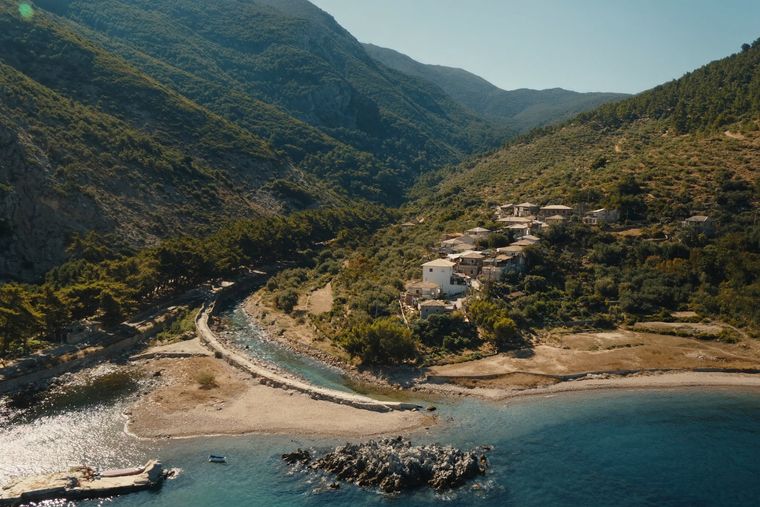
A run of small coves — Bunec, Krorëz and Shpella — below the village of Lukovë.
Onderwerp · Vlorë
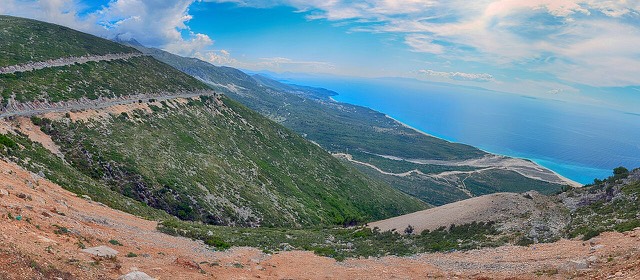
The 120 km of Ionian coast between the Llogara pass and Sarandë, where the Ceraunian mountains fall straight into the sea.
Iets onjuist op deze pagina? Correcties zijn welkom en worden gecontroleerd aan de hand van de bronregistratie. Laat ons weten wat onjuist is en, indien mogelijk, waar het juiste cijfer vandaan komt.